From August 15, 2019, ARRL Newsletter:
The Planetary Society's crowdfunded LightSail 2 spacecraft is successfully raising its orbit solely on the power of sunlight. Since unfurling the spacecraft's solar sail on July 23, mission managers have been optimizing the way the spacecraft orients itself during solar sailing. After a few tweaks, LightSail 2 began raising its orbital apogee, something the mission team said demonstrated the mission's primary LightSail 2 launched on June 25, and it deployed on July 2 from Prox-1, a Georgia Tech student-built spacecraft the size of a small washing machine.
The Planetary Society's crowdfunded LightSail 2 spacecraft is successfully raising its orbit solely on the power of sunlight. Since unfurling the spacecraft's solar sail on July 23, mission managers have been optimizing the way the spacecraft orients itself during solar sailing. After a few tweaks, LightSail 2 began raising its orbital apogee, something the mission team said demonstrated the mission's primary LightSail 2 launched on June 25, and it deployed on July 2 from Prox-1, a Georgia Tech student-built spacecraft the size of a small washing machine.
Using the Experimental License call sign WM9XPA, LightSail
2 automatically transmits a beacon packet on 437.025 MHz (9,600 bps FSK)
every few seconds, which can be decoded into 238 lines of text telemetry
describing the spacecraft's health and status -- everything from battery status
to solar sail deployment motor state.goal of "flight by light for CubeSats." Continuing to sail on
sunlight in Earth orbit, the spacecraft's orbital apogee hit 729 kilometers
(approximately 452 miles) as of August 5, an increase of 3.2 kilometers (nearly
2 miles) since sail deployment.
Every 45 seconds, the spacecraft transmits "LS2" in CW on
437.025 MHz. More information is on The Planetary Society website. --
Thanks to The Planetary Society
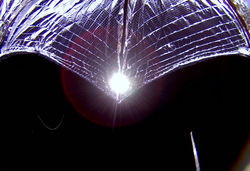 |
| LightSail 2's aluminized Mylar sail shines against the blackness of space, with the Sun peeking through near a sail boom. [Photo courtesy of The Planetary Society] |


