Friday, June 29, 2018

Monitoring the Hurricane Hunters and More During the Hurricane Season


The July issue of The Spectrum Monitor is going to be released today and my monthly Milcom column will have detailed coverage of frequencies and call signs used by the US Government/Military agencies to study, track and report on hurricanes and tropical systems. It includes the latest information on the US Air Force and NOAA Hurricane Hunters.

It has been almost a decade (2008 in Monitoring Times magazine) since my last article on this subject so I had a lot of updates and information to share.

Yesterday, Curt Phillips shared with the Tarheel Scanner Group a list of Amateur Radio frequencies you can monitor during the hurricane season. With possible tropical activity developing off the southeast US coast or Gulf of Mexico in the next few days, my TSM list and this ham radio frequency list from Southgate should be helpful to stay informed.


From Southgate

On the IARU Region 1 site Greg Mossop G0DUB reports on the amateur radio nets that may be active during the Atlantic Hurricane Season June 1 to November 30

So it is time to remind the wider Amateur Radio community that the following frequencies may be in use by nets in North and Central America to track and deal with the consequences of these severe weather events. Radio Amateurs in Region 2 play their part in gathering and distributing information for the weather and emergency services as they do every year.

Radio Amateurs in Region 1 are reminded it is possible to cause unintentional QRM to these nets so please listen carefully if operating near these frequencies:

Belize: 7.177MHz
Caribbean Emergency & Weather Nets (CEWN): 3.815 & 7.162 MHz
Caribbean Emergency: 14.185 MHz
Central America: 7.090 & 3.750 MHz
Cuba: 3.720, 3.740, 7.110 and 7.120 MHz
Eastern Caribbean Narrow Band Emergency System Net: 7.036 MHz USB (Olivia & MT63)
Guatemala: 7.075 MHz
Mexico: 3.690, 3.693(Alternative), 7.060 & 14.120 MHz
Nicaragua: Main Frequencies 3.798, 7.098, 14.298 MHz Alternate Frequencies 3.898, 7.108, 14.198MHz
Panama: 7.085 MHz
Republica Dominicana: 3.780, 7.065 (Main), 14.280 MHz

USA:
Maritime Mobile Service Net: 14.300 MHz
Salvation Army Team Emergency Radio Network (SATERN): 14.265 MHz
Hurricane Watch Net: 14.325 MHz (day) 7.268MHz (Night)
National Hurricane Centre ( WX4NHC ) 14.325MHz

Other local emergency communications groups may also activate if a hurricane approaches their area and those frequencies would be announced at the time.  Thanks to the National Societies and Emergency Communications Groups of IARU Region 2 for updating their frequency information.

IARU Region 1 http://iaru-r1.org/

http://www.southgatearc.org/news/2018/june/atlantic-hurricane-season-ham-radio-nets.htm#.WzT9i9JKjIU

You can get you copy of the July TSM issue that will include my column (electronic pdf format) from Spectrum Monitor for only $3 at https://www.thespectrummonitor.com/. Even better you can get a full year subscription to TSM for only US$24 and never miss any of my monthly Milcom columns. TSM is the only full spectrum radio hobby magazine in the US marketplace.

If you monitor radio you need a TSM subscription.


Thursday, May 24, 2018

From ARRL Newsleter: FT8 Activity Bumping Up at Some Expense to Other Modes

Despite largely dismal HF conditions, there is no doubt that the recent FT8 digital protocol has hams on the air. The mode has caught on so quickly that co-developer Joe Taylor expressed surprise last fall at the rapid uptake of FT8 for making contacts on HF bands Judging by Logbook of The World (LoTW) data, more than 2.3 million FT8 contacts were uploaded in 1 month -- a net gain of 1.2 million contacts on all modes over the same month last year, ARRL Radiosport Manager Norm Fusaro, W3IZ, said. Over the same period, activity in some of the other modes has declined.

"Year-to-date DXCC applications are up by 11% over the same period last year," Fusaro said. "So far, we have processed 898 Worked All States (WAS) applications -- a 72% increase over the same period last year. Of those applications, 347 -- or 39% -- were FT8 endorsements. Application for VUCC are also up by 33% over 2017."

Fusaro said that while some feel that FT8 is "taking over the world," subsuming all other modes, that's not the case. "Activity in the traditional modes of SSB and CW has decreased only slightly, by 10%," he said. "The real decrease is in RTTY and PSK activity and in the other WSJT-X modes. I believe poor propagation would have cut into SSB and CW activity, regardless of the new mode." Anecdotal reports support Fusaro's hard numbers, with wall-to-wall signals surrounding the FT8 watering holes.

Late last year, Denny Berg, WB9MSM, achieved his goal of completing DXCC using FT8. It took him just 4 months.  "I can tell all of you that this mode is spreading like wildfire throughout all the HF bands," Berg told The Daily DX at the time He said he was able to work all states on FT8 in about 6 weeks of operating. Taylor has characterized SSB and CW as "general-purpose modes" that are good for ragchewing, DXing, contesting, disaster communication, and other purposes. On the other hand, he has said, FT8 and the other protocols in the WSJT-X suite are "special-purpose modes," designed for making reliable, error-free contacts using signals that may be too weak to work using more traditional modes -- and sometimes even too far down in the noise even to hear.

ARLS005 Amateur Radio Transponders on Planned Chinese Satellites to Include HF

China's Amateur Radio Satellite organization, CAMSAT, has released some details of three new Amateur Radio satellites that could be launched as early as September. Two of the satellites, CAS-5A and CAS-6, will carry transponders, and one of them will have HF capability.

CAS-5A is a 6U CubeSat. It will have an HF/HF (21/29 MHz) mode linear transponder; an HF/UHF (21/435 MHz) mode linear transponder; an HF CW telemetry beacon; VHF/UHF mode linear transponder; a VHF/UHF mode FM transponder; a UHF CW telemetry beacon, and UHF AX.25 4,000/9,600-baud GMSK Telemetry. Transponders will have 30 kHz passbands, except for the H/U unit, which will be 15 kHz.

The tiny CAS-5B, weighing 1/2 kilogram, will be deployed from CAS-5A in orbit. It will carry a UHF CW beacon on an Amateur Radio frequency. It will be placed into a 539 x 533 kilometer, 97.5-degree orbit.

CAS-5A/B will launch from the Jiuquan Satellite Launch Center.

CAS-6, a 50-kilogram microsat, will include a VHF CW telemetry beacon; a U/V mode 20 kHz linear transponder, and AX.25 4,800-baud GMSK telemetry downlink. It will also carry an atmospheric wind detector and other systems that will operate on non-amateur frequencies.

A launch at sea is planned for CAS-6 from the China Academy of Launch Vehicle Technology. The microsat will be placed into a 579 x 579 kilometer, 45-degree orbit.

CAMSAT has applied to the International Amateur Radio Union (IARU) to coordinate frequencies for all three spacecraft.

Sunday, May 13, 2018

ARLS004 Three CubeSats with Amateur Radio Payloads Deployed from ISS

The Japan Aerospace Exploration Agency (JAXA) has announced that three CubeSats carrying Amateur Radio payloads, including one with a V/U linear transponder, were deployed from the International Space Station (ISS) on May 11 at around 1030 UTC.

Irazu (Costa Rica) and 1KUNS-PF (Kenya) carry beacon/telemetry in the 70-centimeter Amateur Radio band, while UBAKUSAT (Turkey) carries an Amateur Radio linear transponder for SSB and CW, in addition to CW and telemetry beacons. Irazu is a 1U CubeSat developed by students at the Costa Rica Institute of Technology, with a telemetry beacon at 436.500 MHz. 1KUNS-PF is a 3U CubeSat developed by students at the University of Nairobi, with a telemetry beacon (9.6 kbps) at 437.300 MHz.

UBAKUSAT, a 3U CubeSat developed by students at the Istanbul Technical University, has a CW beacon at 437.225 MHz, and a telemetry beacon at 437.325 MHz. The linear transponder downlink is
435.200 - 435.250 MHz; the uplink is 145.940 - 145.990 MHz.

Thursday, May 03, 2018

Summer 2018 International Shortwave Broadcast Guide Now Available at Amazon


Older ham radio operators and radio listeners might remember a time when shortwave radio stations broadcast a nearly constant drumbeat of political propaganda during the Cold War years. Shortwave radio stations such as Radio Moscow, the Voice of America, and the BBC, to name a few, played an important ideological role during that confrontation between the East and the West.

Once again, Global Radio broadcasters have moved to the front lines at what is now shaping up as a new Cold War by some of the world’s major super powers. As tensions heat up in the world’s hotspots such as eastern Europe, the Middle East and Eastern Asia, you can follow breaking international events on the radio waves, but you need an accurate and comprehensive guide to broadcast frequencies to hear it.

Teak Publishing is pleased release that important guide – the 10th edition (Summer 2018) International Shortwave Broadcast Guide (ISWBG) electronic book by Amazon bestselling author Gayle Van Horn W4GVH.

If you want to get in on the action, then this Amazon electronic book is your ticket to travel the Global Radio bands. The ISWBG is an exclusive 24-hour station/frequency guide with schedules for selected mediumwave broadcasters and all known longwave/shortwave radio stations transmitting at time of publication. This unique resource is the only radio publication that has by-hour schedules that includes all language services, frequencies and world target areas for over 500 stations. It has a complete listing of DX radio programs and Internet websites addresses for many of the stations listed in the book. There are also listings for standard time and frequency stations, and even a few intriguing spy numbers station listings.

New in this 10th edition of the ISWBG is a feature, Monitoring Brazil on Shortwave Radio. It is more than futebol! by Gayle Van Horn. Soccer teams from around the world will compete this summer in the FIFA World Cup, and Brazil is expected to be a top contender to win the event. This article will aid you in monitoring broadcasters that will be carrying Brazilian soccer team news during this international event.

Other authors with articles in this edition include The Spectrum Monitor’s Fred Waterer, with a feature on summer radio programming, and Hans Johnson with a profile on the state of DRM broadcasting in 2018. There are also two First Look reviews on the new AirSpy HF+ SDR and the W6LVP Magnetic Loop Antenna by Loyd Van Horn W4LVH.

Spectrum Monitor e-zine columnist/feature writer Larry Van Horn N5FPW has a special feature on Who’s Who in the Shortwave Radio Spectrum that will assist the reader in monitoring Global Radio activity outside the broadcast radio spectrum. This article also includes an update to the Teak Publishing HF 1000+ non-broadcast frequency list.

International Shortwave Broadcast Guide 10th edition of this semiannual Teak Publishing publication is available worldwide from Amazon and their various international websites at https://www.amazon.com/dp/B07CT89MNP.

The price for this latest edition is still US$7.99. Since this book is being released internationally, Amazon customers in the United Kingdom, Germany, France Spain, Italy, Japan, India, Canada, Brazil, Mexico and Australia can order this electronic book (e-Book) from Amazon websites directly servicing these countries. All other countries can use the regular Amazon.com website.
Don’t own a Kindle reader from Amazon? Not a problem. You do not need to own a Kindle to read Amazon e-book publications. You can read any Kindle book with Amazon’s free reading apps on literally any electronic media platform.

A Kindle app is available for most major smartphones, tablets and computers. There is a Kindle app available for the iPad, iPhone, and iPod touch; Android Phone; Android Tablet; PC; Windows 8; Mac Kindle Cloud Reader; Windows Phone; Samsung; BlackBerry 10; BlackBerry; and WebOS. This means with a free Kindle reading apps, you can buy a Kindle book once, and read it on any device with the Kindle app installed*. You can also read that same Kindle book on a Kindle device if you own one.

You can find additional details on these apps by checking out this link to the Amazon website at www.amazon.com/gp/feature.html?ie=UTF8&docId=1000493771.

For additional information on this and other Teak Publishing radio hobby books, monitor the company sponsored Internet blogs – The Military Monitoring Post (http://mt-milcom.blogspot.com/), The Btown Monitor Post (http://monitor-post.blogspot.com/) and The Shortwave Central (http://mt-shortwave.blogspot.com/) for availability of additional e-books that are currently in production. You can learn more about the author by going to her author page on Amazon at http://www.amazon.com/Gayle-Van-Horn/e/B0084MVQCM/.

Global Radio listeners are routinely entertained with unique perspectives to events, music, culture, history, and news from other countries that you won’t see or hear on your local or national broadcast channels. Global Radio broadcasts are not restricted by country borders or oceans, and can travel thousands of miles, reaching millions of listeners worldwide, now in over 300 different languages and dialects.

Listeners can easily hear shortwave broadcast stations from China, Cuba, Egypt, France, Germany, India, Iran, Japan, New Zealand, North/South Korea, Saudi Arabia, Taiwan, Turkey, United Kingdom, United States, Vietnam, and many other counties. If you have a shortwave radio receiver or Internet connection, and this unique radio resource, you will know when and where to listen to your favorite radio broadcast station.

The International Shortwave Broadcast Guide will have wide appeal to amateur radio operators, shortwave radio hobbyists, news agencies, news buffs, educators, foreign language students, expatriates, or anyone else interested in listening to a global view of world news and major events as they happen.

Whether you are an amateur radio operator or shortwave radio enthusiasts and want to get in on the action outside of the ham bands, then this new electronic book from Teak Publishing is a must in your radio reference library.

Monday, April 30, 2018

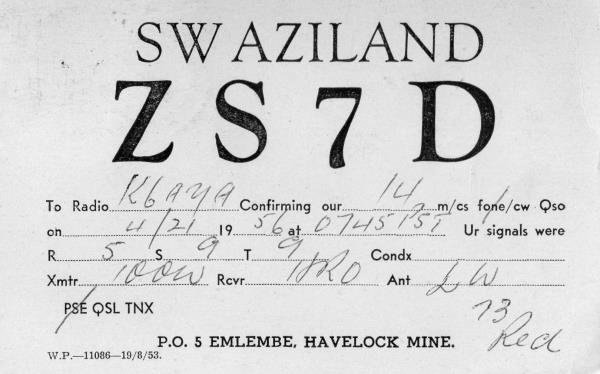
Swaziland Name Change - Kingdom of eSwatini

For all my DXing ham friends, Swaziland is no more.  In an article posted on Snithsonian,com (https://www.smithsonianmag.com/smart-news/swaziland-now-kingdom-eswatini-180968883/), Mswati III of Swaziland, Africa’s last absolute monarch, has declared that his nation’s official name is now the Kingdom of eSwatin.

Though it sounds like an attempt to bring the small, landlocked nation into the digital age, it’s actually the country’s name in Swazi, the local tongue. AFP reports the change was made to commemorate the 50th anniversary of the country’s complete independence from British rule in 1968. The move also coincides with the king’s own 50th birthday, which was on April 19, Sewell Chan at the New York Times reports.

“I would like to announce that Swaziland will now revert to its original name,” the king said during the independence day celebration, according to Reuters. “African countries on getting independence reverted to their ancient names before they were colonized. So from now on, the country will be officially known as the Kingdom of eSwatini.”

The change, according to the king, is also an attempt to distinguish the country’s name from other nations. “Whenever we go abroad, people refer to us as Switzerland,” he added.

The switch is not out of the blue. Reuters points out the country had recently begun using its traditional name at the U.N. General Assembly and at the African Union. In recent years, during addresses to parliament, the king has used the name for the region used before British colonization in 1906.


ast absolute monarch, has declared that his nation’s official name is now the Kingdom of eSwatini.
Read more: https://www.smithsonianmag.com/smart-news/swaziland-now-kingdom-eswatini-180968883/#tf7pWAb6mfGwRpEX.99
Give the gift of Smithsonian magazine for only $12! http://bit.ly/1cGUiGv
Follow us: @SmithsonianMag on Twitter
Guess we will have a new name pop up on the ARRL DXCC list soon.
Image result for ham radio swaziland qsl card

Thursday, November 23, 2017

AO-91 Commissioned - Declared Open for Amateur Use!


SB SAT @ AMSAT $ANS-327.01
ANS-327 AMSAT News Service Special Bulletins - AO-91 Commissioned
Declared Open for Amateur Use

AMSAT News Service Bulletin 327.01
From AMSAT HQ KENSINGTON, MD.
Month Day, 2017
To All RADIO AMATEURS
BID: $ANS-327.01

AO-91 Commissioned - Declared Open for Amateur Use!

At 06:50 UTC November 23, 2017 @AMSAT Engineering officially
commissioned AO-91 (RadFxSat/Fox-1B) Satellite. AMSAT VP of
Engineering, Jery Buxton N0JY turned over operation to Mark Hammond
N8MH and AMSAT Operations in a QSO on the AO-91 repeater during the
pass over the Eastern U.S.

N8MH responded and declared AO-91 open for amateur use!

[ANS thanks AO-91 Ops Team for the above information]

Wednesday, November 22, 2017

The Milcom Files - MT Editions - Are Now Available on Amazon


Mention the words "Monitoring the Military," and most radio hobbyists will immediately think of military air shows, sporting event Military Aircraft Flybys or a whole host of other military activities they would like to hear on their radios. There is a big radio frequency spectrum out there to monitor, and if you know where to listen, you can eavesdrop on some of the coolest radio communications you will ever hear on a scanner or shortwave radio. Military communications monitoring is the one segment of the radio hobby that has exploded in growth in recent years and is getting more popular among the listening community every day.

Larry Van Horn N5FPW, spent 15 years documenting activity in the military radio spectrum in his monthly Milcom column in the pages of Monitoring Times magazine. And now for the first time ever, he is publishing and making available all those columns here at Amazon in the Kindle E-Book format.

Teak Publishing is pleased to announce the release of their latest Kindle e-books -- the first edition of the Milcom Files – Monitoring Times edition by Amazon Bestselling author Larry Van Horn, N5FPW.

The Milcom Files edition one covers the 15 years of Military Communications (Milcom) columns that Larry wrote for the now defunct-Monitoring Times magazine from 1998-2013.

Volume one (ASIN: B077NN7RQ5) of the Milcom Files covers columns published between 1998 to 2006. The column was bimonthly from September 1998 to November 2002, and monthly from January 2003 to December 2006. Volume two (ASIN: B077NQXH3C) covers columns published between 2007 to 2013. These columns were published monthly during this period. A complete index to all the columns is available on the Milcom MP blog at http://mt-milcom.blogspot.com/p/blog-page.html.

The MT Milcom columns documented the U.S. military conversion to narrowband LMR systems, the move from conventional to trunk radio systems, the 225-400 MHz band plan shift, including the new 380-400 MHz sub-band, and HF military frequencies, both foreign and US. This two-volume set of e-books has over 327,000 plus words, and nearly 1,000 pages of frequencies, call signs, and how-to style articles.

Even though these columns were originally published from 1998-2013, you will find a lot of material that is still valid even today. All US military services, HF. VHF. UHF, military satellites, FAA Air Route Traffic Control Center frequencies, base profiles, foreign military frequencies, airshow frequencies, equipment, and a lot more are included. Each column will be presented as it was published in MT in this e-book except for photographs.

If you are interested in monitoring the military, own a scanner and/or shortwave radio, then the Milcom Files two volume set is a must reference on your radio shack shelf.

Teak Publishing’s The Milcom Files Monitoring Times edition is now available for purchase worldwide from Amazon.com.
Volume one is on Amazon at https://www.amazon.com/dp/B077NN7RQ5.
Volume two is on Amazon at https://www.amazon.com/dp/B077NQXH3C.

The price for each e-Book edition is US$7.99. This book is being released internationally. Amazon customers in the United Kingdom, Germany, France Spain, Italy, Japan, India, Canada, Brazil, Mexico and Australia can order the e-Book from Amazon websites directly servicing these countries. All other countries can use the regular Amazon.com website.

You do not need to own a Kindle reader to read Amazon e-book publications. You can read any Kindle book with Amazon’s free reading apps. There are free Kindle reading apps for the Kindle Cloud Reader, Smartphones (iPhone, iTouch, Android, Windows Phone and Blackberry); computer platforms (Windows XP, Vista, 7 and 8 and Mac); Tablets (iPad, Android and Windows 8), and, of course, all the Kindle family of readers including the Kindle Fire series. A Kindle e-book allows you to buy your book once and read it anywhere. You can find additional details on these apps at this link on the Amazon website at www.amazon.com/gp/feature.html?ie=UTF8&docId=1000493771.

For additional information on this and other Teak Publishing radio hobby books, monitor the company sponsored Internet blogs – The Military Monitoring Post (http://mt-milcom.blogspot.com/), The Btown Monitor Post (http://monitor-post.blogspot.com/) and The Shortwave Central (http://mt-shortwave.blogspot.com/) for availability of additional e-books that are currently in production.


Information on other publications by the author is available on the author’s page at Amazon http://www.amazon.com/-/e/B00G1QMO4C.


Monday, November 20, 2017

RadFxSat (Fox-1B) Launched, Designated AMSAT-OSCAR 91 (AO-91)


AMSAT News Service Bulletin 323.01
From AMSAT HQ KENSINGTON, MD.
DATE November 19, 2017
To All RADIO AMATEURS
BID: $ANS-323.01

RadFxSat (Fox-1B) Launched, Designated AMSAT-OSCAR 91 (AO-91)

The Delta II rocket carrying RadFxSat (Fox-1B) launched at 09:47:36 UTC on November 18, 2017 from Vandenberg Air Force Base, California.

Following a picture-perfect launch, RadFxSat was deployed at 11:09 UTC. Then the wait began. At 12:12 UTC, the AMSAT Engineering team, watching ZR6AIC's WebSDR waterfall, saw the characteristic "Fox Tail" of the Fox-1 series FM transmitter, confirming that the satellite was
alive and transmitting over South Africa. Shortly after 12:34 UTC, the first telemetry was received and uploaded to AMSAT servers by Maurizio Balducci, IV3RYQ, in Cervignano del Friuli, Italy. Initial telemetry confirmed that the satellite was healthy.

After confirmation of signal reception, OSCAR Number Administrator Bill Tynan, W3XO, sent an email to the AMSAT Board of Directors designating the satellite AMSAT-OSCAR 91 (AO-91). Bill's email stated:

"RadFxSat (Fox-1B) was launched successfully at 09:47 UTC today November 18, 2017 from Vandenberg Air Force Base in California and has been received by several amateur stations.

RadFxSat (Fox-1B), a 1U CubeSat, is a joint mission of AMSAT and the Institute for Space and Defense Electronics at Vanderbilt University. The Vanderbilt package is intended to measure the  effects of radiation on electronic components, including demonstration of an on-orbit platform for space qualification of components as well as to validate and improve computer models for predicting radiation tolerance of semiconductors.

AMSAT constructed the remainder of the satellite including the spaceframe, on-board computer and power system. The amateur radio package is similar to that currently on orbit on AO-85 with an uplink on 435.250 MHz (67.0 Hz CTCSS) and a downlink on 145.960 MHz. Experiment telemetry will be downlinked via the DUV subaudible telemetry stream, which can be decoded using the FoxTelem software.

RadFxSat (Fox-1B) was sent aloft as a secondary payload on the United Launch Alliance (ULA) Delta II rocket that transported the JPSS-1 satellite to orbit. RadFxSat (Fox-1B) is one of five CubeSats making up this NASA Educational Launch of Nanosatellites (ELaNa) XIV mission, riding as secondary payloads aboard the JPSS-1 mission.

Since RadFxSat (Fox-1B) has met all of the qualifications necessary to receive an OSCAR number, I, by the authority vested in me by the AMSAT President, do hereby confer on this satellite the designation AMSAT-OSCAR 91 or AO-91. I join amateur radio operators in the U.S. and around the world in wishing AO-91 a long and successful life in both its amateur and scientific missions.

I, along with the rest of the amateur community, congratulate all of the volunteers who worked so diligently to construct, test and prepare for launch the newest amateur radio satellite.

William A. (Bill) Tynan, W3XO
AMSAT-NA OSCAR Number Administrator"

AMSAT Engineering reminds stations that the satellite will not be available for general use until the on-orbit checkouts are complete.Please continue to submit telemetry to assist the Engineering team in
completing the commissioning process.

[ANS thanks Paul, N8HM, for the above information]


Thursday, November 09, 2017

RadFxSat (Fox-1B) Launch Delayed; AMSAT Asks for Patience

SB SPACE ARL ARLS012
ARLS012 RadFxSat (Fox-1B) Launch Delayed; AMSAT Asks for Patience
During Commissioning

The launch of the Delta II vehicle carrying RadFxSat (Fox-1B) and other payloads has been delayed, due to a faulty battery on the booster, United Launch Alliance (ULA) announced on November 6. The launch now is scheduled for no earlier than Tuesday, November 14. RadFxSat is one of four CubeSats making up the NASA ELaNa XIV mission, riding as secondary payloads aboard the Joint Polar Satellite System (JPSS)-1 mission, which will launch from Vandenberg Air Force Base, California.

RadFxSat is a partnership with Vanderbilt University's Institute for Space and Defense Electronics (ISDE) and hosts four payloads for the study of radiation effects on commercial off-the-shelf components. It will carry a Fox-1 style FM U/V repeater with an uplink on 435.250 MHz (67.0 Hz CTCSS) and a downlink on 145.960 MHz. Satellite and experiment telemetry will be downlinked via the DUV subaudible telemetry stream, which can be decoded using FoxTelem software
available from, https://www.amsat.org/foxtelem-software-for-windows-mac-linux/ .

AMSAT Vice-President Engineering, Jerry Buxton, N0JY, said RadFxSat/Fox-1B will automatically come up in beacon mode, transmitting a beacon and voice ID ("RadFxSat Safe Mode") every 2
minutes, starting about 50 minutes after deployment. He said AMSATcommand stations will want to see voltage and current data to determine that the spacecraft is healthy and to conduct various tests before opening it up for general use.

Telemetry should begin about 55 minutes after deployment. "[F]or the next 72-96 hours at least, as we look for successful startup, watch the general health and function as the satellite begins to acclimate to space, and perform the on orbit checkout," Buxton said. Ground stations are invited to continue uploading received telemetry for the life of the satellite.

Those using FoxTelem to capture telemetry are asked to check "Upload to Server" in the software's settings and make sure that ground station parameters are provided. "You can help AMSAT and everyone waiting to get on the air with RadFxSat tremendously, by capturing RadFxSat telemetry," Buxton said.

In the initial beacon mode, the transmitter is limited to 10 seconds "on" time, followed by a 2-minute "off" cycle. "If we are seeing good data from user telemetry data, it is likely when it comes over
the US for the first good pass, we will command it from beacon mode to normal safe mode, which then puts RadFxSat in full, but still safe mode, operation and transmits a full two frames of  telemetry," Buxton said.

Buxton called on the satellite community to be "polite and patient" as RadFxSat is commissioned.

"The on-orbit check-out procedure is similar to Fox-1A/AO-85 and could be completed in as little as a few days, if we have the cooperation of the users," he said. "It is very important - not to mention just plain good amateur operating practice - to refrain from using the transponder uplink, so we can do the on-orbit tests, including when we turn on transponder mode for testing. I can't stress enough, the importance of this cooperation, not just for us but for all users, simply having a little patience so we can conduct the tests as quickly and accurately as possible."

Buxton said AMSAT would "make it broadly known" when the transponder is available for general use. "If you hear someone on the transponder, please don't assume that it is open for general use,"
he said. "Check the AMSAT website, Facebook, Twitter, to be sure you're not accidentally jumping in and unwittingly interfering with the commissioning process."
NNNN
/EX

Sunday, November 05, 2017

Product Announcement - DXtreme Monitor Log 11™

DXtreme Software™ has released a new version of its popular logging program for radio monitoring enthusiasts: DXtreme Monitor Log 11.


Monitor Log 11 lets listeners and DXers log the stations they’ve heard using advanced features that can enhance their monitoring experience.

Finding Broadcast Stations to Monitor

The Schedule Checker™ lets users import schedules from Aoki, EiBi, and FCC AM web sites and display schedule data according to the filter criteria they specify. A list box lets users switch between schedule types, and depending on the schedule type selected, users can filter schedule information by band, frequency, station, country, city, state, time of day, language, antenna direction, and target area.

When the What’s On Now? function is activated, the schedule refreshes automatically at the top of each hour for Aoki and EiBi schedules.

For each schedule item, Schedule Checker queries the Monitor Log 11 database to let users know – through user-defined, foreground and background display colors – whether they need to monitor a station for a brand-new or verified country. Schedule Checker also displays bearing and distance, runs optional Afreet Ham CAP(1) propagation predictions, draws optional Afreet DX Atlas (2) azimuth plots, tunes supported radios to schedule frequencies when users double-click schedule items (3 4 5), and starts log entries for scheduled stations monitored.

Finding Amateur Radio Stations to Monitor

Monitor Log 11 integrates with optional Afreet Band Master (6) to let users see, on its graphical interface, where hams are operating. Monitor Log 11 supplies Band Master with an Entity Needed List based on the user’s Monitor Log database, making it possible for Band Master to indicate the stations whose entities (countries) users need to monitor. When invoking Band Master, users can select an Entity Needed List for all bands or individually for the 160- through 6-Meter bands.

Finding Utility Stations to Monitor
A Links menu provides convenient access to user-specified blogs and web sites that can inform users as to where utility and other stations may be operating.

Logging Stations
Monitor Log 11 lets users log all kinds of stations — radio stations, television stations, broadcast stations, Amateur Radio stations, utility stations, military stations, and more! And it lets them log stations across the radio spectrum — from long wave, to medium wave, to short wave, and beyond.

The Last Log Entries Grid on the Monitor Log window shows up to 5000 of the most recent log entries added. Its records can be sorted, and double-clicking records displays detailed data on the Monitor Log window. Users can resize the grid columns and scroll horizontally to columns that do not appear initially. And because the names of stations and NASWA countries can be quite long, users can also display a larger, resizable Last Log Entries window. A Properties window lets users change the order of columns, the number of log entries to display, and the font and color attributes of grids and other program components, such as the Content Editor for describing the content monitored, the Script Editor for creating and editing scripts, the Direct Tune interface for tuning radios, and the Comments tab for typing ad hoc comments.

Reporting Reception
Users can create customized paper and e-mail reception reports for sending to stations plus club report entries for reporting catches to clubs and magazines.

When users add or display a log entry, Monitor Log 11 prepares a post announcing their DX catch and displays it on the Social Media Post tab. From there, users can drag the post to their favorite social media web sites to share their catch with others.

Using the Script Editor window, users can create and edit scripts that format reception reports, eReports, and social media posts to their liking. The software prompts users to select the script they want to use. Dozens of scripts come with Monitor Log 11.

Users can also print SWL and Address labels on industry-standard label stock, and send eQSL requests to hams automatically through the popular www.eQSL.cc site.

Imaging
Improv Imaging™ lets users associate ad hoc images with log entries using Capture, Scan, and Clipboard functions. Captures of stations received on digital applications, waterfall displays, facsimile and Amateur TV pictures are popular. The Improv Imaging tab and Application let users view images anytime, and an Improv Image Explorer lets them peruse their entire collection and display associated log entries.

QSL Imaging™ functions the same as Improv Imaging, but specializes in associating QSL cards and eQSLs with log entries.

Other Features
Rig Control — Retrieves the frequency and mode from supported radios and permits tuning from the Schedule Checker and Direct Tune interface. Rig control is provided through integration with Afreet Omni-Rig and the SDR applications listed on our web site, currently HDSDR (4) (High Definition Software Defined Radio) and SDR Console (5).

Audio Archiving — An embedded Audio facility lets users maintain an audio archive of stations heard.

Reporting — Produces Performance, Stations, and Log Entry reports that track the performance and progress of the user’s monitoring station. The software lets users FTP those reports to user-provided Web space for remote access. Some reports integrate with Afreet DX Atlas to generate pin maps.

Documentation — Context-sensitive Procedural Help, Field Help, and Microhelp are accessible per window to provide instructions quickly. A web-based Information Center is accessible from the Help menu for late-breaking assistance, and Installation Instructions and a Getting Started Guide are delivered in PDF format with the software.

Operating Systems, Pricing, Contact Information
DXtreme Monitor Log 11 runs in 32- and 64-bit versions of Microsoft® Windows® 10, 8.1, 8, 7, Vista®, and XP. It retails for $89.99 USD worldwide for electronic distribution. Pricing for CD versions and upgrading users is available on our Web site. All prices include product support by Internet e-mail. For more information, visit www.dxtreme.com or contact Bob Raymond at bobraymond@dxtreme.com.

1 — Licenses for Afreet Ham CAP and Omni-Rig are required to use Ham CAP.
2 — A license for Afreet DX Atlas is required to perform plots and create pin reports.
3 — A license for Afreet Omni-Rig is required to use rig control with radios supported by Omni-Rig.
4 — Can be used for rig control. HDSDR is owned by Mario Taeubel. Refer to http://www.hdsdr.de/index.html for more information.
5 — Can be used for rig control. SDR Console is owned by Simon Brown, G4ELI. Refer to http://www.sdr-radio.com for more information.
6 — A license for Afreet Band Master is required to use Band Master.


Wednesday, September 27, 2017

FalconSAT-3 Now Open for Amateur Radio Use

The Air Force Academy satellite FalconSAT-3 is now open for Amateur Radio use as a digital store-and-forward system. Built in 2005 and 2006 by cadets and faculty in the Space Systems Research Center at the US Air Force Academy in Colorado Springs, FalconSAT-3 was launched in 2007.

The satellite has completed its scientific and training missions, and the Academy now is making it available for Amateur Radio use. The Packet Bulletin Board System operates at 9600 baud with a
145.840 MHz uplink/435.103 MHz downlink. Output power is 1 W, and the downlink is continuously on. Digipeating is enabled for live QSOs, but unattended digipeating operation is not authorized at this time.

Additional information is available on the AMSAT website at, https://www.amsat.org/falconsat-3/ .
NNNN
/EX

Wednesday, September 06, 2017

FEMA Announces Regions that Could Activate on 60-Meters for Hurricane Irma

The below listed Federal Emergency Management Agency (FEMA) Regions, including call signs, could be activating the 5 MHz/60-meter band frequencies in support of a possible response to Hurricane Irma on September 5.
  • Region 1 — KF1EMA
  • Region 2 — KF2EMA (includes Puerto Rico and US Virgin Islands)
  • Region 3 — KF3EMA
  • Region 4 — KF4EMA
  • Region 6 — KF6EMA
  • Maynard MERS — NF1EMA
  • Thomasville MERS — NF4EMA
  • Denton MERS — NF6EMA
The following suppressed-carrier reference frequencies, also known as dial frequencies or window frequencies, 5330.5 kHz, 5346.5 kHz, 5357.0 kHz, 5371.5 kHz, and 5403.5 kHz, may be used as part of the event.


Amateur Radio HF Nets
Friendly Net 7188.0 kHz 1000-12:00 UTC
Caribbean Emergency Weather Net 3815.0 kHz 1030 UTC and 2200 UTC
Maritime Mobile Service Network 14300.0 kHz 1200-0200 UTC
Hurricane Watch Net 14325.0 kHz National Hurricane Center callsign WX4NHC

Amateur Radio US Virgin Islands Repeaters
St. Croix NP2VI - 147.250/147.850 PL 100.0 Hz
St. Thomas KP2O - 146.810/146.210 PL 100.0 Hz
St. Thomas NP2GO - 146.950/146.350 PL 67.0 Hz
St. Thomas KP2T - 146.970/146.370
St. John KP2SJ - 146.630/ 146.030 PL 100.0 Hz (West side of island coverage only)


VOIP Weather Net Active for Irma


If you are equipped for amateur radio Echolink operations, the VOIP weather net is now active on Echolink Node 7203 for Hurricane Irma.

More frequencies and information will be posted shortly on this blog.

Tuesday, August 15, 2017

Ham Radio Digital Voice


For years now I have watched as a revolution has taken over the ham radio bands - digital communications in all forms across our entire spectrum. While I have embraced to the HF digital revolution big time here at the N5FPW Btown Monitoring Post, I haven't really dived into the digital voice revolution until now.

I recently purchased a DV4Mini from Wireless Holdings LLC (http://wirelesshold.com/) and since I already had an Icom ID-51A Plus D-Star handheld and a TYT MD-380G DMR handheld, I have now put those two rigs to use with my DV4Mini. This is pretty cool technology and a great place to meet new hams from around the world and participate in the many DV nets in the DV universe.

So as time permits I will be adding more coverage here on various DV topics. To get things started I have added a bunch of DV related website links. More is on the way including some articles and perm pages for reference at the top of this blog page.

73 and CU in the Ham DVsphere.


Thursday, May 11, 2017

New Summer 2017 International Shortwave Broadcast Guide Now Available


Teak Publishing is pleased to announce the release of the Summer 2017 International Shortwave Broadcast Guide (ISWBG) electronic book by Amazon bestselling author Gayle Van Horn, W4GVH. This all important semi-annual information resource is your electronic guide to the world of shortwave radio listening.

The release of this book is very timely for international radio monitors given the recent outbreak of tensions in the world hotspots of Eastern Europe, Middle East, East Asia and the Korean Peninsula.

Shortwave radio listeners are routinely entertained with unique perspectives to events, music, culture, history, and news from other countries that you won’t see or hear on your local or national broadcast channels. Shortwave radio broadcast aren’t restricted by country borders or oceans, and can propagate thousands of miles, reaching millions of listeners worldwide, in over 300 different languages and dialects. These worldwide transmissions are monitored on internationally assigned radio frequencies between 1700 kHz and 30 MHz.

There are even broadcasts from the dark side, transmitted from broadcasters known as clandestine or clanny stations. Clandestine broadcasters are wrapped in mystery and intrigue, and they usually exist to bring about some sort of political change to the country they are targeting. Programming may largely be half-truths or sometimes even outright lies, but it is essentially propaganda for their cause.

Listeners who live in the United States can easily hear shortwave broadcast stations from Canada, China, Cuba, Egypt, France, Germany, India, Iran, Japan, New Zealand, North/South Korea, Saudi Arabia, Taiwan, Turkey, United Kingdom, United States, Vietnam, and many other counties if you have an inexpensive shortwave radio receiver, and you know when and where to listen!

If you want to get in on the action, then this Amazon electronic book is your ticket the travel the world via radio. The ISWBG is our exclusive 24-hour station/frequency guide to “all” of the known longwave, selected mediumwave and shortwave radio stations currently broadcasting at time of publication. This unique radio hobby resource is the “only” radio hobby publication that has by-hour station schedules that include all language services, frequencies and world target areas.

New in this eighth edition of the ISWBG is an Surfing the Shortwave Radio Bands without a Radio by senior radio monitor Larry Van Horn Summertime Listening on Shortwave, by shortwave program specialist Fred Waterer, and a feature very timely feature - When News Breaks: Getting Your News from the Front Lines through streaming media by Loyd Van Horn.

There is also an expanded special feature on Who’s Who in the shortwave radio spectrum by former Monitoring Times editor and feature writer Larry Van Horn N5FPW. This story covers services and frequencies outside the regular broadcast and amateur radio bands, and includes our new, exclusive Hot HF 1000+ non-broadcast frequency list. The final feature article in this edition is Getting Started in Shortwave Radio, a primer, by Spectrum Monitor managing editor Ken Reitz KS4ZR.

Also included in this edition is increased frequency and station coverage of longwave broadcasters, selected medium wave broadcast frequencies used by international broadcasters, all known international standard time and frequency stations transmitting worldwide, and some selected spy numbers broadcasts.

The International Shortwave Broadcast Guide (Summer 2017 edition) is now available for purchase worldwide from Amazon.com at https://www.amazon.com/dp/B071VMYYMH/.

The price for this latest edition is still US$7.99. Since this book is being released internationally, Amazon customers in the United Kingdom, Germany, France Spain, Italy, Japan, India, Canada, Brazil, Mexico and Australia can order this electronic book (e-Book) from Amazon websites directly servicing these countries. All other countries can use the regular Amazon.com website.

This new e-publication edition is a much expanded version of the English shortwave broadcast guide that was formerly published in the pages of the former Monitoring Times magazine for well over 20 years. This one of a kind e-book is published twice a year to correspond with shortwave station’s seasonal time and frequency changes.

Don’t own a Kindle reader from Amazon? Not a problem. You do not need to own a Kindle to read Amazon e-book publications. You can read any Kindle book with Amazon’s free reading apps on literally any electronic media platform.

The Kindle app is available for most major smartphones, tablets and computers. There is a Kindle app available for the iPad, iPhone, and iPod touch; Android Phone; Android Tablet; PC; Windows 8; Mac Kindle Cloud Reader; Windows Phone; Samsung; BlackBerry 10; BlackBerry; amd WebOS. This means with a free Kindle reading apps, you can buy a Kindle book once, and read it on any device with the Kindle app installed*. You can also read that same Kindle book on a Kindle device if you own one.

You can find additional details on these apps by checking out this link to the Amazon website at www.amazon.com/gp/feature.html?ie=UTF8&docId=1000493771.

For additional information on this and other Teak Publishing radio hobby books, monitor the company sponsored Internet blogs – The Military Monitoring Post (http://mt-milcom.blogspot.com/), The Btown Monitor Post (http://monitor-post.blogspot.com/) and The Shortwave Central (http://mt-shortwave.blogspot.com/) for availability of additional e-books that are currently in production. You can learn more about the author by going to her author page on Amazon at http://www.amazon.com/Gayle-Van-Horn/e/B0084MVQCM/.

The International Shortwave Broadcast Guide will have wide appeal to shortwave radio hobbyists, amateur radio operators, educators, foreign language students, news agencies, news buffs, or anyone interested in listening to a global view of news and major events as they happen.

Whether you are an amateur radio operator or shortwave radio enthusiasts, and want to get in on the action outside of the ham bands, then this new electronic book from Teak Publishing is a must in your radio reference library.


Tuesday, March 14, 2017

CAS-4A and CAS-4B Linear Transponder Frequencies Announced

XW-2A satellite was launched September 19, 2015 (Graphic courtesy of UK AMSAT)

Frequencies for the CAS-4A and CAS-4B Linear Transponder satellites have been announced by IARU - launch was planned for March 31, 2017. Story at https://amsat-uk.org/2017/03/13/cas-4a-cas-4b-transponder-sats-2/

CAS-4A
• Linear transponder downlink 145.870 MHz, emission designator 20K0V8WWF, output power 20 dBm
• Linear transponder uplink 435.220 MHz
• CW telemetry beacon 145.855 MHz, emission designator 100HA1AAN, output power 17 dBm
• GMSK telemetry 145.835 MHz, emission designator 16K0F1DCN, output power 20 dBm

CAS-4B
• Linear transponder downlink 145.925 MHz, emission designator 20K0V8WWF, output power 20 dBm
• Linear transponder uplink 435.280 MHz
• CW telemetry beacon 145.910 MHz, emission designator 100HA1AAN, output power 17 dBm
• GMSK telemetry 145.890 MHz, emission designator 16K0F1DCN, output power 20 dBm
IARU Satellite Frequency Coordination pages http://www.amsat.org.uk/iaru/


Sunday, March 12, 2017

AMSAT News Service AMS-071

The AMSAT News Service bulletins are a free, weekly news and information service of AMSAT North America, The Radio Amateur Satellite Corporation. ANS publishes news related to Amateur Radio in Space including reports on the activities of a worldwide group of Amateur Radio operators who share an active interest in designing, building, launching and communicating through analog and digital Amateur Radio satellites.

The news feed on http://www.amsat.org publishes news of Amateur Radio in Space as soon as our volunteers can post it.

Please send any amateur satellite news or reports to: ans-editor at amsat.org.

In this edition:

* US ARISS Proposal Window Remains Open Through April 15, 2017
* First Moon Bounce using Opera
* NEON - NASA Educators Online Network - ANNOUNCEMENTS
* Cubesat Developers Workshop 2017
* ARISS News


SB SAT @ AMSAT $ANS-071.01
ANS-071 AMSAT News Service Weekly Bulletins

AMSAT News Service Bulletin 071.01
From AMSAT HQ KENSINGTON, MD.
March 12, 2017
To All RADIO AMATEURS
BID: $ANS-071.01

US ARISS Proposal Window Remains Open Through April 15, 2017

Message to US Educators Amateur Radio on the International Space Station Contact Opportunity

Call for Proposals
Proposal Window February 15 – April 15, 2017

The Amateur Radio on the International Space Station (ARISS) Program is seeking formal and informal education institutions and organizations, individually or working together, to host an Amateur Radio contact with a crew member on board the ISS.  ARISS anticipates that the contact would be held between January 1, 2018 and June 30, 2018. Crew scheduling and ISS orbits will determine the exact contact dates. To maximize these radio contact opportunities, ARISS is
looking for organizations that will draw large numbers of participants and integrate the contact into a well-developed education plan.

The deadline to submit a proposal is April 15, 2017.  Proposal information and documents can be found at www.arrl.org/hosting-an-ariss-contact.

The Opportunity
Crew members aboard the International Space Station will participate in scheduled Amateur Radio contacts. These radio contacts are approximately 10 minutes in length and allow students to interact
with the astronauts through a question-and-answer session.

An ARISS contact is a voice-only communication opportunity via Amateur Radio between astronauts and cosmonauts aboard the space station and classrooms and communities. ARISS contacts afford
education audiences the opportunity to learn firsthand from astronauts what it is like to live and work in space and to learn about space research conducted on the ISS. Students also will have an
opportunity to learn about satellite communication, wireless technology, and radio science. Because of the nature of human spaceflight and the complexity of scheduling activities aboard the
ISS, organizations must demonstrate flexibility to accommodate changes in dates and times of the radio contact.

Amateur Radio organizations around the world, NASA, and space agencies in Russia, Canada, Japan and Europe sponsor this educational opportunity by providing the equipment and operational support to enable direct communication between crew on the ISS and students around the world via Amateur Radio. In the US, the program is managed by AMSAT (Radio Amateur Satellite Corporation) and ARRL (American Radio Relay League) in partnership with NASA and CASIS (Center for the Advancement of Science in Space).

More Information
Interested parties can find more information about the program at www.ariss.org and www.arrl.org/ARISS.

For proposal information and more details such as expectations, proposal guidelines and proposal form, and dates and times of Information Sessions go to http://www.arrl.org/hosting-an-ariss-contact.

Please direct any questions to ariss at arrl.org.

[ANS thanks ARISS for the above information]

---------------------------------------------------------------------

ARISS News

+ A Successful contact was made between Blair Pointe Upper   Elementary School, Peru, IN, USA and Astronaut Shane Kimbrough   KE5HOD using Callsign NA1SS. The contact began Thu 2017-03-09   15:21:33 UTC and lasted about nine and a half minutes. Contact was   Direct via WD9GIU.
ARISS Mentor was Charlie AJ9N.

+ A Successful contact was made between 3rd Junior High School, Komotini, Greece and Astronaut Shane Kimbrough KE5HOD using   Callsign OR4ISS. The contact began  Fri 2017-03-10 08:20:46 UTC and lasted about nine and a half minutes. Contact was Direct via  SV7APQ. ARISS Mentor was Bertus PE1KEH.

Upcoming ARISS Contact Schedule

McBride  High School, Long Beach, CA, direct via K6MHS
The ISS callsign is presently  scheduled to be NA1SS
The scheduled astronaut is Thomas Pesquet KG5FYG
Contact is a go for: Wed 2017-03-15 16:28:44 UTC

[ANS thanks ARISS, Charlie AJ9N and David AA4KN for the above information]

---------------------------------------------------------------------

/EX

In addition to regular membership, AMSAT offers membership in the President's Club. Members of the President's Club, as sustaining donors to AMSAT Project Funds, will be eligible to receive addi-
tional benefits. Application forms are available from the AMSAT Office.

Primary and secondary school students are eligible for membership at one-half the standard yearly rate. Post-secondary school students enrolled in at least half time status shall be eligible for the stu-
dent rate for a maximum of 6 post-secondary years in this status. Contact Martha at the AMSAT Office for additional student membership information.

73,
This week's ANS Editor, EMike McCardel, AA8EM aa8em at amsat dot org
_______________________________________________

Sent via AMSAT-BB@amsat.org. AMSAT-NA makes this open forum available to all interested persons worldwide without requiring membership. Opinions expressed are solely those of the author, and do not reflect the official views of AMSAT-NA. Not an AMSAT-NA member? Join now to support the amateur satellite program! Subscription settings: http://www.amsat.org/mailman/listinfo/amsat-bb