The AMSAT News Service bulletins are a
free, weekly news and infor-
mation service of AMSAT, The Radio Amateur
Satellite Corporation. ANS
publishes news related to Amateur Radio in Space
including reports on
the activities of a worldwide group of Amateur Radio
operators who
share an active interest in designing, building, launching and
commun-
icating through analog and digital Amateur Radio
satellites.
The news feed on http://www.amsat.org publishes news of
Amateur
Radio in Space as soon as our volunteers can post it.
Please
send any amateur satellite news or reports to:
ans-editor at
amsat.org.
You can sign up for free e-mail delivery of the AMSAT News
Service
Bulletins via the ANS List; to join this list see:
http://www.amsat.org/mailman/listinfo/ans
In
this edition:
* Welcome Back XW-2D
* PSAT3 Launch CANCELED
* AMSAT
Academy to be Held Prior to Dayton Hamvention
* The 23cm Satellite Band is
Under Scrutiny in Europe
* Replacing the International Space Station?
*
FO-29 Operational Schedule
* ARISS News
* AMSAT Will be at ScienceCity in
Tucson, March 14-15
* Hamfests, Conventions, Maker Faires, and Other
Events
* Upcoming Satellite Operations
* Satellite Shorts from All
Over
SB SAT @ AMSAT $ANS-068.01
ANS-068 AMSAT News Service
Weekly Bulletins
AMSAT News Service Bulletin 068.01
From AMSAT HQ
KENSINGTON, MD.
DATE 2020 Mar 08
To All RADIO AMATEURS
BID:
$ANS-068.01
Welcome Back XW-2D
XW-2D has come back from its
apparent issues and is back in action.
No official report for the satellite
owner, but reports from operators all
over the world have shown the satellite
is back in operation:
Frequency:
UPLINK LSB 435.210 MHz to 435.230
MHZ
DOWNLINK USB 145.860 MHz to 145.880 MHZ
Make sure to post your
reception reports for all satellites at
https://www.amsat.org/status/
[ANS
thanks Hasan Schiers, N0AN, for the above
information]
---------------------------------------------------------------------
PSAT3
Launch CANCELED
Four days from Shipping PSAT3 to Kodiak for launch, the
launch has been
canceled.
The launch was part of the DARPA LAUNCH
CHALLENGE:
https://darpalaunchchallenge.org/index.html
The
challenge (and $10m prize) was for any launch provider to deliver
a rocket
with only 30 days notice of what payloads they would have and
where they
would launch from. And then to do it again only 30 days
later. We were on
the second launch.
But on 2 March the third attempt by the launch
provider was scrubbed at
T-9 minutes and was not resolved until the launch
window (and DARPA
challenge deadline) had passed. Therefore the CHALLENGE is
over, there
was no winner, and we lost the launch.
So, if anyone hears
of a rocket that needs a CUBESAT PPOD backup
replacement, we have one: http://aprs.org/psat3.html
[ANS
thanks Bob, WB4APR for the above
information]
---------------------------------------------------------------------
AMSAT
Academy to be Held Prior to Dayton Hamvention
Come join us the day before
Hamvention, for AMSAT® Academy – a unique
opportunity to learn all about
amateur radio in space and working FM,
linear transponder, and digital
satellites currently in orbit.
AMSAT® Academy will be held Thursday, May
14, 2020, from 9:00am to
5:00pm, at the Dayton Amateur Radio Association
(DARA) Clubhouse, loc-
ated at 6619 Bellefontaine Rd, Dayton,
Ohio.
The $85 registration fee includes:
• Full day of
instruction, designed for both beginners and advanced
amateur radio
satellite operators, and taught by some of the most
accomplished AMSAT
operators.
• Digital copy of Getting Started with Amateur Satellites, 2020
Edi-
tion ($15 value)
• One-Year, AMSAT® Basic Membership ($44
value)
• Pizza Buffet Lunch
• Invitation to the Thursday night AMSAT® get
together at Ticket Pub
and Eatery in Fairborn.
Registration closes
May 8, 2020. No sign ups at the door. No refunds,
no
cancellations.
Registrations may be purchased on the AMSAT store at
https://www.amsat.org/product/2020-amsat-academy-registration/
[ANS
thanks Robert Bankston, KE4AL, Vice President - User Services for
the above
information]
---------------------------------------------------------------------
The
23cm Satellite Band is Under Scrutiny in Europe
The International Amateur
Radio Union (IARU) Region 1 committee is al-
ready actively participating in
the regulatory work taking place in
the European Conference of Postal and
Telecommunications Administra-
tions (CEPT) to consider coexistence between
the secondary amateur and
amateur satellite services and the primary radio
navigation satellite
service, in the 1.2 GHz band. The principal issue is
Europe's Galileo
system of global navigation satellites.
The Galileo
services are delivered in a number of bands and one occu-
pies the 1260-1300
MHz band. The Galileo team has witnessed interfer-
ence from amateur TV
transmissions which resulted in station shut down
and has experienced
interference from high power EME operations too.
Work is at an early
stage and the IARU will continue to try tp mini-
mise the impact on amateur
operations however it is likely that some
changes will be necessary to the
way we use the band.
The topic is closely related to the agenda of the
next World Radio-
communication Conference coming up in 2013 (WRC-23) at
which represen-
tatives of the United Nations countries who are members of
the Inter-
national Telecommunication Union will agree on coordinated radio
regu-
lations.
For more information, see https://tinyurl.com/tcrdm4j
[ANS
thanks Jacques Verleijen, ON4AVJ, and the IARU Region 1 Newsletter
for the
above
information]
---------------------------------------------------------------------
Replacing
the International Space Station?
Aboard the International Space Station
(ISS), humanity has managed to
maintain an uninterrupted foothold in low
Earth orbit for just shy of
20 years. But as the saying goes, what goes up
must eventually come
down. The ISS is at too low of an altitude to remain in
orbit indef-
initely, and core modules of the structure are already operating
years
beyond their original design lifetimes. As difficult a decision as
it
might be for the countries involved, in the not too distant future
the
$150 billion orbiting outpost will have to be abandoned.
Naturally
there’s some debate as to how far off that day is. NASA of-
ficially plans to
support the Station until at least 2024, and an ex-
tension to 2028 or 2030
is considered very likely. However, one commer-
cial partner is betting on a
longer-term future. Axiom has been select-
ed by NASA to develop a new
habitable module for the U.S. side of the
Station by 2024.
While the
agreement technically only covers a single module, Axiom
hasn’t been shy
about their plans going forward. Once that first module
is installed and
operational, they plan on getting NASA approval to
launch several new modules
branching off of it. Ultimately, they hope
that their “wing” of the ISS can
be detached and become its own inde-
pendent commercial station by the end of
the decade.
Read the full article at https://bit.ly/39tsc6V
[ANS thanks
Hackaday for the above
information]
+=+=+=+=+=+=+=+=+=+=+=+=+=+=+=+=+=+=+=+=+=+=+=+=+=+=+=+=+=+=+=+=+=+
Purchase AMSAT Gear on our Zazzle storefront.
25% of the purchase
price of each product goes
towards Keeping Amateur Radio in
Space
https://www.zazzle.com/amsat_gear
+=+=+=+=+=+=+=+=+=+=+=+=+=+=+=+=+=+=+=+=+=+=+=+=+=+=+=+=+=+=+=+=+=+
FO-29
Operational Schedule
The operation of Fuji 3 (FO-29) has been unstable,
but the
transmitter will be turned on in the next pass. Since the date
and
time are in UTC, add 9 hours to convert to Japan time.
The
operation is until the UVC (lower limit voltage
control)
operates.
[Scheduled time to turn on the analog transmitter
of Fuji 3 (UTC)]
March 8 04:30- 06:15- 14:40
March 14 04:15- 06:00-
14:25
March 15 03:25- 05:10- 15:15
March 21 03:10- 04:55- 15:00
March
22 04:00- 05:45- 14:05
March 28 03:45- 05:30- 13:50
March 29 04:35- 06:20-
14:40
Because of data acquisition, besides this operation plan,
the
transmitter may be turned on for a short time.
[ANS thanks JARL
for the above
information.]
---------------------------------------------------------------------
ARISS
News
An International Space Station (ISS) school contact with an
Australian
school on 13 March will be audible in USA! The ISS will be over
North
America at the time, and the Australians will link to it by land
line
"Telebridge" via a U.S. amateur radio station.
The contact will
be with the Australian Air League - South Australia
Wing, Parafield, South
Australia, but via Telebridge Station K6DUE in
Greenbelt, Maryland, USA. The
ISS callsign is presently scheduled to
be NA1SS and the scheduled astronaut
is Drew Morgan, KI5AAA.
The contact is scheduled at 08:56 UTC with
downlink signals from ISS
heard above Maryland and nearby areas on 145.800
MHz narrowband FM.
[ANS thanks Rudy Parisio, IW2BSF, and Charlie Sufana,
AJ9N, of the
ARISS Operation Team, for the above
information]
+=+=+=+=+=+=+=+=+=+=+=+=+=+=+=+=+=+=+=+=+=+=+=+=+=+=+=+=+=+=+=+=+=+
Need new satellite antennas? Purchase Arrows, Alaskan Arrows,
and M2
LEO-Packs from the AMSAT Store. When you purchase through
AMSAT, a
portion of the proceeds goes towards
Keeping Amateur Radio
in Space.
https://amsat.org/product-category/hardware/
+=+=+=+=+=+=+=+=+=+=+=+=+=+=+=+=+=+=+=+=+=+=+=+=+=+=+=+=+=+=+=+=+=+
AMSAT
Will be at ScienceCity in Tucson, March 14-15
AMSAT will be supporting
the University of Arizona's K7UAZ radio club
during the ScienceCity science
fair on 14-15 March 2020 (a Saturday and
Sunday). ScienceCity will be on the
University of Arizona campus in
Tucson, Arizona. This science fair is
supported by several
organizations at the university, and runs in conjunction
with the
Tucson Festival of Books that will also take place that weekend.
More
information about ScienceCity is available at:
http://sciencecity.arizona.edu/
Information
about the K7UAZ radio club is available at:
http://k7uaz.com/
The K7UAZ radio club will
have a booth in the "Science of Everyday
Life" area at ScienceCity. This
booth will showcase different facets
of amateur radio, including amateur
satellites. WD9EWK, and possibly
other call signs, should be heard during
demonstrations of satellite
operating taking place at ScienceCity. If you
hear us, please call
and be a part of the demonstrations. The University of
Arizona campus
is in grid DM42, in Arizona's Pima County. QSLing will be
determined
by the call sign used for QSOs. WD9EWK will upload to Logbook of
the
World, and will be happy to send QSL cards on request (please
e-mail
Patrick the QSO details - no card or SASE is required to get a
card).
K7UAZ will confirm QSOs by QSL card, following instructions posted
on
QRZ.com.
During the weekend, the @WD9EWK Twitter account will be
used to post
updates from ScienceCity. If you do not use Twitter, you can
view these
updates in a web browser without having a Twitter account
at:
http://twitter.com/WD9EWK
[ANS
thanks Patrick Stoddard, WD9EWK, AMSAT Board Member, for the
above
information]
--------------------------------------------------------------------
Hamfests,
Conventions, Maker Faires, and Other Events
AMSAT Ambassadors provide
presentations, demonstrate communicating
through amateur satellites, and host
information tables at club
meetings, hamfests, conventions, maker faires, and
other events.
Current schedule:
March 14-15, 2020, Science City on
University of Arizona, Tucson, AZ
(see above)
March 21, 2020,
Midwinter Madness Hamfest, Buffalo, MN
March 21, 2020, Scottsdale Amateur
Radio Club Hamfest, Scottsdale, AZ
March 28, 2020, Tucson Spring Hamfest,
Tucson, AZ
March 29, 2020, Vienna Wireless Winterfest, Annandale, VA
May
2, 2020, Cochise Amateur Radio Assoc. Hamfest, Sierra Vista, AZ
May 8-9, 2020
Prescott Hamfest, Prescott, AZ
May 15-17, Hamvention, Xenia, OH
June
12-13, 2020, Ham-Con, Plano, TX
[ANS thanks Robert Bankston, KE4AL, AMSAT
VP-User Services for the
above
information.]
+=+=+=+=+=+=+=+=+=+=+=+=+=+=+=+=+=+=+=+=+=+=+=+=+=+=+=+=+=+=+=+=+=+
AMSAT, along with our ARISS partners, is developing an amateur
radio
package, including two-way communication capability, to
be
carried on-board Gateway in lunar orbit.
Support AMSAT's projects
today at https://www.amsat.org/donate/
+=+=+=+=+=+=+=+=+=+=+=+=+=+=+=+=+=+=+=+=+=+=+=+=+=+=+=+=+=+=+=+=+=+
Upcoming
Satellite Operations
- Shorts
Mar 14-15 DN26/36 KC7JPC Linears (and
possibly FM)
- K7U ROVE March 7-8, 2020
Casey KI7UNJ and Kel KI7UXT
will be operating as K7U from CN93,
CN94, DN03, DN04 a CN92. Details are
posted on QRZ
https://www.qrz.com/db/k7u Updates from
the road on their individual
Twitter feeds: https://twitter.com/KI7UNJ and
https://twitter.com/KI7UXT
- Big
Bend National Park (DL88) March 16-17, 2020
Ron AD0DX, Doug N6UA, and Josh
W3ARD will operate from Big Bend
National Park to put grid DL88 on the air.
Details will be added
here, as they come available, but you are more than
welcome to keep
an eye on their individual Twitter feeds: https://twitter.com/ad0dx,
https://twitter.com/dtabor, and https://twitter.com/W3ARDstroke5
-
#NevadaMayhem part 1: Central Nevada (DM19) March 21, 2020
David, AD7DB, will
venture deep into Central Nevada to specifically
activate grid DM19 on
Saturday March 21. This is actually down a
ide road from "The Loneliest Road
in America." Hardly any hams even
live in that grid. It's for sure that few
ever activate it. On the
way there, Friday March 20, he will try to also
activate some or all
of: DM06, DM16, DM07, DM08, DM17 and DM18. Going home
Sunday,
March 22, he will try to visit them again. This will be on
FM
satellites only. Internet and cell coverage may be very poor up
there
but for updates check Twitter: https:/twitter.com/ad7db
[ANS
thanks Robert Bankston, KE4AL, AMSAT VP-User Services for the
above
information.]
--------------------------------------------------------------------
Satellite
Shorts From All Over
+ The International Amateur Radio Union (IARU) has
completed frequency
coordination HSU-SAT1, a 1U CubeSat to be released from
the ISS
sometime in the coming year. The satellite will include capability
of
a camera image dowlinked by Slow Scan Television (SSTV). The camera
will take a photograph of the Earth at image pixel size 320x240. The
photograph taken will then be converted into analog SSTV signal, and
sent
by FM-SSTV downlink on 437.280 MHz. This be part of the
satellite's main
mission, test of a three-axis attitude control
system. More info at
shorturl.at/dizP0 and shorturl.at/puNW7
(ANS thanks IARU and AMSAT-UK for
the above information)
+ The Japan Amateur Radio League (JARL) reports
that a number of ama-
teur radio events planned for March have been
cancelled as a result
of coronavirus warnings. JARL, in line with
government policy, has
requested that all events scheduled for the next two
weeks be can-
celed or postponed for the time being. Also, Dayton
Hamvention offi-
cials say they are closely following the coronavirus
(COVID-19) sit-
uation. Show organizers will post updates as the May 15 –
17 event
nears, but they’re optimistic that coronavirus will not be an
issue.
(ANS thanks Southgate ARC and ARRL for the above
information)
+ SpaceX-20, a Commercial Resupply Service mission to the
International
Space Station launched at 0449 GMT Saturday from Cape
Canaveral’s
Complex 40 launch pad. The mission carrying, as a primary
payload,
the Interoperable Radio System (IORS). The IORS is the
foundational
element of the ARISS next-generation radio system on ISS. If
all
goes according to plan, the Dragon cargo capsule will dock with
the
space station on Monday, 9 March.
(ANS thanks SpaceflightNow for
the above
information)
---------------------------------------------------------------------
/EX
In
addition to regular membership, AMSAT offers membership in the
President's
Club. Members of the President's Club, as sustaining
donors to AMSAT Project
Funds, will be eligible to receive addi-
tional benefits. Application forms
are available from the AMSAT
Office.
Primary and secondary school
students are eligible for membership
at one-half the standard yearly rate.
Post-secondary school students
enrolled in at least half time status shall be
eligible for the stu-
dent rate for a maximum of 6 post-secondary years in
this status.
Contact Martha at the AMSAT Office for additional student
membership
information.
73 and Remember to help keep amateur radio in
space,
This week's ANS Editor,
Casey Tucker, KI7UNJ
ki7unj at amsat dot
org
_______________________________________________
Via the ANS mailing
list courtesy of AMSAT-NA
https://www.amsat.org/mailman/listinfo/ans
Saturday, March 07, 2020
Thursday, March 05, 2020
AMSAT NEWS SERVICE SPECIAL BULLETIN ANS-065
The AMSAT News Service
bulletins are a free, weekly news and infor-
mation service of AMSAT North America, The Radio Amateur Satellite
Corporation. ANS publishes news related to Amateur Radio in Space
including reports on the activities of a worldwide group of Amateur
Radio operators who share an active interest in designing, building,
launching and communicating through analog and digital Amateur Radio
satellites.
The news feed on http://www.amsat.org publishes news of Amateur
Radio in Space as soon as our volunteers can post it.
Please send any amateur satellite news or reports to:
ans-editor at amsat.org.
You can sign up for free e-mail delivery of the AMSAT News Service
Bulletins via the ANS List; to join this list see:
http://www.amsat.org/mailman/listinfo/ans
In this edition:
* AMSAT Academy to be Held Prior to Dayton Hamvention
SB SAT @ AMSAT $ANS-065
ANS-065 AMSAT News Service Special Bulletin
AMSAT News Service Bulletin 065.01
From AMSAT HQ KENSINGTON, MD.
DATE March 5, 2020
To All RADIO AMATEURS
BID: $ANS-065.01
Come join us the day before Hamvention, for AMSAT® Academy – a unique
opportunity to learn all about amateur radio in space and working FM,
linear transponder, and digital satellites currently in orbit.
AMSAT® Academy will be held Thursday, May 14, 2020, from 9:00am to
5:00pm, at the Dayton Amateur Radio Association (DARA) Clubhouse, loc-
ated at 6619 Bellefontaine Rd, Dayton, Ohio.
The $85 registration fee includes:
• Full day of instruction, designed for both beginners and advanced
amateur radio satellite operators, and taught by some of the most
accomplished AMSAT operators.
• Digital copy of Getting Started with Amateur Satellites, 2020 Edi-
tion ($15 value)
• One-Year, AMSAT® Basic Membership ($44 value)
• Pizza Buffet Lunch
• Invitation to the Thursday night AMSAT® get together at Ticket Pub
and Eatery in Fairborn.
Registration closes May 8, 2020. No sign ups at the door. No refunds,
no cancellations.
Registrations may be purchased on the AMSAT store at
https://www.amsat.org/product/2020-amsat-academy-registration/
[ANS thanks Robert Bankston, KE4AL, Vice President - User Services for
the above information]
/EX
In addition to regular membership, AMSAT offers membership in the
President's Club. Members of the President's Club, as sustaining
donors to AMSAT Project Funds, will be eligible to receive addi-
tional benefits. Application forms are available from the AMSAT
Office.
73 and Remember to help Keep Amateur Radio in Space,
This week's ANS Contributing Editor,
Paul Stoetzer, N8HM
n8hm at amsat dot org
_______________________________________________
Via the ANS mailing list courtesy of AMSAT-NA
https://www.amsat.org/mailman/listinfo/ans
mation service of AMSAT North America, The Radio Amateur Satellite
Corporation. ANS publishes news related to Amateur Radio in Space
including reports on the activities of a worldwide group of Amateur
Radio operators who share an active interest in designing, building,
launching and communicating through analog and digital Amateur Radio
satellites.
The news feed on http://www.amsat.org publishes news of Amateur
Radio in Space as soon as our volunteers can post it.
Please send any amateur satellite news or reports to:
ans-editor at amsat.org.
You can sign up for free e-mail delivery of the AMSAT News Service
Bulletins via the ANS List; to join this list see:
http://www.amsat.org/mailman/listinfo/ans
In this edition:
* AMSAT Academy to be Held Prior to Dayton Hamvention
SB SAT @ AMSAT $ANS-065
ANS-065 AMSAT News Service Special Bulletin
AMSAT News Service Bulletin 065.01
From AMSAT HQ KENSINGTON, MD.
DATE March 5, 2020
To All RADIO AMATEURS
BID: $ANS-065.01
Come join us the day before Hamvention, for AMSAT® Academy – a unique
opportunity to learn all about amateur radio in space and working FM,
linear transponder, and digital satellites currently in orbit.
AMSAT® Academy will be held Thursday, May 14, 2020, from 9:00am to
5:00pm, at the Dayton Amateur Radio Association (DARA) Clubhouse, loc-
ated at 6619 Bellefontaine Rd, Dayton, Ohio.
The $85 registration fee includes:
• Full day of instruction, designed for both beginners and advanced
amateur radio satellite operators, and taught by some of the most
accomplished AMSAT operators.
• Digital copy of Getting Started with Amateur Satellites, 2020 Edi-
tion ($15 value)
• One-Year, AMSAT® Basic Membership ($44 value)
• Pizza Buffet Lunch
• Invitation to the Thursday night AMSAT® get together at Ticket Pub
and Eatery in Fairborn.
Registration closes May 8, 2020. No sign ups at the door. No refunds,
no cancellations.
Registrations may be purchased on the AMSAT store at
https://www.amsat.org/product/2020-amsat-academy-registration/
[ANS thanks Robert Bankston, KE4AL, Vice President - User Services for
the above information]
/EX
In addition to regular membership, AMSAT offers membership in the
President's Club. Members of the President's Club, as sustaining
donors to AMSAT Project Funds, will be eligible to receive addi-
tional benefits. Application forms are available from the AMSAT
Office.
73 and Remember to help Keep Amateur Radio in Space,
This week's ANS Contributing Editor,
Paul Stoetzer, N8HM
n8hm at amsat dot org
_______________________________________________
Via the ANS mailing list courtesy of AMSAT-NA
https://www.amsat.org/mailman/listinfo/ans


Wednesday, March 04, 2020
2020 Teak International Air Show Guide is Now Available for Purchase

Every year, from March through November, millions of people hit the road to watch the excitement and thrills as military and civilian flight demonstration teams put their high-performance aircraft through the paces to entertain the crowds and perform at air shows all over the world. Anyone who has attended one of these events will tell you it is thrilling to watch the close quarter flying of the Blue Angels delta formation or the hair-splitting maneuvers of the Thunderbird opposing solos.
While attending the show and enjoying the sights and sounds is an exciting experience that is only half the fun. You can add another whole dimension to that visual experience by monitoring the performing teams’ radio communications.
With a radio scanner in hand, you will experience a whole new perspective of the show that few of the attendees will ever experience – pilot audio from the aircraft cockpit. While everyone else at the air show is just watching and listening to the public address system narrator, you’ll be able to hear what’s happening inside the cockpit, up in the tower and on the ground with the hundreds of players that keep these screaming, state-of-the-art air machines thundering through the skies.
But you can’t tell the players without a program, and to indulge in the craft of monitoring the air show experience you need a current and well-researched list of frequencies that the various performers may use during their performances.
In our new annual Teak Publishing International Air Show Guide eBook, 21st Edition, former Monitoring Times Editor and TSM Milcom columnist Larry Van Horn - N5FPW, delivers the hundreds of air and ground frequencies that you will need to monitor the action when you are within receiving distance of any air show this year.
From the Blue Angels and Thunderbirds, military parachute and search and rescue demonstration teams, to a wide variety of other military and civilian demonstration teams from the U.S. and abroad, Larry has the list of frequencies each unit has used. Now you can bring the excitement you see at the show to your ears. Listening to the nonstop action at the air show on dozens of radio frequencies is part of the real fun of being there.
But wait, there’s more! Larry also has a chapter on tips for enjoying a great day at the air show. You will also get frequency lists for other possible frequencies that may be used at the air show including DoD Intra-Squad Radio frequencies and hosting site aero and LMR frequencies/call signs. We also include in this eBook up-to-date air show frequency listings for overseas military and civilian aeronautical demonstrations teams.
Finally, you will get the latest air show schedules for the U.S. Navy Blue Angels, U.S. Air Force Thunderbirds, Canadian Forces Snowbirds, the Army Golden Knight Parachute Teams and more. We include the latest air traffic control frequencies and selected LMR trunk radio systems for each facility hosting or associated with a show when known.
This is the 21st annual edition of this popular frequency monitoring guide published by the author in either Monitoring Times magazine, The Spectrum Monitor e-zine, or by Teak Publishing in eBook form. This edition of the Teak Publishing Air Show Guide is the most comprehensive collection of air show information and frequencies ever published for the radio listening hobbyist.
The 2020 Teak International Air Show Guide is now available for purchase worldwide from Amazon.com at https://www.amazon.com/Teak-International-Air-Show-Guide-ebook/dp/B085FV1LCN/. The price for this fourth e-Book the edition is still only US$3.99. Since this book is being released internationally, Amazon customers in the United Kingdom, Germany, France Spain, Italy, Japan, India, Canada, Brazil, Mexico, and Australia can order this e-Book from Amazon websites directly servicing these countries. All other countries can use the regular Amazon.com website.
So when the T-Birds and the Blue Angels, civilian/military precision flight teams, skydiving teams, and vintage aircraft crews are in the air, Larry has all the frequencies you need to hear them in this new e-book from Teak Publishing.
5-Star Amazon reviews on the last Teak Air Show Guide eBook.
Great information for the 2016 airshow season
Just what I was looking for. Great information for the 2016 airshow season. I bought it in preparation for a local airshow that I was going to stream over the internet. I was able to find most of the frequencies that I wanted and made for a great listening experience for all.
Larry Van Horn does his usual best
Excellent reference guide to get you pointed in all the right directions on any Airshow you attend. Covers all the Demo Teams with the latest frequencies
The best Air Show Guide you can buy
I have been a big fan of Larry Van Horn's work for many years. His publications are always very well written and full of detailed information. I look forward to purchasing next year's guide when it is available.
Five Stars
Perfect resource for the subject
Highly informative guide
I’ve been following Larry Van Horn's writings for a long time. This guy knows his stuff. I can without reservation recommend this book to fellow aviation enthusiasts.
Frequency updates, correction and late additions between editions of this e-Book will be posted on his Milcom Monitoring Post blog at http://mt-milcom.blogspot.com/. For a complete list of all the author's books, go to his Amazon authors page at http://www.amazon.com/-/e/B00G1QMO4C.
You do not even need to own a Kindle reader to read Amazon e-book publications. You can read any Kindle book with Amazon’s free reading apps. There are free Kindle reading apps for the Kindle Cloud Reader, Smartphones (iPhone, iTouch, Android, Windows Phone and Blackberry); computer platforms (Windows XP, Vista, 7 and 8 and Mac); Tablets (iPad, Android and Windows 8), and, of course, all of the Kindle family of readers including the Kindle Fire series. A Kindle e-book allows you to buy your book once and read it anywhere. You can find additional details on these apps by checking out this link to the Amazon website at www.amazon.com/gp/feature.html?ie=UTF8&docId=1000493771.
For additional information on this and other Teak Publishing radio hobby books, monitor the company sponsored Internet blogs – The Military Monitoring Post (http://mt-milcom.blogspot.com/), The Btown Monitor Post (http://monitor-post.blogspot.com/) and The Shortwave Central (http://mt-shortwave.blogspot.com/) for the availability of additional e-books that are currently in production.
You can learn more about the author by going to his author page on Amazon at http://www.amazon.com/-/e/B00G1QMO4C.
-30-
Tuesday, March 03, 2020
RadioUser Magazine Reviews the Teak Publishing Global Radio Guide

The March 2020 issue of the RadioUser Magazine has reviewed the current edition of the Global Radio Guide (Winter 2019-2020) by David Harris. We here at Teak Publishing sincerely appreciate his review of our flagship publication. You can purchase your copy of the March 0202 RadioUser at https://www.radioenthusiast.co.uk/store/latest-issue/radio-user/. You can get your copy of the Global Radio Guide (Winter 2019-2020) at Amazon https://www.amazon.com/dp/B082DNSN4P/ for US8.99.
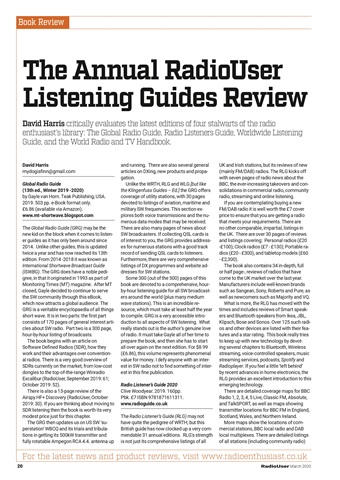
Global Radio Guide (13th ed. Winter 2019 -2020) by Gayle van Horn. Teak Publishing, USA. 2019. 503 pp. eBook format only. £6.86. (available via Amazon)
Global Radio Guide (GRG) may be the new kid on the block when it comes to listener guides as it has only been around since 2014. Unlike other guides, this is updated twice a year and has now reached its 13th edition. From 2014 -2018 it was known as International Shortwave Broadcast Guide (ISWBG). GRG does have a noble pedigree in that it originated in 1993 as part of the much-lamented Monitoring Times (MT) magazine which closed in 2013. After MT closed Gayle decided to continue to serve the SW community through this eBook which now attracts a global audience.
GRG is a veritable encyclopedia of all things SW. It is in two parts: the first part consists of 170 pages of general interest articles about SW radio. Part two is a 300 page, hour by hour listing of broadcasts. The book begins with a lengthy article on Software-Defined Radios (SDR), how they work and their advantages over conventional radios. There is a very good overview of SDRs currently on the market from low-cost dongles to the top of the range Winradio Excalibur. There is also a 13-page review of the Airspy HF+ Discovery. If you are thinking about moving to SDR listening then the book is worth its very modest price just for this chapter.
GRG then updates us on US SW superstation WBCQ and its trials and tribulations in getting its 500 kW. transmitter and fully rotatable Ampegon RCA 4.4. antenna up and running. There are also several general articles on DXing, new products and propagation.
Unlike WRTH, RLG, and WLG, GRG has coverage of utility stations with 30 pages devoted to listings of aviation, maritime and military SW frequencies. This section explores both voice transmissions and the numerous data modes that may be received. There are also many pages of news about SW broadcasters.
If QSLing is an interest then GRG provides addresses for numerous stations with a track record of sending QSL cards to listeners. There are very comprehensive listings of DX programs and website addresses for SW stations.
Some 300 out of 500 pages of this book are devoted to an hour by hour listing guide for all SW broadcasters around the world (plus many mediumwave stations) This is an incredible resource which must take half the year to compile.
GRG is more than just another listener guide – it is a very accessible introduction to all aspects of SW listening. What really stands out is the author’s genuine love of radio. It must take Gayle all of her time to prepare the book and then she has to start all over again in the next edition. For $8.99 (£6.86) it represents phenomenal value for money. I defy anyone with an interest in SW radio not to find something of interest in this fine publication.
Saturday, February 29, 2020
AMSAT NEWS SERVICE ANS-061
The AMSAT News Service bulletins are a
free, weekly news and
information service of AMSAT North America, The Radio
Amateur Satellite Corporation. ANS publishes news related to Amateur
Radio in space including reports on the activities of a worldwide
group of Amateur Radio operators who share an active interest in
designing, building, launching and communicating through analog and
digital Amateur Radio satellites.
The news feed on http://amsat.org publishes news of Amateur Radio
in space as soon as our volunteers can post it.
Please send any amateur satellite news or reports to:
ans-editor at amsat dot org.
In this edition:
* Upcoming SpaceX CRS-20 Launch
* FO-29 Operational Schedule
* Georgia Institute of Technology GT-1 To Feature Amateur Radio Robot Operation
* K7UAZ Radio Club Helps Prepare Satellite Radio Station for Space Camp at Biosphere 2
* New QO-100 Band Plan Announced
* ARISS News
* Hamfests, Conventions, Maker Faires, and Other Events
* Upcoming Satellite Operations
* Satellite Shorts from All Over
SB SAT @ AMSAT $ANS-061.01
ANS-061 AMSAT News Service Weekly Bulletins
AMSAT News Service Bulletin 061.01
From AMSAT HQ KENSINGTON, MD.
March 01, 2020
To All RADIO AMATEURS
BID: $ANS-061.01
Upcoming SpaceX CRS-20 Launch
The spouse of ARISS Hardware team member Ed Krome, K9EK, pointed out
that the ARISS next generation radio system, the InterOperable Radio
System (IORS) is prominently described as a primary payload, not
secondary, on the SpaceX CRS-20 mission which will be launched no
earlier than March 6, 2020 (ET).
The ARISS Team wants to express our heartfelt thanks to everyone that
has contributed to helping ARISS realize this major milestone
It should be noted that the ARISS hardware team is still very busy on
IORS development and final certification. While certified for launch
and stowage on ISS, the team is still in deep into the final
certification of the IORS for flight operations. Also, the build of
the second flight unit is in progress in Florida and in San Diego.
While CRS-20 represents the launch of SN 1001, the first flight unit,
it also represents the beginning of the "ARISS factory build" and
certification of all ten units.
The ARISS team also notes that November 13, 2020 will represent the
20th year of ARISS continuous amateur radio operation on ISS!
[ANS thanks Frank Bauer, KA3HDO AMSAT Vice President, Human Space
Flight for the above information.]
--------------------------------------------------------------------
FO-29 Operational Schedule
The operation of Fuji 3 (FO-29) has been unstable, but the
transmitter will be turned on in the next pass. Since the date and
time are in UTC, add 9 hours to convert to Japan time.
The operation is until the UVC (lower limit voltage control)
operates.
[Scheduled time to turn on the analog transmitter of Fuji 3 (UTC)]
March 1 04:00- 14:05
March 2 04:45- 14:55
March 7 03:40- 05:25- 13:50
March 8 04:30- 06:15- 14:40
March 14 04:15- 06:00- 14:25
March 15 03:25- 05:10- 15:15
March 21 03:10- 04:55- 15:00
March 22 04:00- 05:45- 14:05
March 28 03:45- 05:30- 13:50
March 29 04:35- 06:20- 14:40
Because of data acquisition, besides this operation plan, the
transmitter may be turned on for a short time.
[ANS thanks JARL for the above information.]
+=+=+=+=+=+=+=+=+=+=+=+=+=+=+=+=+=+=+=+=+=+=+=+=+=+=+=+=+=+=+=+=+=+
Purchase AMSAT Gear on our Zazzle storefront.
25% of the purchase price of each product goes
towards Keeping Amateur Radio in Space
https://www.zazzle.com/amsat_gear
+=+=+=+=+=+=+=+=+=+=+=+=+=+=+=+=+=+=+=+=+=+=+=+=+=+=+=+=+=+=+=+=+=+
Georgia Institute of Technology GT-1 To Feature Amateur Radio Robot
Operation
The Glenn Lightsey Research Group, Space Systems Design Lab at the
Georgia Institute of Technology is sponsoring a 1U CubeSat mission.
The primary function of GT-1 is to be an educational proof of concept
and satellite bus demonstrator. It will use this mission as an
opportunity for undergraduates to get involved in all parts of a
space mission, from design to implementation and sustainment. It will
test a prototype deployable antenna and solar panels, which can be
used for future missions derived from the same baseline design, and
with inclusion of additional experimental equipment.
It will operate with AX.25 protocol to collect telemetry data. In
partnership with the W4AQL Georgia Tech Amateur Radio Club, the
satellite will also host a digital contact ROBOT payload, inspired by
the Russian ham satellites RS-12 and RS-13. It will collect QSO
information from individuals who contact the ROBOT as it orbits. The
satellite will also function as a standard digipeater. Proposing a
9k6 UHF downlink using G3RUH FSK modulation. Planning a JAXA
deployment from the ISS in October 2020. A downlink on 437.175 MHz
has been coordinated.
[ANS thanks IARU for the above information.]
--------------------------------------------------------------------
K7UAZ Radio Club Helps Prepare Satellite Radio Station for Space Camp
at Biosphere 2
In preparation for the upcoming Space Camp at Biosphere 2 , members
of the University of Arizona K7UAZ Amateur Radio Club are helping
with the placement of an Amateur Radio satellite ground station. The
first step was to mount the Yaesu G-5500 az-el rotor system to a
Rohn 45 tower. The complete station will include circularly polarized
M2 beam antennas for 2m and 70cm, an Icom IC-9700, computers and
tracking software.
Curt Laumann, K7ZOO, Station Manager for the K7UAZ club reports that
Space Camp management is enthusiastic about having UAZ students help
with the installation and setup of the station. Student involvement
will also include calibrating the rotator system, mapping the
artificial horizon for the tracking software and integration and
testing the tracking software with the radio.
Now in its third year, Space Camp at Biosphere 2 will be held
August 3-8, 2020. Space Camp at Biosphere 2 is a joint effort with
the University of Arizona Biosphere 2, the Arizona NASA Space Grant
Consortium, and the University of Kyoto, Japan. Students attending
the camp will experience college-level curriculum and activities
focusing on the biological/environmental facets of space travel.
More information on Space Camp at Biosphere 2 is available at
https://spacegrant.arizona.edu/research/spacecamp
[ANS thanks Curt Laumann, K7ZOO for the above information.]
+=+=+=+=+=+=+=+=+=+=+=+=+=+=+=+=+=+=+=+=+=+=+=+=+=+=+=+=+=+=+=+=+=+
Need new satellite antennas? Purchase Arrows, Alaskan Arrows,
and M2 LEO-Packs from the AMSAT Store. When you purchase through
AMSAT, a portion of the proceeds goes towards
Keeping Amateur Radio in Space.
https://amsat.org/product-category/hardware/
+=+=+=+=+=+=+=+=+=+=+=+=+=+=+=+=+=+=+=+=+=+=+=+=+=+=+=+=+=+=+=+=+=+
New QO-100 Band Plan Announced
Just in time for the 1-year anniversary of the successful
commissioning of the two transponders of Qatar-OSCAR 100, an encore
is pending: The capacity of the NB transponder will be expanded from
about 250 KHz to almost 500 KHz.
In addition to extended areas for the various operating modes, more
space is also being created in particular for "mixed mode" and other
special operating cases. In addition to frequencies reserved for
emergency radio operations, more experiments are to be made possible
here.
But all this only with a maximum bandwidth of 2.7 kHz. Automatic
operation requires a special license from the local licensing
authorities and must be coordinated with the operator beforehand;
this task is performed by AMSAT-DL on behalf of QARS and Es'hailSat.
To take account of user behavior, AMSAT-DL has almost doubled the
SSB range in particular.
Detailed information is available at
https://amsat-dl.org/en/neuer-qo-100-bandplan/
[ANS thanks AMSAT-DL for the above information.]
--------------------------------------------------------------------
ARISS News
* Upcoming Contacts
River Ridge High School, New Port Richey, FL.
Direct via WA3YFQ.
The scheduled astronaut is Drew Morgan KI5AAA.
The contact is a go for Tuesday, March 3, 2020, 15:17:44 UTC.
[ANS thanks Charlie Sufana, AJ9N for the above information.]
--------------------------------------------------------------------
Hamfests, Conventions, Maker Faires, and Other Events
AMSAT Ambassadors provide presentations, demonstrate communicating
through amateur satellites, and host information tables at club
meetings, hamfests, conventions, maker faires, and other events.
Current schedule:
March 6, 2020, Irving Hamfest, Irving, TX
March 14-15, 2020, Science City on University of Arizona, Tucson, AZ
March 21, 2020, Midwinter Madness Hamfest, Buffalo, MN
March 21, 2020, Scottsdale Amateur Radio Club Hamfest, Scottsdale, AZ
March 28, 2020, Tucson Spring Hamfest, Tucson, AZ
March 29, 2020, Vienna Wireless Winterfest, Annandale, VA
May 2, 2020, Cochise Amateur Radio Assoc. Hamfest, Sierra Vista, AZ
May 8-9, 2020 Prescott Hamfest, Prescott, AZ
May 15-17, Hamvention, Xenia, OH
June 12-13, 2020, Ham-Con, Plano, TX
[ANS thanks Robert Bankston, KE4AL for the above information.]
+=+=+=+=+=+=+=+=+=+=+=+=+=+=+=+=+=+=+=+=+=+=+=+=+=+=+=+=+=+=+=+=+=+
AMSAT, along with our ARISS partners, is developing an amateur
radio package, including two-way communication capability, to
be carried on-board Gateway in lunar orbit.
Support AMSAT's projects today at https://www.amsat.org/donate/
+=+=+=+=+=+=+=+=+=+=+=+=+=+=+=+=+=+=+=+=+=+=+=+=+=+=+=+=+=+=+=+=+=+
Upcoming Satellite Operations
- Shorts
Mar 14-15 DN26/36 KC7JPC Linears (and possibly FM)
- Big Bend National Park (DL88) March 16-17, 2020
Ron AD0DX, Doug N6UA, and Josh W3ARD will operate from Big Bend
National Park to put grid DL88 on the air. Details will be added
here, as they come available, but you are more than welcome to keep
an eye on their individual Twitter feeds: https://twitter.com/ad0dx,
https://twitter.com/dtabor, and https://twitter.com/W3ARDstroke5
- #NevadaMayhem part 1: Central Nevada (DM19) March 21, 2020
David, AD7DB, will venture deep into Central Nevada to specifically
activate grid DM19 on Saturday March 21. This is actually down a
side road from "The Loneliest Road in America." Hardly any hams even
live in that grid. It's for sure that few ever activate it. On the
way there, Friday March 20, he will try to also activate some or all
of: DM06, DM16, DM07, DM08, DM17 and DM18. Going home Sunday,
March 22, he will try to visit them again. This will be on FM
satellites only. Internet and cell coverage may be very poor up there
but for updates check Twitter: https:/twitter.com/ad7db
[ANS thanks Robert Bankston, KE4AL for the above information.]
--------------------------------------------------------------------
Satellite Shorts from All Over
AMSAT SA Space Symposium Announced
* The AMSAT SA Space Symposium will be held on July 11, 2020.
Prospective authors are invited to propose papers by submitting a
brief synopsis to admin@amsatsa.org.za before Friday,
February 28, 2020. While the call for papers is ongoing till the end
of February, AMSAT SA is pleased to announce that Burns Fisher WB1FJ,
of AMSAT NA will delivery two papers at the symposium: Fox-in-a-box,
Fox telemetry reception using an inexpensive Raspberry Pi and a
J-pole antenna including a discussion on the optimal positioning for
a J-pole antenna for satellite reception and an overview of what is
in orbit currently and expected in the near future and their features.
More information available at http://www.sarl.org.za/
[ANS thanks SARL for the above information.]
* MEMESat-1 Proposed
Let's Go to Space, Inc.'s first satellite mission is the Mission for
Education and Multimedia Engagement, better known as MEMESat-1. This
spacecraft will be a 1U amateur radio CubeSat. It's primary mission
is to serve as an FM Repeater and to downlink donor submitted memes
via UHF SSTV protocol. MEMESat is also being created to engage people
through the sharing of memes from space and help fund small satellite
focused research.
More information available at https://letsgo2space.com/memesat-1-3/
[ANS thanks Michael Frazier, KJ5Z for the above information.]
* Two Commercial Satellites Link Up for First Time
A Northrop Grumman robotic servicing spacecraft has hooked up with an
aging Intelsat communications satellite more than 22,000 miles over
the Pacific Ocean, accomplishing the first link-up between two
commercial satellites in space, and the first docking with a
satellite that was never designed to receive a visitor.
Northrop Grumman's first commercial Mission Extension Vehicle, or
MEV 1, will take over propulsion responsibilities for Intelsat 901,
which is running low on fuel after more than 18 years in service
relaying data and television signals. MEV 1 is the first spacecraft
of its kind, and officials say the successful link-up with Intelsat
901 is a harbinger for a new era of commercial satellite servicing.
The automated docking early Tuesday also marked the first connection
of two satellites in geosynchronous orbit, a region high above the
equator where spacecraft move at speeds that match the rate of
Earth's rotation.
Complete information at https://tinyurl.com/ANS-061-Grumman
[ANS thanks SpaceFlightNow.com for the above information.]
--------------------------------------------------------------------
In addition to regular membership, AMSAT offers membership in the
President's Club. Members of the President's Club, as sustaining
donors to AMSAT Project Funds, will be eligible to receive
additional benefits. Application forms are available from the
AMSAT office.
Primary and secondary school students are eligible for membership at
one-half the standard yearly rate. Post-secondary school students
enrolled in at least half time status shall be eligible for the
student rate for a maximum of six post-secondary years in this
status.
Contact Martha at the AMSAT office for additional student
membership information.
73,
This week's ANS Editor,
Frank Karnauskas, N1UW
n1uw at amsat dot org
Sent via AMSAT-BB@amsat.org. AMSAT-NA makes this open forum
available to all interested persons worldwide without requiring
membership. Opinions expressed are solely those of the author
and do not reflect the official views of AMSAT-NA.
Not an AMSAT member? Join now to support the amateur satellite
program!
Subscription settings: http://www.amsat.org/mailman/listinfo/amsat-bb
_______________________________________________
Via the ANS mailing list courtesy of AMSAT-NA
https://www.amsat.org/mailman/listinfo/ans
information service of AMSAT North America, The Radio
Amateur Satellite Corporation. ANS publishes news related to Amateur
Radio in space including reports on the activities of a worldwide
group of Amateur Radio operators who share an active interest in
designing, building, launching and communicating through analog and
digital Amateur Radio satellites.
The news feed on http://amsat.org publishes news of Amateur Radio
in space as soon as our volunteers can post it.
Please send any amateur satellite news or reports to:
ans-editor at amsat dot org.
In this edition:
* Upcoming SpaceX CRS-20 Launch
* FO-29 Operational Schedule
* Georgia Institute of Technology GT-1 To Feature Amateur Radio Robot Operation
* K7UAZ Radio Club Helps Prepare Satellite Radio Station for Space Camp at Biosphere 2
* New QO-100 Band Plan Announced
* ARISS News
* Hamfests, Conventions, Maker Faires, and Other Events
* Upcoming Satellite Operations
* Satellite Shorts from All Over
SB SAT @ AMSAT $ANS-061.01
ANS-061 AMSAT News Service Weekly Bulletins
AMSAT News Service Bulletin 061.01
From AMSAT HQ KENSINGTON, MD.
March 01, 2020
To All RADIO AMATEURS
BID: $ANS-061.01
Upcoming SpaceX CRS-20 Launch
The spouse of ARISS Hardware team member Ed Krome, K9EK, pointed out
that the ARISS next generation radio system, the InterOperable Radio
System (IORS) is prominently described as a primary payload, not
secondary, on the SpaceX CRS-20 mission which will be launched no
earlier than March 6, 2020 (ET).
The ARISS Team wants to express our heartfelt thanks to everyone that
has contributed to helping ARISS realize this major milestone
It should be noted that the ARISS hardware team is still very busy on
IORS development and final certification. While certified for launch
and stowage on ISS, the team is still in deep into the final
certification of the IORS for flight operations. Also, the build of
the second flight unit is in progress in Florida and in San Diego.
While CRS-20 represents the launch of SN 1001, the first flight unit,
it also represents the beginning of the "ARISS factory build" and
certification of all ten units.
The ARISS team also notes that November 13, 2020 will represent the
20th year of ARISS continuous amateur radio operation on ISS!
[ANS thanks Frank Bauer, KA3HDO AMSAT Vice President, Human Space
Flight for the above information.]
--------------------------------------------------------------------
FO-29 Operational Schedule
The operation of Fuji 3 (FO-29) has been unstable, but the
transmitter will be turned on in the next pass. Since the date and
time are in UTC, add 9 hours to convert to Japan time.
The operation is until the UVC (lower limit voltage control)
operates.
[Scheduled time to turn on the analog transmitter of Fuji 3 (UTC)]
March 1 04:00- 14:05
March 2 04:45- 14:55
March 7 03:40- 05:25- 13:50
March 8 04:30- 06:15- 14:40
March 14 04:15- 06:00- 14:25
March 15 03:25- 05:10- 15:15
March 21 03:10- 04:55- 15:00
March 22 04:00- 05:45- 14:05
March 28 03:45- 05:30- 13:50
March 29 04:35- 06:20- 14:40
Because of data acquisition, besides this operation plan, the
transmitter may be turned on for a short time.
[ANS thanks JARL for the above information.]
+=+=+=+=+=+=+=+=+=+=+=+=+=+=+=+=+=+=+=+=+=+=+=+=+=+=+=+=+=+=+=+=+=+
Purchase AMSAT Gear on our Zazzle storefront.
25% of the purchase price of each product goes
towards Keeping Amateur Radio in Space
https://www.zazzle.com/amsat_gear
+=+=+=+=+=+=+=+=+=+=+=+=+=+=+=+=+=+=+=+=+=+=+=+=+=+=+=+=+=+=+=+=+=+
Georgia Institute of Technology GT-1 To Feature Amateur Radio Robot
Operation
The Glenn Lightsey Research Group, Space Systems Design Lab at the
Georgia Institute of Technology is sponsoring a 1U CubeSat mission.
The primary function of GT-1 is to be an educational proof of concept
and satellite bus demonstrator. It will use this mission as an
opportunity for undergraduates to get involved in all parts of a
space mission, from design to implementation and sustainment. It will
test a prototype deployable antenna and solar panels, which can be
used for future missions derived from the same baseline design, and
with inclusion of additional experimental equipment.
It will operate with AX.25 protocol to collect telemetry data. In
partnership with the W4AQL Georgia Tech Amateur Radio Club, the
satellite will also host a digital contact ROBOT payload, inspired by
the Russian ham satellites RS-12 and RS-13. It will collect QSO
information from individuals who contact the ROBOT as it orbits. The
satellite will also function as a standard digipeater. Proposing a
9k6 UHF downlink using G3RUH FSK modulation. Planning a JAXA
deployment from the ISS in October 2020. A downlink on 437.175 MHz
has been coordinated.
[ANS thanks IARU for the above information.]
--------------------------------------------------------------------
K7UAZ Radio Club Helps Prepare Satellite Radio Station for Space Camp
at Biosphere 2
In preparation for the upcoming Space Camp at Biosphere 2 , members
of the University of Arizona K7UAZ Amateur Radio Club are helping
with the placement of an Amateur Radio satellite ground station. The
first step was to mount the Yaesu G-5500 az-el rotor system to a
Rohn 45 tower. The complete station will include circularly polarized
M2 beam antennas for 2m and 70cm, an Icom IC-9700, computers and
tracking software.
Curt Laumann, K7ZOO, Station Manager for the K7UAZ club reports that
Space Camp management is enthusiastic about having UAZ students help
with the installation and setup of the station. Student involvement
will also include calibrating the rotator system, mapping the
artificial horizon for the tracking software and integration and
testing the tracking software with the radio.
Now in its third year, Space Camp at Biosphere 2 will be held
August 3-8, 2020. Space Camp at Biosphere 2 is a joint effort with
the University of Arizona Biosphere 2, the Arizona NASA Space Grant
Consortium, and the University of Kyoto, Japan. Students attending
the camp will experience college-level curriculum and activities
focusing on the biological/environmental facets of space travel.
More information on Space Camp at Biosphere 2 is available at
https://spacegrant.arizona.edu/research/spacecamp
[ANS thanks Curt Laumann, K7ZOO for the above information.]
+=+=+=+=+=+=+=+=+=+=+=+=+=+=+=+=+=+=+=+=+=+=+=+=+=+=+=+=+=+=+=+=+=+
Need new satellite antennas? Purchase Arrows, Alaskan Arrows,
and M2 LEO-Packs from the AMSAT Store. When you purchase through
AMSAT, a portion of the proceeds goes towards
Keeping Amateur Radio in Space.
https://amsat.org/product-category/hardware/
+=+=+=+=+=+=+=+=+=+=+=+=+=+=+=+=+=+=+=+=+=+=+=+=+=+=+=+=+=+=+=+=+=+
New QO-100 Band Plan Announced
Just in time for the 1-year anniversary of the successful
commissioning of the two transponders of Qatar-OSCAR 100, an encore
is pending: The capacity of the NB transponder will be expanded from
about 250 KHz to almost 500 KHz.
In addition to extended areas for the various operating modes, more
space is also being created in particular for "mixed mode" and other
special operating cases. In addition to frequencies reserved for
emergency radio operations, more experiments are to be made possible
here.
But all this only with a maximum bandwidth of 2.7 kHz. Automatic
operation requires a special license from the local licensing
authorities and must be coordinated with the operator beforehand;
this task is performed by AMSAT-DL on behalf of QARS and Es'hailSat.
To take account of user behavior, AMSAT-DL has almost doubled the
SSB range in particular.
Detailed information is available at
https://amsat-dl.org/en/neuer-qo-100-bandplan/
[ANS thanks AMSAT-DL for the above information.]
--------------------------------------------------------------------
ARISS News
* Upcoming Contacts
River Ridge High School, New Port Richey, FL.
Direct via WA3YFQ.
The scheduled astronaut is Drew Morgan KI5AAA.
The contact is a go for Tuesday, March 3, 2020, 15:17:44 UTC.
[ANS thanks Charlie Sufana, AJ9N for the above information.]
--------------------------------------------------------------------
Hamfests, Conventions, Maker Faires, and Other Events
AMSAT Ambassadors provide presentations, demonstrate communicating
through amateur satellites, and host information tables at club
meetings, hamfests, conventions, maker faires, and other events.
Current schedule:
March 6, 2020, Irving Hamfest, Irving, TX
March 14-15, 2020, Science City on University of Arizona, Tucson, AZ
March 21, 2020, Midwinter Madness Hamfest, Buffalo, MN
March 21, 2020, Scottsdale Amateur Radio Club Hamfest, Scottsdale, AZ
March 28, 2020, Tucson Spring Hamfest, Tucson, AZ
March 29, 2020, Vienna Wireless Winterfest, Annandale, VA
May 2, 2020, Cochise Amateur Radio Assoc. Hamfest, Sierra Vista, AZ
May 8-9, 2020 Prescott Hamfest, Prescott, AZ
May 15-17, Hamvention, Xenia, OH
June 12-13, 2020, Ham-Con, Plano, TX
[ANS thanks Robert Bankston, KE4AL for the above information.]
+=+=+=+=+=+=+=+=+=+=+=+=+=+=+=+=+=+=+=+=+=+=+=+=+=+=+=+=+=+=+=+=+=+
AMSAT, along with our ARISS partners, is developing an amateur
radio package, including two-way communication capability, to
be carried on-board Gateway in lunar orbit.
Support AMSAT's projects today at https://www.amsat.org/donate/
+=+=+=+=+=+=+=+=+=+=+=+=+=+=+=+=+=+=+=+=+=+=+=+=+=+=+=+=+=+=+=+=+=+
Upcoming Satellite Operations
- Shorts
Mar 14-15 DN26/36 KC7JPC Linears (and possibly FM)
- Big Bend National Park (DL88) March 16-17, 2020
Ron AD0DX, Doug N6UA, and Josh W3ARD will operate from Big Bend
National Park to put grid DL88 on the air. Details will be added
here, as they come available, but you are more than welcome to keep
an eye on their individual Twitter feeds: https://twitter.com/ad0dx,
https://twitter.com/dtabor, and https://twitter.com/W3ARDstroke5
- #NevadaMayhem part 1: Central Nevada (DM19) March 21, 2020
David, AD7DB, will venture deep into Central Nevada to specifically
activate grid DM19 on Saturday March 21. This is actually down a
side road from "The Loneliest Road in America." Hardly any hams even
live in that grid. It's for sure that few ever activate it. On the
way there, Friday March 20, he will try to also activate some or all
of: DM06, DM16, DM07, DM08, DM17 and DM18. Going home Sunday,
March 22, he will try to visit them again. This will be on FM
satellites only. Internet and cell coverage may be very poor up there
but for updates check Twitter: https:/twitter.com/ad7db
[ANS thanks Robert Bankston, KE4AL for the above information.]
--------------------------------------------------------------------
Satellite Shorts from All Over
AMSAT SA Space Symposium Announced
* The AMSAT SA Space Symposium will be held on July 11, 2020.
Prospective authors are invited to propose papers by submitting a
brief synopsis to admin@amsatsa.org.za before Friday,
February 28, 2020. While the call for papers is ongoing till the end
of February, AMSAT SA is pleased to announce that Burns Fisher WB1FJ,
of AMSAT NA will delivery two papers at the symposium: Fox-in-a-box,
Fox telemetry reception using an inexpensive Raspberry Pi and a
J-pole antenna including a discussion on the optimal positioning for
a J-pole antenna for satellite reception and an overview of what is
in orbit currently and expected in the near future and their features.
More information available at http://www.sarl.org.za/
[ANS thanks SARL for the above information.]
* MEMESat-1 Proposed
Let's Go to Space, Inc.'s first satellite mission is the Mission for
Education and Multimedia Engagement, better known as MEMESat-1. This
spacecraft will be a 1U amateur radio CubeSat. It's primary mission
is to serve as an FM Repeater and to downlink donor submitted memes
via UHF SSTV protocol. MEMESat is also being created to engage people
through the sharing of memes from space and help fund small satellite
focused research.
More information available at https://letsgo2space.com/memesat-1-3/
[ANS thanks Michael Frazier, KJ5Z for the above information.]
* Two Commercial Satellites Link Up for First Time
A Northrop Grumman robotic servicing spacecraft has hooked up with an
aging Intelsat communications satellite more than 22,000 miles over
the Pacific Ocean, accomplishing the first link-up between two
commercial satellites in space, and the first docking with a
satellite that was never designed to receive a visitor.
Northrop Grumman's first commercial Mission Extension Vehicle, or
MEV 1, will take over propulsion responsibilities for Intelsat 901,
which is running low on fuel after more than 18 years in service
relaying data and television signals. MEV 1 is the first spacecraft
of its kind, and officials say the successful link-up with Intelsat
901 is a harbinger for a new era of commercial satellite servicing.
The automated docking early Tuesday also marked the first connection
of two satellites in geosynchronous orbit, a region high above the
equator where spacecraft move at speeds that match the rate of
Earth's rotation.
Complete information at https://tinyurl.com/ANS-061-Grumman
[ANS thanks SpaceFlightNow.com for the above information.]
--------------------------------------------------------------------
In addition to regular membership, AMSAT offers membership in the
President's Club. Members of the President's Club, as sustaining
donors to AMSAT Project Funds, will be eligible to receive
additional benefits. Application forms are available from the
AMSAT office.
Primary and secondary school students are eligible for membership at
one-half the standard yearly rate. Post-secondary school students
enrolled in at least half time status shall be eligible for the
student rate for a maximum of six post-secondary years in this
status.
Contact Martha at the AMSAT office for additional student
membership information.
73,
This week's ANS Editor,
Frank Karnauskas, N1UW
n1uw at amsat dot org
Sent via AMSAT-BB@amsat.org. AMSAT-NA makes this open forum
available to all interested persons worldwide without requiring
membership. Opinions expressed are solely those of the author
and do not reflect the official views of AMSAT-NA.
Not an AMSAT member? Join now to support the amateur satellite
program!
Subscription settings: http://www.amsat.org/mailman/listinfo/amsat-bb
_______________________________________________
Via the ANS mailing list courtesy of AMSAT-NA
https://www.amsat.org/mailman/listinfo/ans
Saturday, February 22, 2020
AMSAT NEWS SERVICE ANS-054
The AMSAT News Service bulletins are a
free, weekly news and infor-
mation service of AMSAT, The Radio Amateur Satellite Corporation. ANS
publishes news related to Amateur Radio in Space including reports on
the activities of a worldwide group of Amateur Radio operators who
share an active interest in designing, building, launching and commun-
icating through analog and digital Amateur Radio satellites.
The news feed on http://www.amsat.org publishes news of Amateur
Radio in Space as soon as our volunteers can post it.
Please send any amateur satellite news or reports to:
ans-editor at amsat.org.
You can sign up for free e-mail delivery of the AMSAT News Service
Bulletins via the ANS List; to join this list see:
http://www.amsat.org/mailman/listinfo/ans
In this edition:
* QARMAN and Phoenix CubeSats Deployed from ISS
* AMSAT Files Comments Opposing Deletion of 3.4 GHz Band
* NEMO-1 Buoy Report
* GNU Radio Conference - Tickets and Call for Papers
* U.S. Naval Academy's PSAT3 Scheduled to Launch in Mid-March
* Changes to AMSAT-NA TLE Distribution
* "Getting Started with Amateur Satellites" Available with Membership
* ARISS Radio Telebridge Stalwart Gerald Klatzko, ZS6BTD, SK
* Upcoming ARISS Contacts
* Hamfests, Conventions, Maker Faires, and Other Events
* Upcoming Satellite Operations
* Satellite Shorts From All Over
SB SAT @ AMSAT $ANS-054.01
ANS-054 AMSAT News Service Weekly Bulletins
AMSAT News Service Bulletin 054.01
From AMSAT HQ KENSINGTON, MD.
DATE 2020 Feb 23
To All RADIO AMATEURS
BID: $ANS-054.01
QARMAN and Phoenix CubeSats Deployed from ISS
The von Karman Institute in Belgium (VKI) reports the successful de-
ployment of the QARMAN satellite from the International Space Station
on Wednesday, 19 February. QARMAN is one of several cubesats that were
scheduled for deployment this week.
Also, Arizona State University reports that its Phoenix CubeSat was
successfully deployed from the ISS as scheduled at 9:35 UTC Wednesday.
Roughly 30 minutes after deployment, its beacon was heard for the first
time at an amateur radio ground station located in Indonesia.
VKI also reports successful reception and decoding of telemetry from
QARMAN. It is important to note that both of these satellites are using
the same frequency, 437.35 MHz, for telemetry transmissions, and that
they are in very similar orbits. Both satellites also follow the AX.25
protocol at 9600 baud, with GMSK modulation. It will take some trial
and error before each spacecraft’s TLEs can be confirmed.
Operators of these satellites are actively seeking observations from
amateurs. Please report to:
https://community.libre.space/c/satellites-observations
ANS is awaiting reports regarding the other satellites that were
scheduled for deployment on Wednesday, as listed below:
CubeSat Downlink (MHz) Uplink (MHz) Scheduled Deployment Time (UTC)
RadSat-u 437.425 437.425 7:10
CryoCube 2261.00 2082.004 12:55
AztechSat-1 437.3 437.3 12:55
SOCRATES 914.7 914.7 14:30
Argus-02 437.29 437.29 16:00
HARP 468.0 450.0 16:00
SORTIE 468.0 450.0 17:40
[ANS thanks AMSAT-UK, VKI, and Arizona State for the above information]
---------------------------------------------------------------------
AMSAT Files Comments Opposing Deletion of 3.4 GHz Band
AMSAT has filed comments on the Federal Communications Commission's
Notice of Proposed Rulemaking which proposes to delete the 3.3 - 3.5
GHz (9 cm) amateur band, including the 3.40 - 3.41 GHz amateur sat-
ellite service allocation.
In the comments, AMSAT opposes the deletion of this allocation and em-
phasizes the necessity of adequate microwave spectrum for future ama-
teur satellite projects, including AMSAT's GOLF program and the Lunar
Gateway.
AMSAT further notes that the most desirable allocations for use as up-
links are the allocations between 2.4 and 5.67 GHz. These allocations
total 80 MHz. The most desirable allocation for downlink use is the
10.45 - 10.50 GHz allocation, totaling 50 MHz. As many of the proposed
uses include amateur television and high-speed data transmission with
satellites in high earth orbit or lunar orbit, these allocations may
quickly become inadequate. AMSAT also notes that the 2.4 and 5.67 GHz
allocations are widely used for ISM and consumer devices, such as WiFi
and Bluetooth-enabled devices. The 3.4 GHz allocation is shared be-
tween amateur use and other non-federal and federal licensees, but is
free from the unpredictable interference of consumer devices.
While acknowledging that the 3.4 GHz amateur satellite service allo-
cation is not currently used by any amateur satellites and that it is
unsuitable for worldwide communication since it is not available in
ITU Region 1, AMSAT identifies a number of potential future uses for
the band as worldwide usage of the other available allocations in-
creases. These potential uses include a future amateur satellite in
geostationary orbit above the Americas.
In the comments, AMSAT also noted several non-amateur satellite uses
of the broader 3.3 - 3.5 GHz amateur service allocation, including its
wide use in mesh networking, EME communications, and contesting.
The full text of the comments as filed can be downloaded at
https://tinyurl.com/ANS-054-FCC
Interested parties may file reply comments on or before March 22,
2020 at https://www.fcc.gov/ecfs/ The proceeding is WT Docket No. 19-
348.
[ANS thanks Paul Stoetzer, N8HM, Executive Vice President. for the ab-
ove information]
---------------------------------------------------------------------
NEMO-1 Buoy Report
AMSAT ARGENTINA launched the NEMO-1 buoy into the Atlantic sea on Jan-
uary 30th at noon, using the callsign LU7AA. It was transported 70 km
east of Mar del Plata by the fisherman's ship 'Porteño', from Sandokan.
The buoy, which emits in WSPR mode at 14095.6 KHz and FM VHF in APRS
mode, navigated drifting free for 12 days traveling about 1100 kilo-
meters, until on February 11th it was sighted and taken out of the
water by the tuna vessel 'Juan Pablo II'.
The captain of the ship, Rinaldi Yaco, considered that the buoy was
sailing semi-sunk and decided to rescue it, informing Amsat Argentina
of that event.
The NEMO-1 then traveled eight more days aboard the tuna vessel, con-
tinuing its mission of data capture and broadcasting, until on Feb-19
it arrived at the port of Mar del Plata, where colleagues from the Mar
del Plata Radio Club picked it up and kept in custody.
A group of AMSAT-LU is traveling to recover NEMO-1. The buoy will be
reconditioned and a new launch is planned. It will be tried to take it,
on this occasion, to more than 200 km offshore, so that it will con-
tinue to navigate freely, reaffirming the commitment and contribution
of radio amateurs to QRPp propagation research also helping navigation
and the community.
AMSAT ARGENTINA especially thanks the Captains and crews of the
'Porteño', the 'Juan Pablo II' ships and the Mar del Plata RClub in
the persons of its Secretary, Jose Luis Hermida (LU9DHJ) and Jorge
Garelli (LU5EOR) for the help provided and to the more than 100 'trav-
elers' in NEMO-1, who supported this project helping to carry it out.
http://amsat.org.ar?f=ce
Adventure photos: http://amsat.org.ar?f=buoy
[ANS thanks LU7AA, AMSAT Argentina for the above information]
+=+=+=+=+=+=+=+=+=+=+=+=+=+=+=+=+=+=+=+=+=+=+=+=+=+=+=+=+=+=+=+=+=+
Purchase AMSAT Gear on our Zazzle storefront.
25% of the purchase price of each product goes
towards Keeping Amateur Radio in Space
https://www.zazzle.com/amsat_gear
+=+=+=+=+=+=+=+=+=+=+=+=+=+=+=+=+=+=+=+=+=+=+=+=+=+=+=+=+=+=+=+=+=+
GNU Radio Conference - Tickets and Call for Papers
GNU Radio is used by spacecraft and ground station developers around
the world. GRCon is the annual conference for the GNU Radio project
and community. GRCon20 will be held September 14-18, 2020 in Charlotte,
N.C.
The GNU Radio Conference celebrates and showcases the substantial and
remarkable progress of the world’s best open source digital signal
processing framework for software-defined radios. In addition to pre-
senting GNU Radio’s theoretical and practical presence in academia,
industry, the military, and among amateurs and hobbyists, GNU Radio
Conference 2020 will have a very special focus: Speed, latency, delay,
and timing!
Enjoy our racing theme throughout the conference, featured in our con-
tests and a high-octane Thursday night dinner. Papers and presentations
on theme will be recognized at the conference with an award.
But wait, there’s more! We’ll be co-located and coordinated with the
TAPR Digital Communications Conference. It’s the weekend immediately
preceding GRCon20. Find out more at: https://tapr.org/?page_id=68
Registration and an online and mobile-friendly schedule will be posted
at https://www.gnuradio.org/grcon/grcon20/
Developers and users from the GNU Radio Community are invited to pre-
sent projects, presentations, papers, posters, and problems at GRCon20.
Submit talks, demos, and code! Please share this Call widely. To sub-
mit your content for the conference, visit the dedicated conference
submission site at: https://pretalx.gnuradio.org/grcon20/cfp
First round closes 17 April 2020. If accepted, your content will be
immediately scheduled. Notifications go out 26 June 2020.
Final round closes 1 September 2019. Submissions received between 18
April 2020 and 1 September 2020 are accepted space permitting, and
notifications will be sent out on a rolling basis.
Those with questions or need assistance with submitting then please
write grcon@gnuradio.org
[ANS thanks Michelle Thompson, W5NYV, AMSAT Board Member, for the
above information]
---------------------------------------------------------------------
U.S. Naval Academy's PSAT3 Scheduled to Launch in Mid-March
The U. S. Naval Academy's PSAT3 payload is scheduled to launch in mid-
March from the Pacific Spaceport Complex - Alaska in Kodiak, AK.
PSAT3 is functionally equivalent to NO-104 (PSAT2), but does not in-
clude PSK31 functionality. It carries a 145.825 MHz APRS digipeater
and SSTV downlink capability.
PSAT3 will not be a free-flying satellite. It will remain attached to
the upper stage of the launch vehicle. Consequently, the mission dur-
ation will be limited to a few months, when the rocket body will de-
orbit.
More information about PSAT3 can be found at
http://aprs.org/psat3.html
[ANS thanks Bob Bruninga, WB4APR, and the IARU for the above information]
---------------------------------------------------------------------
Changes to AMSAT-NA TLE Distribution
The following Amateur Radio satellite has been added to this weeks
AMSAT TLE Distribution:
SwampSat-2 NORAD CAT ID 45115 (Deployed from Northrop Grumman NG-12
Cygnus 2-3-2020.)
(Thanks to Nico Janseen, PA0DLO, for satellite identification.)
Sadly, AO-85 (Fox-1A) has been declared at end of mission. But, I
think I will retain AO-85 in the TLE distribution for a while just in
case there are some last comments from our friend. (Remember AO-7?)
[ANS thanks Ray Hoad, WA5QGD, AMSAT Orbital Elements Manager, for the
above information]
---------------------------------------------------------------------
Free Digital Copy of "Getting Started with Amateur Satellites" Avail-
able for New or Renewing Members
While HuskySat-1 completes it's scientific mission, check out the best
resource for learning how to work through linear transponder sat-
ellites (and other types of amateur satellites). For a limited time,
AMSAT is making the "Getting Started With Amateur Satellites" book
available as a download with any paid new or renewal membership
purchased via the AMSAT Store. This offer is only available with
purchases completed online, and for only a limited time. A perennial
favorite, Getting Started is updated every year with the latest
amateur satellite information, and is the premier primer of satellite
operation. The book is presented in PDF format, in full color, and
covers all aspects of making your first contacts on a ham radio
satellite.
Please take advantage of this offer today by visiting the AMSAT store
at https://www.amsat.org/shop/ and selecting any membership option.
While there, check out AMSAT's other items, including the M2 LEOpack
antenna system, Arrow antennas, AMSAT shirts, and other swag. Be sure
to view your cart before going to checkout. If you add a membership
and then go directly to checkout, you'll never see an option to add
your free gift.
If you have trouble selecting your free gift, please see this YouTube
video to see the steps necessary. https://youtu.be/oRqk5Am-UzE
[ANS thanks the AMSAT Office for the above information]
---------------------------------------------------------------------
ARISS Radio Telebridge Stalwart Gerald Klatzko, ZS6BTD, SK
When the International Space Station (ISS) orbit is not favorable for
a direct Amateur Radio on the International Space Station (ARISS) con-
tact with a particular school or location scheduled to speak with an
astronaut, ARISS radio telebridge stations bridge the gap. Gerald
Klatzko, ZS6BTD, of Parklands, South Africa, one of the “regulars”
during the earlier years of the ARISS program, died on February 1 at
age 95.
Klatzko served as an ARISS radio telebridge station in South Africa
for many years until he retired. ARISS telebridge stations establish
the direct ham radio link and feed two-way audio into a telebridge
line for delivery to the contact site. John Sygo, ZS6JON, described
Klatzko as “always bright and cheerful and a great operator,” who made
major contributions to the amateur service.
“He was one of the first to experiment with slow-scan television,”
Sygo said. “For many years, he assisted NASA to link astronauts with
their families using amateur radio links from Mir, the Space Shuttle,
and the International Space Station. For over 2 decades he was the co-
producer and presenter of Amateur Radio Mirror International.”
[ANS thanks ARRL for the above information]
+=+=+=+=+=+=+=+=+=+=+=+=+=+=+=+=+=+=+=+=+=+=+=+=+=+=+=+=+=+=+=+=+=+
Need new satellite antennas? Purchase Arrows, Alaskan Arrows,
and M2 LEO-Packs from the AMSAT Store. When you purchase through
AMSAT, a portion of the proceeds goes towards
Keeping Amateur Radio in Space.
https://amsat.org/product-category/hardware/
+=+=+=+=+=+=+=+=+=+=+=+=+=+=+=+=+=+=+=+=+=+=+=+=+=+=+=+=+=+=+=+=+=+
Upcoming ARISS Contacts
ARISS lets students worldwide experience the excitement of talking
directly with crew members of the International Space Station. A con-
tact is scheduled with the Kittredge Magnet School, Atlanta, GA, direct
via KQ4KMS. The ISS callsign is presently scheduled to be NA1SS, and
the scheduled astronaut is Drew Morgan, KI5AAA. The contact is go for:
Monday, 2020-02-24 at 18:23:55 UTC (31 degrees elevation).
A contact is also scheduled with the Celia Hays Elementary School,
Rockwall, Texas, direct via W5SO. The ISS callsign is presently sched-
uled to be NA1SS, and the scheduled astronaut is Drew Morgan, KI5AAA.
The contact is go for: Tuesday, 2020-02-25 at 17:35:18 UTC (31 degrees)
Watch for live stream at https://live.myvrspot.com/st?cid=NWM5NW
The ARISS webpage is at https://www.ariss.org/
Note that all times are approximate. It is recommended that you do
your own orbital prediction or start listening about 10 minutes before
the listed time.
[ANS thanks Charlie Sufana, AJ9N, of the ARISS operation team for the
above information]
---------------------------------------------------------------------
Hamfests, Conventions, Maker Faires, and Other Events
Want to see AMSAT in action or learn more about amateur radio in space?
AMSAT Ambassadors provide presentations, demonstrate communicating
through amateur satellites, and host information tables at club meet-
ings, hamfests, conventions, maker faires, and other events.
Current schedule:
March 6, 2020, Irving Hamfest, Irving, TX
March 14-15, 2020, Science City on University of Arizona, Tuscon
March 21, 2020, Midwinter Madness Hamfest, Buffalo, MN
March 21, 2020, Scottsdale Amateur Radio Club Hamfest, Arizona
March 28, 2020, Tucson Spring Hamfest, Tucson, AZ
March 29, 2020, Vienna Wireless Winterfest, Annandale, VA
May 2, 2020, Cochise Amateur Radio Assn Hamfest, Sierra Vista, AZ
May 8-9, 2020 Prescott Hamfest, Prescott, AZ
May 15-17, Hamvention, Xenia, OH
June 12-13, 2020, Ham-Con, Plano, TX
A copy of the AMSAT hamfest brochure is available for download: AMSAT
Intro Brochure. This color brochure is designed to be printed double-
sided and folded into a tri-fold handout.
To include your upcoming AMSAT presentation and/or demonstration,
please send an email to ambassadors (at) amsat (dot) org.
[ANS thanks Robert Bankston, KE4AL, AMSAT Vice President - User Serv-
ices, for the above information]
+=+=+=+=+=+=+=+=+=+=+=+=+=+=+=+=+=+=+=+=+=+=+=+=+=+=+=+=+=+=+=+=+=+
AMSAT, along with our ARISS partners, is developing an amateur
radio package, including two-way communication capability, to
be carried on-board Gateway in lunar orbit.
Support AMSAT's projects today at https://www.amsat.org/donate/
+=+=+=+=+=+=+=+=+=+=+=+=+=+=+=+=+=+=+=+=+=+=+=+=+=+=+=+=+=+=+=+=+=+
Upcoming Satellite Operations
#SnowBirdRove (EL79) – February 1-29, 2020
Joe, KE9AJ, will cross the border into Florida, seeking climatical
asylum in EL79 for the entire month of February. Since he will be
there for an extended period, with both FM and linear gear, keep an
eye on Joe’s Twitter feed for specific pass announcements:
https://twitter.com/KE9AJ
There is a possibility that Joe may have to make a pit stop in EM54
and EM53 on his way down South on February 1st. Monitor Twitter
for updates.
Culebra Island, PR (FK78) February 22-23, 2020
Radio Operadores del Este, Inc, KP3E will be returning to Culebra
Island February 21-23. Listen for Rafael, KP4RV, on FM satellites.
https://www.youtube.com/watch?v=_xSbPgIyhtA&feature=youtu.be
Vidalia, LA (EM41) February 28 – March 1, 2020
Brian, KG5GJT, will will be operating from the bank of the Missis-
sippi River in Vidalia, La. (EM41), where Jim Bowie was seriously
wounded in the Sandbar Fight on September 19, 1827. This will be
vacation style, so keep an eye on Brian’s Twitter feed for updates:
https://twitter.com/KG5GJT
DN26/36 Mar 14-15 KC7JPC Linears (and possibly FM)
Big Bend National Park (DL88) March 16-17, 2020
Ron AD0DX, Doug N6UA, and Josh W3ARD will operate from Big Bend
National Park to put grid DL88 on the air. Details will be added
here, as they come available, but you are more than welcome to keep
an eye on their individual Twitter feeds: https://twitter.com/ad0dx
https://twitter.com/dtabor, and https://twitter.com/W3ARDstroke5
#NevadaMayhem part 1: Central Nevada (DM19) March 21, 2020
David, AD7DB, will venture deep into Central Nevada to specifically
activate grid DM19 on Saturday March 21. This is actually down a
side road from “The Loneliest Road in America.” Hardly any hams
even live in that grid. It’s for sure that few ever activate it.
On the way there, Friday March 20, he will try to also activate
some or all of: DM06, DM16, DM07, DM08, DM17 and DM18. Going home
Sunday March 22, he will try to visit them again. This will be on
FM satellites only. Internet and cell coverage may be very poor up
there, but for updates check Twitter: https:/twitter.com/ad7db
Please submit any additions or corrections to ke4al (at) amsat.org
[ANS thanks Robert Bankston, KE4AL, AMSAT Vice President - User Serv-
ices, for the above information]
---------------------------------------------------------------------
Satellite Shorts From All Over
+ Students in the Husky Satellite Lab at the University of Washington
have confirmed via their Facebook page that they have been commanding
HuskySat-1 to various transmitter power levels and beacon intervals.
Some amateurs tracking the bird, which carries a linear transponder
to be activated later, had feared that the varying levels were a
sign of problems. But this is part of the experimentation. The Husky-
Sat team has been providing updates on their operations on their
Facebook page at: https://www.facebook.com/pg/UWCubeSat/posts/
You should not need a Facebook account to view that link.
(ANS thanks UW CubeSat Team for the above information)
+ NASA will accept applications for its next astronaut class March 2
to 31. Applicants must be U.S. citizens with a master's degree in a
STEM field and two years of relevant professional experience. To
sign up, see: https://www.nasa.gov/astronauts
(ANS thanks NASA HQ News for the above information)
+ International Astronomical Youth Camp will take place in Spain from
12 July to 1 August 2020. The camp typically hosts around 65 parti-
cipants, aged between 16-24 years old. The IAYC’s main aims are to
promote knowledge on astronomy and related sciences in a unique, in-
ternational atmosphere. Participants work on a research project of
their own choosing over the course of the three weeks, culminating
in a final report. See https://www.iayc.org/ for details.
(ANS thanks Carys Herbert, IAYC Leaderteam, for the above informa-
tion)
+ The ARISS-UK Team have announced that the Electromagnetic Field 2020
event is to host an ARISS contact during the weekend of July 23-26.
The event will be held at Easton Manor Deer Park, near Ledbury in
Herefordshire, UK. Information and event tickets available at:
https://blog.emfcamp.org/2020/02/14/ticket-sales-dates/
(ANS thanks AMSAT-UK for the above information)
+ The maiden flight of the Long March-5B rocket carrying a trial ver-
sion of China's new-generation manned spaceship is expected to take
place in April, indicating the imminent start of construction of
China's space station. The rocket, the prototype core capsule of the
space station, and the experimental manned spaceship are undergoing
tests at the Wenchang Space Launch Center on the coast of south
China's island province of Hainan. https://bit.ly/2VcjXrO
(ANS thanks Space Daily for the above information)
+ A new version of the game of "chicken" is evolving in outer space.
According to Gen. John Raymond, the U.S. Space Force Chief, Russian
"inspector" satellites are threatening the tenuous stand-off stabil-
ity between adversarial spacefaring nations. Since Novemeber, the
U.S. Space Command has been tracking a satellite known as Cosmos-
2542 which ejected a smaller, nested satellite referred to as Cosmos-
2543. The Russian satellites have been actively maneuvering near USA
245, a classified military imaging satellite.
(ANS thanks Space Daily for the above information)
+ Amazon has patented a mechanism for throwing satellites into space
with a multi-drone-guided whip, mounted on a boat. See details at:
https://bit.ly/37KWPmL Note, though, that Amazon (and other tech
companies) have a history of patenting things that they’ll never
actually build, such as Amazon’s underwater fulfillment centers:
https://bit.ly/2Tf7DV9 Has April Fool come early?
(ANS thanks The Orbital Index for the above information)
---------------------------------------------------------------------
/EX
In addition to regular membership, AMSAT offers membership in the
President's Club. Members of the President's Club, as sustaining
donors to AMSAT Project Funds, will be eligible to receive addi-
tional benefits. Application forms are available from the AMSAT
Office.
Primary and secondary school students are eligible for membership
at one-half the standard yearly rate. Post-secondary school students
enrolled in at least half time status shall be eligible for the stu-
dent rate for a maximum of 6 post-secondary years in this status.
Contact Martha at the AMSAT Office for additional student membership
information.
73 and Remember to help keep amateur radio in space,
This week's ANS Editor,
K0JM at amsat dot org
_______________________________________________
Via the ANS mailing list courtesy of AMSAT-NA
https://www.amsat.org/mailman/listinfo/ans
mation service of AMSAT, The Radio Amateur Satellite Corporation. ANS
publishes news related to Amateur Radio in Space including reports on
the activities of a worldwide group of Amateur Radio operators who
share an active interest in designing, building, launching and commun-
icating through analog and digital Amateur Radio satellites.
The news feed on http://www.amsat.org publishes news of Amateur
Radio in Space as soon as our volunteers can post it.
Please send any amateur satellite news or reports to:
ans-editor at amsat.org.
You can sign up for free e-mail delivery of the AMSAT News Service
Bulletins via the ANS List; to join this list see:
http://www.amsat.org/mailman/listinfo/ans
In this edition:
* QARMAN and Phoenix CubeSats Deployed from ISS
* AMSAT Files Comments Opposing Deletion of 3.4 GHz Band
* NEMO-1 Buoy Report
* GNU Radio Conference - Tickets and Call for Papers
* U.S. Naval Academy's PSAT3 Scheduled to Launch in Mid-March
* Changes to AMSAT-NA TLE Distribution
* "Getting Started with Amateur Satellites" Available with Membership
* ARISS Radio Telebridge Stalwart Gerald Klatzko, ZS6BTD, SK
* Upcoming ARISS Contacts
* Hamfests, Conventions, Maker Faires, and Other Events
* Upcoming Satellite Operations
* Satellite Shorts From All Over
SB SAT @ AMSAT $ANS-054.01
ANS-054 AMSAT News Service Weekly Bulletins
AMSAT News Service Bulletin 054.01
From AMSAT HQ KENSINGTON, MD.
DATE 2020 Feb 23
To All RADIO AMATEURS
BID: $ANS-054.01
QARMAN and Phoenix CubeSats Deployed from ISS
The von Karman Institute in Belgium (VKI) reports the successful de-
ployment of the QARMAN satellite from the International Space Station
on Wednesday, 19 February. QARMAN is one of several cubesats that were
scheduled for deployment this week.
Also, Arizona State University reports that its Phoenix CubeSat was
successfully deployed from the ISS as scheduled at 9:35 UTC Wednesday.
Roughly 30 minutes after deployment, its beacon was heard for the first
time at an amateur radio ground station located in Indonesia.
VKI also reports successful reception and decoding of telemetry from
QARMAN. It is important to note that both of these satellites are using
the same frequency, 437.35 MHz, for telemetry transmissions, and that
they are in very similar orbits. Both satellites also follow the AX.25
protocol at 9600 baud, with GMSK modulation. It will take some trial
and error before each spacecraft’s TLEs can be confirmed.
Operators of these satellites are actively seeking observations from
amateurs. Please report to:
https://community.libre.space/c/satellites-observations
ANS is awaiting reports regarding the other satellites that were
scheduled for deployment on Wednesday, as listed below:
CubeSat Downlink (MHz) Uplink (MHz) Scheduled Deployment Time (UTC)
RadSat-u 437.425 437.425 7:10
CryoCube 2261.00 2082.004 12:55
AztechSat-1 437.3 437.3 12:55
SOCRATES 914.7 914.7 14:30
Argus-02 437.29 437.29 16:00
HARP 468.0 450.0 16:00
SORTIE 468.0 450.0 17:40
[ANS thanks AMSAT-UK, VKI, and Arizona State for the above information]
---------------------------------------------------------------------
AMSAT Files Comments Opposing Deletion of 3.4 GHz Band
AMSAT has filed comments on the Federal Communications Commission's
Notice of Proposed Rulemaking which proposes to delete the 3.3 - 3.5
GHz (9 cm) amateur band, including the 3.40 - 3.41 GHz amateur sat-
ellite service allocation.
In the comments, AMSAT opposes the deletion of this allocation and em-
phasizes the necessity of adequate microwave spectrum for future ama-
teur satellite projects, including AMSAT's GOLF program and the Lunar
Gateway.
AMSAT further notes that the most desirable allocations for use as up-
links are the allocations between 2.4 and 5.67 GHz. These allocations
total 80 MHz. The most desirable allocation for downlink use is the
10.45 - 10.50 GHz allocation, totaling 50 MHz. As many of the proposed
uses include amateur television and high-speed data transmission with
satellites in high earth orbit or lunar orbit, these allocations may
quickly become inadequate. AMSAT also notes that the 2.4 and 5.67 GHz
allocations are widely used for ISM and consumer devices, such as WiFi
and Bluetooth-enabled devices. The 3.4 GHz allocation is shared be-
tween amateur use and other non-federal and federal licensees, but is
free from the unpredictable interference of consumer devices.
While acknowledging that the 3.4 GHz amateur satellite service allo-
cation is not currently used by any amateur satellites and that it is
unsuitable for worldwide communication since it is not available in
ITU Region 1, AMSAT identifies a number of potential future uses for
the band as worldwide usage of the other available allocations in-
creases. These potential uses include a future amateur satellite in
geostationary orbit above the Americas.
In the comments, AMSAT also noted several non-amateur satellite uses
of the broader 3.3 - 3.5 GHz amateur service allocation, including its
wide use in mesh networking, EME communications, and contesting.
The full text of the comments as filed can be downloaded at
https://tinyurl.com/ANS-054-FCC
Interested parties may file reply comments on or before March 22,
2020 at https://www.fcc.gov/ecfs/ The proceeding is WT Docket No. 19-
348.
[ANS thanks Paul Stoetzer, N8HM, Executive Vice President. for the ab-
ove information]
---------------------------------------------------------------------
NEMO-1 Buoy Report
AMSAT ARGENTINA launched the NEMO-1 buoy into the Atlantic sea on Jan-
uary 30th at noon, using the callsign LU7AA. It was transported 70 km
east of Mar del Plata by the fisherman's ship 'Porteño', from Sandokan.
The buoy, which emits in WSPR mode at 14095.6 KHz and FM VHF in APRS
mode, navigated drifting free for 12 days traveling about 1100 kilo-
meters, until on February 11th it was sighted and taken out of the
water by the tuna vessel 'Juan Pablo II'.
The captain of the ship, Rinaldi Yaco, considered that the buoy was
sailing semi-sunk and decided to rescue it, informing Amsat Argentina
of that event.
The NEMO-1 then traveled eight more days aboard the tuna vessel, con-
tinuing its mission of data capture and broadcasting, until on Feb-19
it arrived at the port of Mar del Plata, where colleagues from the Mar
del Plata Radio Club picked it up and kept in custody.
A group of AMSAT-LU is traveling to recover NEMO-1. The buoy will be
reconditioned and a new launch is planned. It will be tried to take it,
on this occasion, to more than 200 km offshore, so that it will con-
tinue to navigate freely, reaffirming the commitment and contribution
of radio amateurs to QRPp propagation research also helping navigation
and the community.
AMSAT ARGENTINA especially thanks the Captains and crews of the
'Porteño', the 'Juan Pablo II' ships and the Mar del Plata RClub in
the persons of its Secretary, Jose Luis Hermida (LU9DHJ) and Jorge
Garelli (LU5EOR) for the help provided and to the more than 100 'trav-
elers' in NEMO-1, who supported this project helping to carry it out.
http://amsat.org.ar?f=ce
Adventure photos: http://amsat.org.ar?f=buoy
[ANS thanks LU7AA, AMSAT Argentina for the above information]
+=+=+=+=+=+=+=+=+=+=+=+=+=+=+=+=+=+=+=+=+=+=+=+=+=+=+=+=+=+=+=+=+=+
Purchase AMSAT Gear on our Zazzle storefront.
25% of the purchase price of each product goes
towards Keeping Amateur Radio in Space
https://www.zazzle.com/amsat_gear
+=+=+=+=+=+=+=+=+=+=+=+=+=+=+=+=+=+=+=+=+=+=+=+=+=+=+=+=+=+=+=+=+=+
GNU Radio Conference - Tickets and Call for Papers
GNU Radio is used by spacecraft and ground station developers around
the world. GRCon is the annual conference for the GNU Radio project
and community. GRCon20 will be held September 14-18, 2020 in Charlotte,
N.C.
The GNU Radio Conference celebrates and showcases the substantial and
remarkable progress of the world’s best open source digital signal
processing framework for software-defined radios. In addition to pre-
senting GNU Radio’s theoretical and practical presence in academia,
industry, the military, and among amateurs and hobbyists, GNU Radio
Conference 2020 will have a very special focus: Speed, latency, delay,
and timing!
Enjoy our racing theme throughout the conference, featured in our con-
tests and a high-octane Thursday night dinner. Papers and presentations
on theme will be recognized at the conference with an award.
But wait, there’s more! We’ll be co-located and coordinated with the
TAPR Digital Communications Conference. It’s the weekend immediately
preceding GRCon20. Find out more at: https://tapr.org/?page_id=68
Registration and an online and mobile-friendly schedule will be posted
at https://www.gnuradio.org/grcon/grcon20/
Developers and users from the GNU Radio Community are invited to pre-
sent projects, presentations, papers, posters, and problems at GRCon20.
Submit talks, demos, and code! Please share this Call widely. To sub-
mit your content for the conference, visit the dedicated conference
submission site at: https://pretalx.gnuradio.org/grcon20/cfp
First round closes 17 April 2020. If accepted, your content will be
immediately scheduled. Notifications go out 26 June 2020.
Final round closes 1 September 2019. Submissions received between 18
April 2020 and 1 September 2020 are accepted space permitting, and
notifications will be sent out on a rolling basis.
Those with questions or need assistance with submitting then please
write grcon@gnuradio.org
[ANS thanks Michelle Thompson, W5NYV, AMSAT Board Member, for the
above information]
---------------------------------------------------------------------
U.S. Naval Academy's PSAT3 Scheduled to Launch in Mid-March
The U. S. Naval Academy's PSAT3 payload is scheduled to launch in mid-
March from the Pacific Spaceport Complex - Alaska in Kodiak, AK.
PSAT3 is functionally equivalent to NO-104 (PSAT2), but does not in-
clude PSK31 functionality. It carries a 145.825 MHz APRS digipeater
and SSTV downlink capability.
PSAT3 will not be a free-flying satellite. It will remain attached to
the upper stage of the launch vehicle. Consequently, the mission dur-
ation will be limited to a few months, when the rocket body will de-
orbit.
More information about PSAT3 can be found at
http://aprs.org/psat3.html
[ANS thanks Bob Bruninga, WB4APR, and the IARU for the above information]
---------------------------------------------------------------------
Changes to AMSAT-NA TLE Distribution
The following Amateur Radio satellite has been added to this weeks
AMSAT TLE Distribution:
SwampSat-2 NORAD CAT ID 45115 (Deployed from Northrop Grumman NG-12
Cygnus 2-3-2020.)
(Thanks to Nico Janseen, PA0DLO, for satellite identification.)
Sadly, AO-85 (Fox-1A) has been declared at end of mission. But, I
think I will retain AO-85 in the TLE distribution for a while just in
case there are some last comments from our friend. (Remember AO-7?)
[ANS thanks Ray Hoad, WA5QGD, AMSAT Orbital Elements Manager, for the
above information]
---------------------------------------------------------------------
Free Digital Copy of "Getting Started with Amateur Satellites" Avail-
able for New or Renewing Members
While HuskySat-1 completes it's scientific mission, check out the best
resource for learning how to work through linear transponder sat-
ellites (and other types of amateur satellites). For a limited time,
AMSAT is making the "Getting Started With Amateur Satellites" book
available as a download with any paid new or renewal membership
purchased via the AMSAT Store. This offer is only available with
purchases completed online, and for only a limited time. A perennial
favorite, Getting Started is updated every year with the latest
amateur satellite information, and is the premier primer of satellite
operation. The book is presented in PDF format, in full color, and
covers all aspects of making your first contacts on a ham radio
satellite.
Please take advantage of this offer today by visiting the AMSAT store
at https://www.amsat.org/shop/ and selecting any membership option.
While there, check out AMSAT's other items, including the M2 LEOpack
antenna system, Arrow antennas, AMSAT shirts, and other swag. Be sure
to view your cart before going to checkout. If you add a membership
and then go directly to checkout, you'll never see an option to add
your free gift.
If you have trouble selecting your free gift, please see this YouTube
video to see the steps necessary. https://youtu.be/oRqk5Am-UzE
[ANS thanks the AMSAT Office for the above information]
---------------------------------------------------------------------
ARISS Radio Telebridge Stalwart Gerald Klatzko, ZS6BTD, SK
When the International Space Station (ISS) orbit is not favorable for
a direct Amateur Radio on the International Space Station (ARISS) con-
tact with a particular school or location scheduled to speak with an
astronaut, ARISS radio telebridge stations bridge the gap. Gerald
Klatzko, ZS6BTD, of Parklands, South Africa, one of the “regulars”
during the earlier years of the ARISS program, died on February 1 at
age 95.
Klatzko served as an ARISS radio telebridge station in South Africa
for many years until he retired. ARISS telebridge stations establish
the direct ham radio link and feed two-way audio into a telebridge
line for delivery to the contact site. John Sygo, ZS6JON, described
Klatzko as “always bright and cheerful and a great operator,” who made
major contributions to the amateur service.
“He was one of the first to experiment with slow-scan television,”
Sygo said. “For many years, he assisted NASA to link astronauts with
their families using amateur radio links from Mir, the Space Shuttle,
and the International Space Station. For over 2 decades he was the co-
producer and presenter of Amateur Radio Mirror International.”
[ANS thanks ARRL for the above information]
+=+=+=+=+=+=+=+=+=+=+=+=+=+=+=+=+=+=+=+=+=+=+=+=+=+=+=+=+=+=+=+=+=+
Need new satellite antennas? Purchase Arrows, Alaskan Arrows,
and M2 LEO-Packs from the AMSAT Store. When you purchase through
AMSAT, a portion of the proceeds goes towards
Keeping Amateur Radio in Space.
https://amsat.org/product-category/hardware/
+=+=+=+=+=+=+=+=+=+=+=+=+=+=+=+=+=+=+=+=+=+=+=+=+=+=+=+=+=+=+=+=+=+
Upcoming ARISS Contacts
ARISS lets students worldwide experience the excitement of talking
directly with crew members of the International Space Station. A con-
tact is scheduled with the Kittredge Magnet School, Atlanta, GA, direct
via KQ4KMS. The ISS callsign is presently scheduled to be NA1SS, and
the scheduled astronaut is Drew Morgan, KI5AAA. The contact is go for:
Monday, 2020-02-24 at 18:23:55 UTC (31 degrees elevation).
A contact is also scheduled with the Celia Hays Elementary School,
Rockwall, Texas, direct via W5SO. The ISS callsign is presently sched-
uled to be NA1SS, and the scheduled astronaut is Drew Morgan, KI5AAA.
The contact is go for: Tuesday, 2020-02-25 at 17:35:18 UTC (31 degrees)
Watch for live stream at https://live.myvrspot.com/st?cid=NWM5NW
The ARISS webpage is at https://www.ariss.org/
Note that all times are approximate. It is recommended that you do
your own orbital prediction or start listening about 10 minutes before
the listed time.
[ANS thanks Charlie Sufana, AJ9N, of the ARISS operation team for the
above information]
---------------------------------------------------------------------
Hamfests, Conventions, Maker Faires, and Other Events
Want to see AMSAT in action or learn more about amateur radio in space?
AMSAT Ambassadors provide presentations, demonstrate communicating
through amateur satellites, and host information tables at club meet-
ings, hamfests, conventions, maker faires, and other events.
Current schedule:
March 6, 2020, Irving Hamfest, Irving, TX
March 14-15, 2020, Science City on University of Arizona, Tuscon
March 21, 2020, Midwinter Madness Hamfest, Buffalo, MN
March 21, 2020, Scottsdale Amateur Radio Club Hamfest, Arizona
March 28, 2020, Tucson Spring Hamfest, Tucson, AZ
March 29, 2020, Vienna Wireless Winterfest, Annandale, VA
May 2, 2020, Cochise Amateur Radio Assn Hamfest, Sierra Vista, AZ
May 8-9, 2020 Prescott Hamfest, Prescott, AZ
May 15-17, Hamvention, Xenia, OH
June 12-13, 2020, Ham-Con, Plano, TX
A copy of the AMSAT hamfest brochure is available for download: AMSAT
Intro Brochure. This color brochure is designed to be printed double-
sided and folded into a tri-fold handout.
To include your upcoming AMSAT presentation and/or demonstration,
please send an email to ambassadors (at) amsat (dot) org.
[ANS thanks Robert Bankston, KE4AL, AMSAT Vice President - User Serv-
ices, for the above information]
+=+=+=+=+=+=+=+=+=+=+=+=+=+=+=+=+=+=+=+=+=+=+=+=+=+=+=+=+=+=+=+=+=+
AMSAT, along with our ARISS partners, is developing an amateur
radio package, including two-way communication capability, to
be carried on-board Gateway in lunar orbit.
Support AMSAT's projects today at https://www.amsat.org/donate/
+=+=+=+=+=+=+=+=+=+=+=+=+=+=+=+=+=+=+=+=+=+=+=+=+=+=+=+=+=+=+=+=+=+
Upcoming Satellite Operations
#SnowBirdRove (EL79) – February 1-29, 2020
Joe, KE9AJ, will cross the border into Florida, seeking climatical
asylum in EL79 for the entire month of February. Since he will be
there for an extended period, with both FM and linear gear, keep an
eye on Joe’s Twitter feed for specific pass announcements:
https://twitter.com/KE9AJ
There is a possibility that Joe may have to make a pit stop in EM54
and EM53 on his way down South on February 1st. Monitor Twitter
for updates.
Culebra Island, PR (FK78) February 22-23, 2020
Radio Operadores del Este, Inc, KP3E will be returning to Culebra
Island February 21-23. Listen for Rafael, KP4RV, on FM satellites.
https://www.youtube.com/watch?v=_xSbPgIyhtA&feature=youtu.be
Vidalia, LA (EM41) February 28 – March 1, 2020
Brian, KG5GJT, will will be operating from the bank of the Missis-
sippi River in Vidalia, La. (EM41), where Jim Bowie was seriously
wounded in the Sandbar Fight on September 19, 1827. This will be
vacation style, so keep an eye on Brian’s Twitter feed for updates:
https://twitter.com/KG5GJT
DN26/36 Mar 14-15 KC7JPC Linears (and possibly FM)
Big Bend National Park (DL88) March 16-17, 2020
Ron AD0DX, Doug N6UA, and Josh W3ARD will operate from Big Bend
National Park to put grid DL88 on the air. Details will be added
here, as they come available, but you are more than welcome to keep
an eye on their individual Twitter feeds: https://twitter.com/ad0dx
https://twitter.com/dtabor, and https://twitter.com/W3ARDstroke5
#NevadaMayhem part 1: Central Nevada (DM19) March 21, 2020
David, AD7DB, will venture deep into Central Nevada to specifically
activate grid DM19 on Saturday March 21. This is actually down a
side road from “The Loneliest Road in America.” Hardly any hams
even live in that grid. It’s for sure that few ever activate it.
On the way there, Friday March 20, he will try to also activate
some or all of: DM06, DM16, DM07, DM08, DM17 and DM18. Going home
Sunday March 22, he will try to visit them again. This will be on
FM satellites only. Internet and cell coverage may be very poor up
there, but for updates check Twitter: https:/twitter.com/ad7db
Please submit any additions or corrections to ke4al (at) amsat.org
[ANS thanks Robert Bankston, KE4AL, AMSAT Vice President - User Serv-
ices, for the above information]
---------------------------------------------------------------------
Satellite Shorts From All Over
+ Students in the Husky Satellite Lab at the University of Washington
have confirmed via their Facebook page that they have been commanding
HuskySat-1 to various transmitter power levels and beacon intervals.
Some amateurs tracking the bird, which carries a linear transponder
to be activated later, had feared that the varying levels were a
sign of problems. But this is part of the experimentation. The Husky-
Sat team has been providing updates on their operations on their
Facebook page at: https://www.facebook.com/pg/UWCubeSat/posts/
You should not need a Facebook account to view that link.
(ANS thanks UW CubeSat Team for the above information)
+ NASA will accept applications for its next astronaut class March 2
to 31. Applicants must be U.S. citizens with a master's degree in a
STEM field and two years of relevant professional experience. To
sign up, see: https://www.nasa.gov/astronauts
(ANS thanks NASA HQ News for the above information)
+ International Astronomical Youth Camp will take place in Spain from
12 July to 1 August 2020. The camp typically hosts around 65 parti-
cipants, aged between 16-24 years old. The IAYC’s main aims are to
promote knowledge on astronomy and related sciences in a unique, in-
ternational atmosphere. Participants work on a research project of
their own choosing over the course of the three weeks, culminating
in a final report. See https://www.iayc.org/ for details.
(ANS thanks Carys Herbert, IAYC Leaderteam, for the above informa-
tion)
+ The ARISS-UK Team have announced that the Electromagnetic Field 2020
event is to host an ARISS contact during the weekend of July 23-26.
The event will be held at Easton Manor Deer Park, near Ledbury in
Herefordshire, UK. Information and event tickets available at:
https://blog.emfcamp.org/2020/02/14/ticket-sales-dates/
(ANS thanks AMSAT-UK for the above information)
+ The maiden flight of the Long March-5B rocket carrying a trial ver-
sion of China's new-generation manned spaceship is expected to take
place in April, indicating the imminent start of construction of
China's space station. The rocket, the prototype core capsule of the
space station, and the experimental manned spaceship are undergoing
tests at the Wenchang Space Launch Center on the coast of south
China's island province of Hainan. https://bit.ly/2VcjXrO
(ANS thanks Space Daily for the above information)
+ A new version of the game of "chicken" is evolving in outer space.
According to Gen. John Raymond, the U.S. Space Force Chief, Russian
"inspector" satellites are threatening the tenuous stand-off stabil-
ity between adversarial spacefaring nations. Since Novemeber, the
U.S. Space Command has been tracking a satellite known as Cosmos-
2542 which ejected a smaller, nested satellite referred to as Cosmos-
2543. The Russian satellites have been actively maneuvering near USA
245, a classified military imaging satellite.
(ANS thanks Space Daily for the above information)
+ Amazon has patented a mechanism for throwing satellites into space
with a multi-drone-guided whip, mounted on a boat. See details at:
https://bit.ly/37KWPmL Note, though, that Amazon (and other tech
companies) have a history of patenting things that they’ll never
actually build, such as Amazon’s underwater fulfillment centers:
https://bit.ly/2Tf7DV9 Has April Fool come early?
(ANS thanks The Orbital Index for the above information)
---------------------------------------------------------------------
/EX
In addition to regular membership, AMSAT offers membership in the
President's Club. Members of the President's Club, as sustaining
donors to AMSAT Project Funds, will be eligible to receive addi-
tional benefits. Application forms are available from the AMSAT
Office.
Primary and secondary school students are eligible for membership
at one-half the standard yearly rate. Post-secondary school students
enrolled in at least half time status shall be eligible for the stu-
dent rate for a maximum of 6 post-secondary years in this status.
Contact Martha at the AMSAT Office for additional student membership
information.
73 and Remember to help keep amateur radio in space,
This week's ANS Editor,
K0JM at amsat dot org
_______________________________________________
Via the ANS mailing list courtesy of AMSAT-NA
https://www.amsat.org/mailman/listinfo/ans
Monday, February 17, 2020
Jonathan's Space Report, No. 775
Jonathan's Space Report
No. 775 2020 Feb 17 Somerville, MA
---------------------------------------------------------------------------------------------
International Space Station
---------------------------
Expedition 61 continued until undocking of Soyuz MS-13 on Feb 6, which began Expedition 62
under the command of Oleg Skripochka.
On Jan 29 the Cyclops deployer was used to deploy the USAF STPSAT-4
satellite delivered to ISS aboard NG-12. STPSAT-4/Cyclops was extracted
from the Kibo airlock and STPSAT-4 was ejected into orbit at 0720 UTC
Jan 29.
On Jan 31 at about 1115 UTC the Canadarm-2 unberthed Cygnus NG-12, the S.S. Alan Bean,
from the Unity nadir port. Cygnus NG-12 was released into orbit at 1436 UTC.
On Jan 31 to Feb 1 Cygnus NG-12 released seven cubesats from the Nanoracks NRCSD-E dispenser and
seven cubesats from the SEOPS/SpaceflightInc Slingshot system.
On Feb 6, Soyuz MS-13 undocked from Poisk at 0550 UTC carrying Skvortsov, Koch and Parmitano.
The spacecraft fired its deorbit engine at 0818 UTC, lowering perigee below the Earth's surface.
At 0846 UTC the orbital and service modules were jettisoned, and at 0850 UTC the descent module
began reentry, with landing in Kazakhstan at 0912 UTC Feb 6.
On Feb 15 Cygnus mission NG-13, the S.S. Robert Lawrence, was launched on an Antares from
Wallops Island on a mission to deliver cargo to the ISS.
NROL-151
--------
RocketLab flew its 11th Electron mission from New Zealand's Mahia Peninsula on Jan 31.
It placed a satellite for the US National Reconnaissance Office in low Earth orbit
with approximately 70 degrees inclination. The mission was designated NROL-151 and the
satellite is codenamed USA 294. Exact orbit of NROL-151 is not yet known. US registration
documents supplied to the UN are apparently stuck in a backlog - the latest made public
online covers up to early 2017.
OneWeb
------
The second launch for the OneWeb constellation took off from Baykonur on Feb 6.
The Fregat upper stage carried a dispenser with 34 satellites, two on a `top hat'
deck K and four decks A, B, C, D with eight satellites each. The satellites were deployed
in a 443 km orbit and will use their on-board propulsion to raise to 1000 km.
(Spacecraft numbers in the table below are in deployment order; thanks to Cameron Meek for data.)
IGS O-7
-------
Japan's IGS O-7 (Information Gathering Satellite/Optical 7, or Joho shushu eisei kogaku 7 goki,
was launched on Feb 9 to sun-sync orbit with 1030 local time descending node.
Solar Orbiter
-------------
The ESA-led Solar Orbiter probe, built by Airbus UK, was launched to an escape trajectory on Feb 10.
Solar Orbiter will enter a 0.513 x 0.991 AU x 1.9 deg solar orbit and make a Venus gravity assist
flyby on Dec 26. After more Venus and Earth flybys it will lower perihelion to about 0.3 AU
by 2022 and by 2028 will increase its orbital inclination to the ecliptic to 25 degrees, allow
imaging of the solar poles. Unlike Parker Solar Probe (which gets closer to the Sun) SO carries a
range of imaging instruments.
X-37 Secret Deployment
-----------------------
Sometime between 2017 and 2019 the US DoD covertly deployed three small
satellites from the orbiting X-37 spaceplane. Those satellites have
finally been added to the US satellite catalog as USA 295-297 (SSN
45169-45171) although with no orbital data provided. A page on Space-Track.org noted
that the three satellites are no longer in orbit; this adds weight to my guess that
they were deployed close to the beginning of the OTV-5 mission in 2017.
I welcome this step of acknowledging the satellites and hope that the
US will bring itself back into compliance with the UN Registration
Convention by providing basic orbital parameters for the satellites, even though
they are no longer up.
Simorgh
--------
Iran launched a Simorgh rocket from Khomeini Space Centre on Feb 9. The upper stage
underperformed or failed, and the payload - an imaging satellite called Zafar - fell in the
Indian Ocean after reaching a 540 km apogee.
Errata
--------
- There is still some confusion about which spacesuits were on which astronaut for the
recent EVAs. In particular, Andrey Krasilnikov tells me for EVA 64 it was
Morgan - EMU 3008 and Parmitano - EMU 3004.
- I put the wrong orbit in last time for Yinhe 1, it's in a 621 x 638 km orbit.
Table of Recent Orbital Launches
----------------------------------
Date UT Name Launch Vehicle Site Mission INTL. Catalog Perigee Apogee Incl Notes
Jan 7 0219 Starlink 1066 ) Falcon 9 Canaveral SLC40 Comms 01AS S44954 301 x 305 x 53.0
Starlink 1069-1104 ) Comms )
Starlink 1106-1119 ) Comms )
Starlink 1121-1126 ) Comms )
Starlink 1128 ) Comms ) 01A-01BM
Starlink 1130 ) Comms ) 44914-
Starlink 1144 ) Comms ) 44973
Jan 7 1520 TJS 5 Chang Zheng 3B Xichang Comms 02A S44978 195 x 35804 x 27.5
Jan 15 0253 Jilin-1 Kuanfu 1 ) Chang Zheng 2D Taiyuan Imaging 03A S45016 477 x 492 x 97.3
Sophie ) Imaging 03B S45017 475 x 492 x 97.3
Marie ) Imaging 03C S45018 477 x 493 x 97.3
Tianqi-5 ) Comms 03D?S45019 475 x 492 x 97.3
Jan 16 0302 Yinhe 1 Kuaizhou 1A Jiuquan Comms 04A S45024 621 x 638 x 86.4
Jan 16 2105 Eutelsat Konnect ) Ariane 5ECA Kourou ELA3 Comms 05B S45027 499 x 36234 x 6.0
GSAT-30 ) Comms 05A S45026 35775 x 35799 x 0.1
Jan 29 0720 STPSAT-4 ISS, LEO Tech 9867QY S45043 415 x 423 x 51.6
Jan 29 1406 Starlink 1120 ) Falcon 9 Canaveral SLC40 Comms )
Starlink 1127 ) Comms )
Starlink 1129 ) Comms )
Starlink 1131-1137) Comms ) 06A-06BM 276 x 291 x 53.0
Starlink 1139-1142) Comms )
Starlink 1145-1153) Comms )
Starlink 1155-1186) Comms )
Starlink 1190 ) Comms )
Starlink 1193-1196) Comms )
Jan 31 0256 USA 294 Electron Mahia LC1 Unknown 07A 45110 Unknown orbit x 70.0?
Jan 31? Aerocube-14A ) NRCSD-E/NG-12, LEO Tech 19071D S45114 459 x 474 x 51.6
Aerocube-14B ) Tech 19071E? S45115 459 x 474 x 51.6
Jan 31? Aerocube-15A ) NRCSD-E/NG-12, LEO Tech 19071F? S45116 459 x 474 x 51.6
Aerocube-15B ) Tech 19071G S45117 459 x 474 x 51.6
Jan 31 2230? SwampSat-2 ) NRCSD-E/NG-12, LEO Tech 19071J S45119 459 x 474 x 51.6
HuskySat-1 ) Tech 19071C S45113 459 x 474 x 51.6
Jan 31? Orbital Factory 2 NRCSD-E/NG-12, LEO Tech 19071H? S45118 459 x 474 x 51.6
Feb 1 1544 CIRiS Slingshot/NG-12,LEO Sci 19071K? S45120? 458 x 474 x 51.6
Feb 1 1943 ORCA-2 Slingshot/NG-12,LEO Tech 19071L? S45121? 459 x 473 x 51.6
Feb 1 2115 EdgeCube ) Slingshot/NG-12,LEO Rem.sen. 19071M? S45122? 459 x 473 x 51.6
MakerSat-1?) Tech 19071N? S45123? 459 x 473 x 51.6
Feb 1? MiniCarb Slingshot/NG-12,LEO Sci 19071P? S45124? 459 x 473 x 51.6
Feb 1? VPM Slingshot/NG-12,LEO Sci 19071Q? S45125? 459 x 473 x 51.6
Feb 1? Lynk Slingshot/NG-12,LEO Comms 19071R? S45126? 459 x 473 x 51.6
Feb 6 2142 OneWeb 0013 ) Soyuz 2-1B/Fregat Baykonur LC31 Comms 08A S45131 439 x 460 x 87.4
OneWeb 0021 ) Comms 08D S45134 439 x 464 x 87.4
OneWeb 0028 ) Comms 08K S45140 440 x 465 x 87.4
OneWeb 0026 ) Comms 08J S45139 440 x 465 x 87.4
OneWeb 0020 ) Comms 08C S45133 449 x 466 x 87.4
OneWeb 0051 ) Comms 08AA S45155 440 x 466 x 87.4
OneWeb 0059 ) Comms 08AH S45162 442 x 467 x 87.4
OneWeb 0036 ) Comms 08P S45144 443 x 467 x 87.4
OneWeb 0032 ) Comms 08L S45141 443 x 468 x 87.4
OneWeb 0058 ) Comms 08AG S45161 444 x 468 x 87.4
OneWeb 0022 ) Comms 08E S45135 446 x 467 x 87.4
OneWeb 0024 ) Comms 08G S45137 447 x 467 x 87.4
OneWeb 0044 ) Comms 08V S45150 447 x 467 x 87.4
OneWeb 0041 ) Comms 08T S45148 448 x 468 x 87.4
OneWeb 0039 ) Comms 08R S45146 448 x 468 x 87.4
OneWeb 0047 ) Comms 08X S45152 448 x 468 x 87.4
OneWeb 0056 ) Comms 08AE S45159 448 x 469 x 87.4
OneWeb 0062 ) Comms 08AJ S45163 448 x 470 x 87.4
OneWeb 0057 ) Comms 08AF S45160 448 x 472 x 87.4
OneWeb 0023 ) Comms 08F S45136 448 x 472 x 87.4
OneWeb 0038 ) Comms 08Q S45145 448 x 473 x 87.4
OneWeb 0054 ) Comms 08AD S45154 448 x 473 x 87.4
OneWeb 0049 ) Comms 08Z S45154 448 x 474 x 87.4
OneWeb 0035 ) Comms 08N S45143 449 x 475 x 87.4
OneWeb 0017 ) Comms 08B S45132 449 x 475 x 87.4
OneWeb 0065 ) Comms 08AK S45164 449 x 476 x 87.4
OneWeb 0025 ) Comms 08H S45138 451 x 476 x 87.4
OneWeb 0052 ) Comms 08AB S45156 451 x 476 x 87.4
OneWeb 0053 ) Comms 08AC S45157 452 x 476 x 87.4
OneWeb 0040 ) Comms 08S S45147 452 x 476 x 87.4
OneWeb 0033 ) Comms 08M S45142 453 x 476 x 87.4
OneWeb 0045 ) Comms 08W S45151 454 x 476 x 87.4
OneWeb 0048 ) Comms 08Y S45153 454 x 476 x 87.4
OneWeb 0043 ) Comms 08U S45149 455 x 476 x 87.4
Feb 9 0134 IGS O-7 H-IIA Tanegashima Imaging 09A S45165 477? x 506?x 97.4?
Feb 9 1515 Zafar Simorgh Khomeini Imaging F01 F01548 -2000? x 540 x 55
Feb 10 0403 Solar Orbiter Atlas V 411 Canaveral LC41 Probe 10A S45167 240 x-38671x32.9
Feb 15 2021 S.S. Robert Lawrence Antares 230+ Wallops MARS LA0A Cargo 11A S45175 195 x 267 x 51.6
Table of Recent Suborbital Launches
-----------------------------------
On Jan 7 Iran launched a series of Zulfiqar and Qiam-1 missiles against US military targets in Iraq.
The exact number and mix of missiles is unknown.
Date UT Payload/Flt Name Launch Vehicle Site Mission Apogee/km Target
Jan 7 2245? HE Warhead Zulfiqar ?, Iran Weapon 100? Al Asad, Iraq
Jan 7 2245? HE Warhead Zulfiqar ?, Iran Weapon 100? Erbil, Iraq
Jan 7 2245? HE Warhead Zulfiqar ?, Iran Weapon 100? Al Asad, Iraq
Jan 7 2245? HE Warhead Zulfiqar ?, Iran Weapon 100? Al Asad, Iraq
Jan 7 2245? HE Warhead Qiam-1 ?, Iran Weapon 100? Al Asad, Iraq
Jan 7 2245? HE Warhead Qiam-1 ?, Iran Weapon 100? Al Asad, Iraq
Jan 7 2315? HE Warhead Zulfiqar ?, Iran Weapon 100? Al Asad, Iraq
Jan 7 2315? HE Warhead Zulfiqar ?, Iran Weapon 100? Erbil, Iraq
Jan 7 2315? HE Warhead Qiam-1 ?, Iran Weapon 100? Erbil, Iraq
Jan 9 0800 S-310-45 S-310 Uchinoura Test 131 Pacific
Jan 19 RV K-4 Visakhapatnam Test 500? Indian Ocean
Jan 27 1340 Polar NOx 2 Black Brant 9 Poker Flat Aeronomy 260 Alaska
Feb 5 0833 FTU-2 Minuteman 3 Vandenberg Test 1300? Kwajalein
Feb 12 USN RVs Trident D5LE USS Maine, Pacific Test 1000? Wake Island
-------------------------------------------------------------------------.
| Jonathan McDowell | |
| Somerville MA 02143 | inter : planet4589 at gmail |
| USA | twitter: @planet4589 |
| |
| JSR: https://www.planet4589.org/jsr.html |
| Back issues: https://www.planet4589.org/space/jsr/back |
| Subscribe/unsub: https://www.planet4589.org/mailman/listinfo/jsr |
'-------------------------------------------------------------------------'
_______________________________________________
JSR mailing list
JSR@www.planet4589.org
http://www.planet4589.org/mailman/listinfo/jsr
To unsubscribe, email jsr-leave@www.planet4589.org
No. 775 2020 Feb 17 Somerville, MA
---------------------------------------------------------------------------------------------
International Space Station
---------------------------
Expedition 61 continued until undocking of Soyuz MS-13 on Feb 6, which began Expedition 62
under the command of Oleg Skripochka.
On Jan 29 the Cyclops deployer was used to deploy the USAF STPSAT-4
satellite delivered to ISS aboard NG-12. STPSAT-4/Cyclops was extracted
from the Kibo airlock and STPSAT-4 was ejected into orbit at 0720 UTC
Jan 29.
On Jan 31 at about 1115 UTC the Canadarm-2 unberthed Cygnus NG-12, the S.S. Alan Bean,
from the Unity nadir port. Cygnus NG-12 was released into orbit at 1436 UTC.
On Jan 31 to Feb 1 Cygnus NG-12 released seven cubesats from the Nanoracks NRCSD-E dispenser and
seven cubesats from the SEOPS/SpaceflightInc Slingshot system.
On Feb 6, Soyuz MS-13 undocked from Poisk at 0550 UTC carrying Skvortsov, Koch and Parmitano.
The spacecraft fired its deorbit engine at 0818 UTC, lowering perigee below the Earth's surface.
At 0846 UTC the orbital and service modules were jettisoned, and at 0850 UTC the descent module
began reentry, with landing in Kazakhstan at 0912 UTC Feb 6.
On Feb 15 Cygnus mission NG-13, the S.S. Robert Lawrence, was launched on an Antares from
Wallops Island on a mission to deliver cargo to the ISS.
NROL-151
--------
RocketLab flew its 11th Electron mission from New Zealand's Mahia Peninsula on Jan 31.
It placed a satellite for the US National Reconnaissance Office in low Earth orbit
with approximately 70 degrees inclination. The mission was designated NROL-151 and the
satellite is codenamed USA 294. Exact orbit of NROL-151 is not yet known. US registration
documents supplied to the UN are apparently stuck in a backlog - the latest made public
online covers up to early 2017.
OneWeb
------
The second launch for the OneWeb constellation took off from Baykonur on Feb 6.
The Fregat upper stage carried a dispenser with 34 satellites, two on a `top hat'
deck K and four decks A, B, C, D with eight satellites each. The satellites were deployed
in a 443 km orbit and will use their on-board propulsion to raise to 1000 km.
(Spacecraft numbers in the table below are in deployment order; thanks to Cameron Meek for data.)
IGS O-7
-------
Japan's IGS O-7 (Information Gathering Satellite/Optical 7, or Joho shushu eisei kogaku 7 goki,
was launched on Feb 9 to sun-sync orbit with 1030 local time descending node.
Solar Orbiter
-------------
The ESA-led Solar Orbiter probe, built by Airbus UK, was launched to an escape trajectory on Feb 10.
Solar Orbiter will enter a 0.513 x 0.991 AU x 1.9 deg solar orbit and make a Venus gravity assist
flyby on Dec 26. After more Venus and Earth flybys it will lower perihelion to about 0.3 AU
by 2022 and by 2028 will increase its orbital inclination to the ecliptic to 25 degrees, allow
imaging of the solar poles. Unlike Parker Solar Probe (which gets closer to the Sun) SO carries a
range of imaging instruments.
X-37 Secret Deployment
-----------------------
Sometime between 2017 and 2019 the US DoD covertly deployed three small
satellites from the orbiting X-37 spaceplane. Those satellites have
finally been added to the US satellite catalog as USA 295-297 (SSN
45169-45171) although with no orbital data provided. A page on Space-Track.org noted
that the three satellites are no longer in orbit; this adds weight to my guess that
they were deployed close to the beginning of the OTV-5 mission in 2017.
I welcome this step of acknowledging the satellites and hope that the
US will bring itself back into compliance with the UN Registration
Convention by providing basic orbital parameters for the satellites, even though
they are no longer up.
Simorgh
--------
Iran launched a Simorgh rocket from Khomeini Space Centre on Feb 9. The upper stage
underperformed or failed, and the payload - an imaging satellite called Zafar - fell in the
Indian Ocean after reaching a 540 km apogee.
Errata
--------
- There is still some confusion about which spacesuits were on which astronaut for the
recent EVAs. In particular, Andrey Krasilnikov tells me for EVA 64 it was
Morgan - EMU 3008 and Parmitano - EMU 3004.
- I put the wrong orbit in last time for Yinhe 1, it's in a 621 x 638 km orbit.
Table of Recent Orbital Launches
----------------------------------
Date UT Name Launch Vehicle Site Mission INTL. Catalog Perigee Apogee Incl Notes
Jan 7 0219 Starlink 1066 ) Falcon 9 Canaveral SLC40 Comms 01AS S44954 301 x 305 x 53.0
Starlink 1069-1104 ) Comms )
Starlink 1106-1119 ) Comms )
Starlink 1121-1126 ) Comms )
Starlink 1128 ) Comms ) 01A-01BM
Starlink 1130 ) Comms ) 44914-
Starlink 1144 ) Comms ) 44973
Jan 7 1520 TJS 5 Chang Zheng 3B Xichang Comms 02A S44978 195 x 35804 x 27.5
Jan 15 0253 Jilin-1 Kuanfu 1 ) Chang Zheng 2D Taiyuan Imaging 03A S45016 477 x 492 x 97.3
Sophie ) Imaging 03B S45017 475 x 492 x 97.3
Marie ) Imaging 03C S45018 477 x 493 x 97.3
Tianqi-5 ) Comms 03D?S45019 475 x 492 x 97.3
Jan 16 0302 Yinhe 1 Kuaizhou 1A Jiuquan Comms 04A S45024 621 x 638 x 86.4
Jan 16 2105 Eutelsat Konnect ) Ariane 5ECA Kourou ELA3 Comms 05B S45027 499 x 36234 x 6.0
GSAT-30 ) Comms 05A S45026 35775 x 35799 x 0.1
Jan 29 0720 STPSAT-4 ISS, LEO Tech 9867QY S45043 415 x 423 x 51.6
Jan 29 1406 Starlink 1120 ) Falcon 9 Canaveral SLC40 Comms )
Starlink 1127 ) Comms )
Starlink 1129 ) Comms )
Starlink 1131-1137) Comms ) 06A-06BM 276 x 291 x 53.0
Starlink 1139-1142) Comms )
Starlink 1145-1153) Comms )
Starlink 1155-1186) Comms )
Starlink 1190 ) Comms )
Starlink 1193-1196) Comms )
Jan 31 0256 USA 294 Electron Mahia LC1 Unknown 07A 45110 Unknown orbit x 70.0?
Jan 31? Aerocube-14A ) NRCSD-E/NG-12, LEO Tech 19071D S45114 459 x 474 x 51.6
Aerocube-14B ) Tech 19071E? S45115 459 x 474 x 51.6
Jan 31? Aerocube-15A ) NRCSD-E/NG-12, LEO Tech 19071F? S45116 459 x 474 x 51.6
Aerocube-15B ) Tech 19071G S45117 459 x 474 x 51.6
Jan 31 2230? SwampSat-2 ) NRCSD-E/NG-12, LEO Tech 19071J S45119 459 x 474 x 51.6
HuskySat-1 ) Tech 19071C S45113 459 x 474 x 51.6
Jan 31? Orbital Factory 2 NRCSD-E/NG-12, LEO Tech 19071H? S45118 459 x 474 x 51.6
Feb 1 1544 CIRiS Slingshot/NG-12,LEO Sci 19071K? S45120? 458 x 474 x 51.6
Feb 1 1943 ORCA-2 Slingshot/NG-12,LEO Tech 19071L? S45121? 459 x 473 x 51.6
Feb 1 2115 EdgeCube ) Slingshot/NG-12,LEO Rem.sen. 19071M? S45122? 459 x 473 x 51.6
MakerSat-1?) Tech 19071N? S45123? 459 x 473 x 51.6
Feb 1? MiniCarb Slingshot/NG-12,LEO Sci 19071P? S45124? 459 x 473 x 51.6
Feb 1? VPM Slingshot/NG-12,LEO Sci 19071Q? S45125? 459 x 473 x 51.6
Feb 1? Lynk Slingshot/NG-12,LEO Comms 19071R? S45126? 459 x 473 x 51.6
Feb 6 2142 OneWeb 0013 ) Soyuz 2-1B/Fregat Baykonur LC31 Comms 08A S45131 439 x 460 x 87.4
OneWeb 0021 ) Comms 08D S45134 439 x 464 x 87.4
OneWeb 0028 ) Comms 08K S45140 440 x 465 x 87.4
OneWeb 0026 ) Comms 08J S45139 440 x 465 x 87.4
OneWeb 0020 ) Comms 08C S45133 449 x 466 x 87.4
OneWeb 0051 ) Comms 08AA S45155 440 x 466 x 87.4
OneWeb 0059 ) Comms 08AH S45162 442 x 467 x 87.4
OneWeb 0036 ) Comms 08P S45144 443 x 467 x 87.4
OneWeb 0032 ) Comms 08L S45141 443 x 468 x 87.4
OneWeb 0058 ) Comms 08AG S45161 444 x 468 x 87.4
OneWeb 0022 ) Comms 08E S45135 446 x 467 x 87.4
OneWeb 0024 ) Comms 08G S45137 447 x 467 x 87.4
OneWeb 0044 ) Comms 08V S45150 447 x 467 x 87.4
OneWeb 0041 ) Comms 08T S45148 448 x 468 x 87.4
OneWeb 0039 ) Comms 08R S45146 448 x 468 x 87.4
OneWeb 0047 ) Comms 08X S45152 448 x 468 x 87.4
OneWeb 0056 ) Comms 08AE S45159 448 x 469 x 87.4
OneWeb 0062 ) Comms 08AJ S45163 448 x 470 x 87.4
OneWeb 0057 ) Comms 08AF S45160 448 x 472 x 87.4
OneWeb 0023 ) Comms 08F S45136 448 x 472 x 87.4
OneWeb 0038 ) Comms 08Q S45145 448 x 473 x 87.4
OneWeb 0054 ) Comms 08AD S45154 448 x 473 x 87.4
OneWeb 0049 ) Comms 08Z S45154 448 x 474 x 87.4
OneWeb 0035 ) Comms 08N S45143 449 x 475 x 87.4
OneWeb 0017 ) Comms 08B S45132 449 x 475 x 87.4
OneWeb 0065 ) Comms 08AK S45164 449 x 476 x 87.4
OneWeb 0025 ) Comms 08H S45138 451 x 476 x 87.4
OneWeb 0052 ) Comms 08AB S45156 451 x 476 x 87.4
OneWeb 0053 ) Comms 08AC S45157 452 x 476 x 87.4
OneWeb 0040 ) Comms 08S S45147 452 x 476 x 87.4
OneWeb 0033 ) Comms 08M S45142 453 x 476 x 87.4
OneWeb 0045 ) Comms 08W S45151 454 x 476 x 87.4
OneWeb 0048 ) Comms 08Y S45153 454 x 476 x 87.4
OneWeb 0043 ) Comms 08U S45149 455 x 476 x 87.4
Feb 9 0134 IGS O-7 H-IIA Tanegashima Imaging 09A S45165 477? x 506?x 97.4?
Feb 9 1515 Zafar Simorgh Khomeini Imaging F01 F01548 -2000? x 540 x 55
Feb 10 0403 Solar Orbiter Atlas V 411 Canaveral LC41 Probe 10A S45167 240 x-38671x32.9
Feb 15 2021 S.S. Robert Lawrence Antares 230+ Wallops MARS LA0A Cargo 11A S45175 195 x 267 x 51.6
Table of Recent Suborbital Launches
-----------------------------------
On Jan 7 Iran launched a series of Zulfiqar and Qiam-1 missiles against US military targets in Iraq.
The exact number and mix of missiles is unknown.
Date UT Payload/Flt Name Launch Vehicle Site Mission Apogee/km Target
Jan 7 2245? HE Warhead Zulfiqar ?, Iran Weapon 100? Al Asad, Iraq
Jan 7 2245? HE Warhead Zulfiqar ?, Iran Weapon 100? Erbil, Iraq
Jan 7 2245? HE Warhead Zulfiqar ?, Iran Weapon 100? Al Asad, Iraq
Jan 7 2245? HE Warhead Zulfiqar ?, Iran Weapon 100? Al Asad, Iraq
Jan 7 2245? HE Warhead Qiam-1 ?, Iran Weapon 100? Al Asad, Iraq
Jan 7 2245? HE Warhead Qiam-1 ?, Iran Weapon 100? Al Asad, Iraq
Jan 7 2315? HE Warhead Zulfiqar ?, Iran Weapon 100? Al Asad, Iraq
Jan 7 2315? HE Warhead Zulfiqar ?, Iran Weapon 100? Erbil, Iraq
Jan 7 2315? HE Warhead Qiam-1 ?, Iran Weapon 100? Erbil, Iraq
Jan 9 0800 S-310-45 S-310 Uchinoura Test 131 Pacific
Jan 19 RV K-4 Visakhapatnam Test 500? Indian Ocean
Jan 27 1340 Polar NOx 2 Black Brant 9 Poker Flat Aeronomy 260 Alaska
Feb 5 0833 FTU-2 Minuteman 3 Vandenberg Test 1300? Kwajalein
Feb 12 USN RVs Trident D5LE USS Maine, Pacific Test 1000? Wake Island
-------------------------------------------------------------------------.
| Jonathan McDowell | |
| Somerville MA 02143 | inter : planet4589 at gmail |
| USA | twitter: @planet4589 |
| |
| JSR: https://www.planet4589.org/jsr.html |
| Back issues: https://www.planet4589.org/space/jsr/back |
| Subscribe/unsub: https://www.planet4589.org/mailman/listinfo/jsr |
'-------------------------------------------------------------------------'
_______________________________________________
JSR mailing list
JSR@www.planet4589.org
http://www.planet4589.org/mailman/listinfo/jsr
To unsubscribe, email jsr-leave@www.planet4589.org
Subscribe to:
Posts (Atom)