Saturday, February 08, 2020

The 2019 Milcom Files - TSM Edition - Now Available on Amazon


The Teak Publishing Company is pleased to announce the release of its latest eBook in the Milcom Archive series – The Spectrum Monitor Volume 2 (2019) by Larry Van Horn.

Some of the topics covered in this new book during 2019 include:

• Base/Unit Profiles: TAW-5 (NAS Whiting Field FL), 180FW (Toledo OH), 14FTW (Columbus AFB MS), Phantoms in the Desert (Nevada Statewide Milair), and MCAS Cherry Point NC
• Profiles for the Venezuela Military, Pakistan, and Indian Navies
• A North American DoD Aerial Refueling Profile and Frequencies
• Monitoring Government/Military Aircraft in the VHF Aircraft Band
• Monitoring the Air Route Traffic Control Centers: FAA ARTCC Special Use Frequencies, Atlanta ARTCC
• Profiles for the DoD HFHCS HF Radio Network and various USAF HF ALE networks
• Aircraft Spotting in the Digital Age (ADS-B)
• Military Call Sign Lists
• WWV/WWVH Military Broadcasts
• Monitoring the Weather, the Old Fashion Way

The latest Milcom Files - TSM Milcom edition eBook is available now on Amazon at

All his early MT columns have been published in two eBooks. The first two books in the Milcom Files series cover his columns published in Monitoring Times and are available at Amazon.

Book one of The Milcom Files covers the columns published from 1998 to 2006 and sells for US$5.99 at https://www.amazon.com/gp/product/B077NN7RQ5. Book Two in the series covers the period 2007 to 2013 and sells for US$6.99 at https://www.amazon.com/gp/product/B077NQXH3C.

In 2017 Larry joined the Spectrum Monitor writing staff to continue his efforts to chronicle military communications in a new monthly TSM Milcom column.

His first TSM Milcom Archive eBook, the third book of the Milcom Archive series was published at Amazon in May 2019 and is available at https://www.amazon.com/Milcom-Files-Spectrum-Monitor-2017-2018-ebook/dp/B07RN1ZGLJ/ for US$4.99.

This third eBook in the series incorporates the first two years of his TSM Milcom columns written from September 2017 to the end of 2018. These Milcom columns documented HF military frequencies (both foreign and U.S.), and VHF/UHF spectrum military frequencies, mostly for U.S. based monitors. This third book in the series has over 200 pages of frequencies, call signs, monitoring tips, and how-to style articles.


Given recent international events and natural disasters, most radio listeners quickly learn that when the world is in crisis the military will usually be the first organization called upon to intervene. It pays to monitor military frequencies when international events heat up. Monitoring the military can offer some of the most productive and rewarding listening you will ever experience using your radio. The good news is you do not have to live close to a military installation to hear these communications. But you do need to learn where and when to tune in military communications.

Mention the words "Monitor the Military" and most radio hobbyists will immediately think of military air shows, military aircraft flybys or a whole host of other activities that can be heard via radio frequencies. There is a big radio frequency spectrum out there to monitor but if you know where to listen, and some cases when to listen, you can eavesdrop on some of the most fascinating radio communications you will ever hear on a scanner or shortwave radio.

If you are interested in monitoring military communications, own a scanner, shortwave radio, or have an Internet connection for web software-defined radio (SDR) monitoring, the Milcom Archive Files are a must reference on your radio shack shelf.

Larry Van Horn N5FPW, has been a radio hobbyist for more than 55 years listening to world events and monitoring military radio communications. He has spent over 33 years documenting activity in the military radio spectrum in his monthly Satellite, Utility World, and Milcom (Military Communications) columns in the pages of Monitoring TimesSatellite Times, and The Spectrum Monitor magazines. During this time, he has published a treasure trove of military communication monitoring information.


This book is being released internationally. Amazon customers in the United Kingdom, Germany, France Spain, Italy, Japan, India, Canada, Brazil, Mexico, and Australia can order the eBook from Amazon websites directly servicing these countries. All other countries can use the regular Amazon.com website.

You do not need to own a Kindle reader to read Amazon eBook publications. You can read any Kindle book with Amazon’s free reading apps. There are free Kindle reading apps for the Kindle Cloud Reader, Smartphones (iPhone, iTouch, Android, Windows Phone and Blackberry); computer platforms (Windows XP, Vista, 7 and 8 and Mac); Tablets (iPad, Android and Windows 8), and, of course, all the Kindle family of readers including the Kindle Fire series. A Kindle eBook allows you to buy your book once and read it anywhere. You can find additional details on these apps at this link on the Amazon website at www.amazon.com/gp/feature.html?ie=UTF8&docId=1000493771.

For additional information on this and other Teak Publishing radio hobby books, monitor the company sponsored Internet blogs – The Military Monitoring Post (http://mt-milcom.blogspot.com/), The Btown Monitor Post (http://monitor-post.blogspot.com/) and The Shortwave Central (http://mt-shortwave.blogspot.com/) for availability of additional eBooks that are currently in production. Information on other publications by the author is available on the author’s page at Amazon http://www.amazon.com/-/e/B00G1QMO4C.


AMSAT NEWS SERVICE ANS-040

The AMSAT News Service bulletins are a free, weekly news and infor-
mation service of AMSAT, The Radio Amateur Satellite Corporation. ANS
publishes news related to Amateur Radio in Space including reports on
the activities of a worldwide group of Amateur Radio operators who
share an active interest in designing, building, launching and commun-
icating through analog and digital Amateur Radio satellites.

The news feed on http://www.amsat.org publishes news of Amateur
Radio in Space as soon as our volunteers can post it.

Please send any amateur satellite news or reports to:
ans-editor at amsat.org.

You can sign up for free e-mail delivery of the AMSAT News Service
Bulletins via the ANS List; to join this list see:
http://www.amsat.org/mailman/listinfo/ans

In this edition:

* Clayton Coleman, W5PFG, Elected AMSAT President
* Phoenix CubeSat Upcoming Deployment
* New ISS Tour Video Goes Inside Cygnus NG-12
* Changes to AMSAT-NA TLE Distribution
* HuskySat-1 Gains Enthusiastic Following
* Robert Bankston, KE4AL, Proposes amsatLink Project
* 10 US Schools Moved Forward in ARISS Selection Process
* AMSAT at Yuma (Arizona) Hamfest, 14-15 February 2020
* Hamfests, Conventions, Maker Faires, and Other Events
* Upcoming Satellite Operations
* Satellite Shorts From All Over


SB SAT @ AMSAT $ANS-040.01
ANS-040 AMSAT News Service Weekly Bulletins

AMSAT News Service Bulletin 040.01
From AMSAT HQ KENSINGTON, MD.
DATE 2020 Feb 09
To All RADIO AMATEURS
BID: $ANS-040.01

Clayton Coleman, W5PFG, Elected AMSAT President

At a special meeting held via teleconference, the AMSAT Board of
Directors elected Clayton Coleman, W5PFG, President. Coleman previous-
ly served as a member of the Board of Directors from 2017-2019 and
also served as AMSAT's Secretary during this time. He has also volun-
teered in several other capacities for AMSAT, including chairing the
2016 AMSAT Space Symposium held aboard the cruise ship Carnival
Liberty.

Coleman’s first introduction to amateur radio in space was with SAREX
and Mir. An interest in setting up an AX.25 BBS and nodes led to him
trying out the Mir Personal Message System (PMS) and digipeater to
make contacts in the early 1990s. It wasn’t until a visit from a
friend in 2011 that Coleman was bitten by the OSCAR bug and began his
AMSAT journey chasing operating awards.

Having held other leadership roles in his community, nonprofits, and
critical infrastructure, Coleman’s desire is working with constituents
to improve organizational processes and align them with strategic
goals. Professionally, Coleman works in the industrial process con-
trol sector as both a consultant and business development manager. He
resides in the North Texas area with his spouse and two children.

[ANS thanks the AMSAT Board of Directors and AMSAT President Clayton
Coleman, W5PFG for the above information]

---------------------------------------------------------------------

Phoenix CubeSat Upcoming Deployment

Several CubeSats are scheduled to be deployed from the ISS into orbit
on 12 Feb. Among them is the Phoenix CubeSat, which is a 3U CubeSat
developed by Arizona State University to study the effects of Urban
Heat Islands through infrared remote sensing. Following deployment,
the Phoenix operations team would appreciate as much help as possible
with identifying the spacecraft and verifying that it is operational.

Phoenix is scheduled for a deployment time of *8:30 UTC* on 12 Feb.

Please note that two CubeSats being deployed on this date operate on
the same frequency. Both Phoenix and QARMAN share the frequency of
*437.35 MHz*, and both utilize an AX.25 9600 baud protocol with GMSK
modulation. Both CubeSats will also be deployed within 1.5 hours of
each other, and will therefore be close to each other in orbit. Please
be mindful of this situation, and if you have any doubt about the Cube-
Sat that you are receiving, please get in touch with Sarah Rogers,
Project Manager, Phoenix CubeSat, sroger13 [at} asu.edu with any ques-
tions or concerns.

To read more about the Phoenix CubeSat, it's transmitter characteris-
tics, and how you can decode the signal, please see the website at
http://phxcubesat.asu.edu/content/amateur-operations!

[ANS thanks Sarah Rogers, KI7OOY, for the above information]

---------------------------------------------------------------------

+=+=+=+=+=+=+=+=+=+=+=+=+=+=+=+=+=+=+=+=+=+=+=+=+=+=+=+=+=+=+=+=+=+

    AMSAT, along with our ARISS partners, is developing an Amateur
    Radio package, including two-way communication capability, to
          be carried on-board Gateway in lunar orbit.
   Support AMSAT's projects today at https://www.amsat.org/donate/

+=+=+=+=+=+=+=+=+=+=+=+=+=+=+=+=+=+=+=+=+=+=+=+=+=+=+=+=+=+=+=+=+=+

---------------------------------------------------------------------

New ISS Tour Video Goes Inside Cygnus NG-12

A  video by astronauts Luca Parmitano and Andrew Morgan posted on the
European Space Agency YouTube channel on January 26th, 2020 shows Luca
going inside the Cygnus NG-12 vehicle, which took cargo, as well as
several satellites, including HuskySat-1, to the ISS.

Even more relevant to HuskySat-1 and the the amateur radio satellite
community, Luca mentions the "delivery system" they planned to install
on the vehicle before it was released, which happened on January 31st.
HuskySat-1 was deployed from the delivery system later that day. Luca
says he thinks it's really cool that the delivery system provides
another way to gain access to space, and I couldn't agree more.

The Cygnus tour begins at 24:42 into the video, and the delivery
system is mentioned at 26:57.

This link to the video goes directly to 24:42:

https://youtu.be/Snn1k_qEx20?t=1482

[ANS thanks John Brier, KG4AKV, for the above information]

---------------------------------------------------------------------

Changes to AMSAT-NA TLE Distribution

The following satellite's NORAD CAT ID has been changed in this week's
AMSAT TLE distribution:
OCULUS-ASR is now object NORAD CAT ID 44348

The following satellites have been deleted from this week's AMSAT TLE
distribution:
OBJECT H - NORAD CAT ID 44346 (non-amateur satellite TEPCE, decayed
   February 1,2020)
OBJECT J - NORAD CAT ID 44347 (non-amateur satellite FALCONSAT-7)
TBEX-A   - NORAD CAT ID 44356 (non-amateur satellite)

The following Amateur Radio satellite has been added to this week's
TLE distribution:
HuskySat 1 - NORAD CAT ID 45117 (Cygnus NG-12 Spacecraft deployment,
1/31/2020).
(Thanks to Nico Janseen, PA0DLO, for satellite identification.)

[ANS thanks Ray Hoad, WA5QGD, AMSAT Orbital Elements Manager, for the
 above information]

---------------------------------------------------------------------

HuskySat-1 Gains Enthusiastic Following

Initial reports indicate considerable interest among amateurs in
tracking and capturing data from the newly deployed HuskySat-1. The
satellite, designed at the University of Washington, was launched to
the ISS by Cygnus NG-12 on November 2, 2019. It was deployed to a
higher orbit from the ISS by Cygnus on January 31, and began telemetry
transmissions on 435.800 MHz.

HuskySat-1’s 1,200 bps BPSK beacon is active and decodable with the
latest release of AMSAT’s FoxTelem software. FoxTelem is available at
https://github.com/ac2cz/FoxTelem

HuskySat-1 is a CubeSat, and will demonstrate onboard plasma propul-
sion and high gain telemetry for low Earth orbit that would be a pre-
cursor for an attempt at a larger CubeSat designed for orbital inser-
tion at the Moon.

HuskySat-1 is expected to carry out its primary mission before being
turned over to AMSAT for activation of a 30 kHz wide V/U linear trans-
ponder for SSB and CW.

Initially it looked like object 2019-071G was HuskySat-1, but our
friends at the 18th Space Control Squadron published data on addi-
ional objects in recent days, and there is considerable evidence
suggesting that HuskySat-1 is actually one of those instead.
Element sets for objects 2019-071H and 2019-071J are now distributed
in nasabare.txt as candidates for the "Real" HuskySat-1.

Usually element sets are good for a week or more, at least for ham
purposes where we have fairly wide beam widths. The exception is the
ISS, the only spacecraft we have in nasabare.txt that maneuvers, and
we keep its element sets "fresh" by applying updates from Johnson
Spaceflight Center several times per day. Husky-Sat 1 will be testing
a thruster early in its mission, and endeavors to demonstrate a delta-
V of 100m/sec or more.  This could cause the accuracy of element sets
to degrade more quickly than usual.

[ANS thanks Joe Fitzgerald, KM1P, AMSAT IT Team Leader for the above
information]

---------------------------------------------------------------------

Robert Bankston, KE4AL, Proposes amsatLink Project

amsatLink is a proposed three-phased program to ultimately establish a
constellation of nanosatellites, linked in a peer-to-peer voice commun-
ications network for amateur satellite service. As a wireless ad hoc
network, future satellites can be added to the network and ground
stations, moving in and out of a nanosatellite node’s footprint, can
easily join and exit the network.

The proposal is to create an IEEE 802.11 wireless ad hoc network, op-
erating within the FCC Part 97 amateur radio frequency allocation of
the 2.4 GHz microwave band. Individual satellite and ground nodes would
connect directly, dynamically, and non-hierarchically to as many other
nodes as possible and cooperate with one another to create one virtual
network that can efficiently route data from/to clients.

While the idea of cross-link communication between satellites is not
new, amsatLink hopes to continue the efforts of NASA’s PhoneSat, EDSN
constellation, and NODES missions, by expanding the network to include
ground-based nodes, demonstrating the use of voice over internet pro-
tocol communications, and organizing nodes into clusters, where each
cluster consists of one nanosatellite node and any visible ground nodes.

amsatLink will continue NASA’s design philosophy by utilizing commer-
cial-off-the-shelf hardware and keeping the design and mission objec-
tives as simple as possible. Estimated total hardware cost per satel-
lite is less than $5,000. Proposed ground stations will also use off
the shelf equipment with a total estimated cost of less than $150.

For more details, see https://ke4al.github.io/amsatLink/  Robert seeks
further discussion of this proposal among AMSAT members.

[ANS thanks Robert Bankston, KE4AL, for the above information]

---------------------------------------------------------------------

+=+=+=+=+=+=+=+=+=+=+=+=+=+=+=+=+=+=+=+=+=+=+=+=+=+=+=+=+=+=+=+=+=+

           Purchase AMSAT Gear on our Zazzle storefront.
          25% of the purchase price of each product goes
            towards Keeping Amateur Radio in Space
              https://www.zazzle.com/amsat_gear

+=+=+=+=+=+=+=+=+=+=+=+=+=+=+=+=+=+=+=+=+=+=+=+=+=+=+=+=+=+=+=+=+=+

---------------------------------------------------------------------

10 US Schools Moved Forward in ARISS Selection Process

Amateur Radio on the International Space Station (ARISS) is pleased to
announce the schools and host organizations selected for the second
half of 2020.  Of the proposals submitted during the recent proposal
window, 10 were accepted to move forward in the selection process for
a scheduled amateur radio contact with a crew member on the ISS. The
primary goal of the ARISS program is to engage young people in Science,
Technology, Engineering, Arts and Math (STEAM) activities and raise
their awareness of space communications, radio communications, space
exploration, and related areas of study and career possibilities.

The schools and host organizations are now engaged in the next step of
the acceptance process. When ready, they will be put in the scheduling
queue for a contact during the July to December 2020 time period. Al-
though ARISS expects to schedule all 10 during this period, changes to
NASA crew availability might force some delays to the next time period.

The schools and host organizations are:

     Estes Park Elementary School
     Estes Park, CO

     Green Bank Elementary School
     Green Bank, WV

     Tecumseh Public School
     Tecumseh, OK

     RSU #21
     Kennebunk, ME

     JFK High School
     Denver, CO

     Oregon Charter School
     Mill City, OR

     Newcastle High School
     Newcastle, WY

     Tarwater Elementary School
     Chandler, AZ

     Kopernik Observatory
     Vestel, NY

     Salem-South Lyon District Library
     South Lyon, MI

[ANS thanks Dave Jordan, AA4KN, ARISS PR, for the above information]

---------------------------------------------------------------------

AMSAT at Yuma (Arizona) Hamfest, 14-15 February 2020

AMSAT will be at the Yuma Hamfest, which is also serving as the 2020
ARRL Southwestern Division Convention, on Friday and Saturday, 14-15
February 2020. The hamfest will be at the Yuma County Fairgrounds,
along 32nd Street, across the street from Yuma International Airport
and Marine Corps Air Station Yuma, south of Interstate 8. More about
the hamfest is available at:

http://www.yumahamfest.org/

WD9EWK will be on the satellites during the hamfest, demonstrating
satellite operating. If you hear WD9EWK on a pass, please call and join
in the demonstration. The hamfest site is in grid DM22, in Arizona's
Yuma County. QSOs made during the hamfest will be uploaded to Logbook
of the World, and QSL cards are available on request (please e-mail
WD9EWK directly with the QSO details).

Patrick will tweet updates from the hamfest using the @WD9EWK Twitter
account. If you do not use Twitter, you can see the tweets in a web
browser at:

http://twitter.com/WD9EWK

In addition to the WD9EWK demonstration, AMSAT member Dave Bartholomew,
AD7DB, will give a presentation "Getting Started on FM Satellites" on
Saturday (15 February) morning at the hamfest. Dave's presentation is
scheduled for 10:20 a.m.

[ANS thanks Patrick Stoddard, WD9EWK/VA7EWK, for the above information]

---------------------------------------------------------------------

Hamfests, Conventions, Maker Faires, and Other Events

AMSAT Ambassadors provide presentations, demonstrate communicating
through amateur satellites, and host information tables at club meet-
ings, hamfests, conventions, maker faires, and other events.

Current schedule:

    February 14-15, 2020, Yuma Hamfest and ARRL Southwest Division
         Convention, Yuma, AZ (see details above)
    February 15, 2020, Cabin Fever Reliever Hamfest, Saint Cloud, MN
    March 6, 2020, Irving Hamfest, Irving, TX
    March 14-15, 2020, Science City, University of Arizona, Tuscon, AZ
    March 21, 2020, Midwinter Madness Hamfest, Buffalo, MN
    March 21, 2020, Scottsdale (AZ) Amateur Radio Club Hamfest
    March 28, 2020, Tucson Spring Hamfest, Tucson, AZ
    March 29, 2020, Vienna Wireless Winterfest, Annandale, VA
    May 2, 2020, Cochise Amateur Radio Assn. Hamfest, Sierra Vista, AZ
    May 8-9, 2020 Prescott Hamfest, Prescott, AZ
    May 15-17, Hamvention, Xenia, OH
    June 12-13, 2020, Ham-Con, Plano, TX

A copy of the AMSAT hamfest brochure is available for download: AMSAT
Intro Brochure. This color brochure is designed to be printed double-
sided and folded into a tri-fold handout.

To include your upcoming AMSAT presentation and/or demonstration,
please send an email to ambassadors (at) amsat (dot) org.

[ANS thanks Robert Bankston, KE4AL, AMSAT VP-User Services, for the
above information]

---------------------------------------------------------------------

Upcoming Satellite Operations

Satellite Shorts
    Feb 15  CN78  ADODX  FM and Linear (@ad0dx)
    Mar 14-15  DN26/36  KC7JPC  Linears (and possibly FM)

#SnowBirdRove (EL79) – February 1-29, 2020
    Joe, KE9AJ, will cross the border into Florida, seeking climatical
    asylum in EL79 for the entire month of February. Since he will be
    there for an extended period, with both FM and linear gear, keep
    an eye on Joe’s Twitter feed for specific pass announcements:
    https://twitter.com/KE9AJ

Key West and Boca Grande Key (EL94, EL84+) February 9-11,2020
    Clayton, W5PFG, will be in Key West, Florida (EL94) February 9
    through the 11, 2020.  Monday, February 10, 13:15-17:30 UTC, Clay-
    ton will operate FM & SSB satellites from EL84xm, Boca Grande Key.
    Listen for W5PFG near these dates for additional Florida grids,
    such as EL79, EL89, EL99, EL86, EL96, & EL95. Keep an eye on Clay-
    ton’s Twitter feed for announcements https://twitter.com/w5pfg

Del Carmen Island (EK48cp)  February 9, 2020
    Ismael, XE1AY, will operate from Del Carmen Island (DL87th) on Sun-
    day 9 February, using the callsign 4A2L (see QRZ).  Ismael only
    expects to operate FM satellites for a couple of hours.  In addi-
    tion, they plan to operate CW, SSB, and FT8.

Isla Perez, Mexico (EL52, EL50, EL51) February 11 – 17, 2020
    Members of Radio Club Puebla DX will be active as 6F3A from Isla
    Perez, Mexico, between February 11-17. The operators mentioned are
    Patricia/XE1SPM (Team Leader), Ismael/XE1AY, Eduardo/XE2YW and
    Ricardo/XE1SY. Activity will be on 80/40/20/17/15/12/10/6 meters,
    and include the ARRL DX CW Contest (February 15-16). QSL via XE1SY.
    Ismael, XE1AY, reports that he doing CW and the satellites, and
    will also TX from EL50 and XE1AY/mm from EL51.

Big Bend National Park (DL88)  March 16-17, 2020
    Ron AD0DX, Doug N6UA, and Josh W3ARD will operate from Big Bend
    National Park to put grid DL88 on the air.  Details will be added
    here, as they come available, but you are more than welcome to
    keep an eye on their individual Twitter feeds:
    https://twitter.com/ad0dxhttps://twitter.com/dtabor, and
    https://twitter.com/W3ARDstroke5

Please submit any additions or corrections to ke4al (at) amsat.org

[ANS thanks Robert Bankston, KE4AL, AMSAT VP-User Services, for the
above information]

Operators Alex/VE1RUS and Pierre/VE3TKB will once again be active as
   VY0ERC from the Eureka Weather station between now and March 28th.
   This station is operated by the Eureka Amateur Radio Club [probably
   the most northerly located amateur radio club in the world] from
   Eureka, Nunavut, Canada. The suggested bands are 40 and 20 meters
   (possibly 80m), as well as FM satellites (from ER60, EQ79) using
   SSB, the Digital modes (FT8 and RTTY) and very slow CW. Activity
   will be limited to their spare time. QSL via M0OXO, OQRS or direct.
   For updates, see:  https://twitter.com/vy0erc

[ANS thanks The Ohio/Penn Dx Bulletin for the above information]
---------------------------------------------------------------------

Satellite Shorts From All Over

+ After setting a record for the longest single spaceflight in history
  by a woman, NASA astronaut Christina Koch returned to Earth on Feb.
  6, along with Soyuz Commander Alexander Skvortsov of the Russian
  space agency Roscosmos and Luca Parmitano of the European Space
  Agency. Koch launched March 14, 2019. Her first journey into space
  of 328 days is the second-longest single spaceflight by a U.S. astro-
  naut and also places her seventh on the list of cumulative time in
  space for American astronauts. Full story: https://bit.ly/386BTrc
  (ANS thanks spaceref.com for the above information)

+ SpaceX has been garnering all the headlines when it comes to satel-
  lite constellations. Their Starlink system will eventually have thou-
  sands of tiny satellites working together to provide internet access.
  But on Thursday, Feb. 6, OneWeb launched 34 satellite from the Bai-
  konur Cosmodrome in Kazakhstan on a Soyuz launch vehicle. Eventually,
  OneWeb intends to have as many as 5,000 satellites in orbit.
  (ANS thank universetoday.com for the above information)

+ An industry report forecasts demand for 14,000 to 20,000 new satel-
  lites to be launched in the next decade. The report suggests that
  launch slot availability will be a challenge for satellite operators,
  and that delays due to longer lead times and additional costs will
  put pressure on research, commercial, and military operators.
  (ANS thanks satmagazine.com for the above information)

+ NASA declared the Spitzer Space Telescope’s 16-year mission complete
  on Thursday, Jan. 30 after sending final commands for the spacecraft
  to enter hibernation as it drifts farther from Earth. The Spitzer
  Space Telescope, one of NASA’s original four “Great Observatories,”
  studied the most distant galaxy ever observed in the universe,
  gathered data on the characteristics of planets around other stars,
  and detected a new ring around Saturn.
  (ANS thanks spaceflightnow.com for the above information)

+ Finnish amateur photographers have discovered a new auroral form.
  Named 'dunes' by the hobbyists, the phenomenon is believed to be
  caused by waves of oxygen atoms glowing due to a stream of particles
  released from the Sun. In the study, published in the journal AGU
  Advances, the origins of the dunes were tracked to a wave guide
  formed within the mesosphere and its boundary, the mesopause.
  (ANS thanks astrowatch.net for the above information)

+ The JAMSAT general meeting and space symposium will take place at the
  Tokyo, Odaiba, Science Museum on March 14 and 15.
  (ANS thanks JAMSAT for the above information)

+ Bob Atkins KA1GT has documented his recent observations of interfer-
  ence to 1296 EME from the Galileo navigation satellites' E6 mode.
  Read Bob's article at https://bobatkins.com/radio/galileo-1296.html
  (ANS thanks Southgate ARC for the above information)

+ Minutes of the 2019 AMSAT Board of Directors meeting are now avail-
  able at https://www.amsat.org/minutes-of-the-board-of-directors/
  The December 2018 Annual Financial Review report is also now avail-
  able at https://www.amsat.org/audit-and-other-financial-reports/
  (ANS thanks the AMSAT Office for the above information)


---------------------------------------------------------------------

/EX

In addition to regular membership, AMSAT offers membership in the
President's Club. Members of the President's Club, as sustaining
donors to AMSAT Project Funds, will be eligible to receive addi-
tional benefits. Application forms are available from the AMSAT
Office.

Primary and secondary school students are eligible for membership
at one-half the standard yearly rate. Post-secondary school students
enrolled in at least half time status shall be eligible for the stu-
dent rate for a maximum of 6 post-secondary years in this status.
Contact Martha at the AMSAT Office for additional student membership
information.

73 and Remember to help keep amateur radio in space,
This week's ANS Editor,

K0JM at amsat dot org
_______________________________________________
Via the ANS mailing list courtesy of AMSAT-NA
https://www.amsat.org/mailman/listinfo/ans

Wednesday, February 05, 2020

AMSAT NEWS SERVICE SPECIAL BULLETIN ANS-036

The AMSAT News Service bulletins are a free, weekly news and infor-
mation service of AMSAT North America, The Radio Amateur Satellite
Corporation. ANS publishes news related to Amateur Radio in Space
including reports on the activities of a worldwide group of Amateur
Radio operators who share an active interest in designing, building,
launching and communicating through analog and digital Amateur Radio
satellites.

The news feed on http://www.amsat.org publishes news of Amateur
Radio in Space as soon as our volunteers can post it.

Please send any amateur satellite news or reports to:
ans-editor at amsat.org.

You can sign up for free e-mail delivery of the AMSAT News Service
Bulletins via the ANS List; to join this list see:
http://www.amsat.org/mailman/listinfo/ans

In this edition:

* Clayton Coleman, W5PFG, Elected AMSAT President

SB SAT @ AMSAT $ANS-036
ANS-036 AMSAT News Service Special Bulletin

AMSAT News Service Bulletin 036.01
 From AMSAT HQ KENSINGTON, MD.
DATE February 5, 2020
To All RADIO AMATEURS
BID: $ANS-036.01

Clayton Coleman, W5PFG, Elected AMSAT President

At a special meeting held via teleconference, the AMSAT Board of
Directors elected Clayton Coleman, W5PFG, President. Coleman previous-
ly served as a member of the Board of Directors from 2017-2019 and
also served as AMSAT's Secretary during this time. He has also volun-
teered in several other capacities for AMSAT, including chairing the
2016 AMSAT Space Symposium held aboard the cruise ship Carnival
Liberty.

Coleman’s first introduction to amateur radio in space was with SAREX
and Mir. An interest in setting up an AX.25 BBS and nodes led to him
trying out the Mir Personal Message System (PMS) and digipeater to
make contacts in the early 1990s. It wasn’t until a visit from a
friend in 2011 that Coleman was bitten by the OSCAR bug and began his
AMSAT journey chasing operating awards.

Having held other leadership roles in his community, nonprofits, and
critical infrastructure, Coleman’s desire is working with constituents
to improve organizational processes and align them with strategic
goals. Professionally, Coleman works in the industrial process con-
trol sector as both a consultant and business development manager. He
resides in the North Texas area with his spouse and two children.

AMSAT members will have the opportunity to meet Coleman at the Orlando
HamCation on Saturday, February 8th. He will hold a meet and greet at
the AMSAT booth from 9:30am-10:30am and 2:00pm-3:00pm. He will also
make remarks at the AMSAT Forum, which will be held at 12:30pm Satur-
day in Room CS III at the Lakeside Pavilion.

[ANS thanks the AMSAT Board of Directors and AMSAT President Clayton
Coleman, W5PFG for the above information]

/EX

In addition to regular membership, AMSAT offers membership in the
President's Club. Members of the President's Club, as sustaining
donors to AMSAT Project Funds, will be eligible to receive addi-
tional benefits. Application forms are available from the AMSAT
Office.

73 and Remember to help Keep Amateur Radio in Space,

This week's ANS Contributing Editor,

Paul Stoetzer, N8HM
n8hm at amsat dot org
_______________________________________________
Via the ANS mailing list courtesy of AMSAT-NA
https://www.amsat.org/mailman/listinfo/ans

Tuesday, February 04, 2020

Shazam Style Automatic Signal Identification Via The Sigidwiki Database

Fingerprinted Audio Samples of Radio Signals


This is a really interesting development for the digital modes monitors.

Check out https://www.rtl-sdr.com/shazam-style-automatic-signal-identification-via-the-sigidwiki-database/?fbclid=IwAR1okj7C86sJFLzhi7co7Ye-WPBipWaBSXOnlAy4PFUqIiDKslClesn0g1g

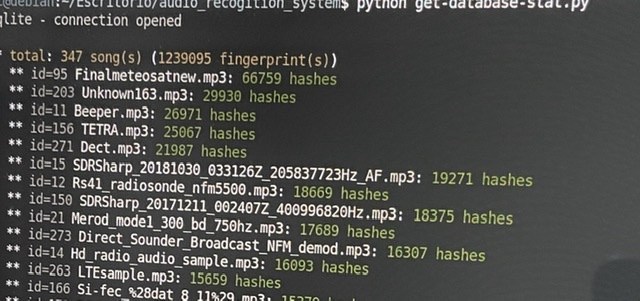
Thank you to José Carlos Rueda for submitting news about his work on converting a "Shazam"-like Python program made originally for song identification into a program that can be used to automatically identify radio signals based on their demodulated audio sounds. Shazam is a popular app for smartphones that can pull up the name of any song playing within seconds via the microphone. It works by using audio fingerprinting algorithms and a database of stored song fingerprints.


Using a similar algorithm to Shazam, programmer Joseph Balikuddembe created an open-source program called "audio_recogition_system" [sic] which was designed for creating your own audio fingerprint databases out of any mp3 files.
José then had the clever idea to take the database of signal sounds from sigidwiki.com, and create an identification database of signal sounds for audio recognition_system. He writes that from his database the program can now identify up to 350 known signals from the sigidwiki database. His page contains the installation instructions and a link to download his pre-made database. The software can identify via audio that is input from the PC microphone/virtual audio cable or from a file.


Saturday, February 01, 2020

AMSAT NEWS SERVICE ANS-033

The AMSAT News Service bulletins are a free, weekly news and
information service of AMSAT North America, The Radio
Amateur Satellite Corporation.  ANS publishes news related to Amateur
Radio in space including reports on the activities of a worldwide
group of Amateur Radio operators who share an active interest in
designing, building, launching and communicating through analog and
digital Amateur Radio satellites.

The news feed on http://amsat.org publishes news of Amateur Radio
in space as soon as our volunteers can post it.

Please send any amateur satellite news or reports to:
ans-editor at amsat dot org.

In this edition:

* HuskySat-1 Deployed, Telemetry Beacon Active
* Free Digital Copy of "Getting Started with Amateur Satellites" Now Available for New or Renewing Members
* Joe Spier, K6WAO, Resigns as AMSAT President
* Melissa Pore To Be Honored at Hamcation February 2020
* W1ANT Pro Satellite Tracker Announced
* AMSAT Argentina Drifting APRS Buoy on 145.825 MHz
* VUCC Awards-Endorsements for February 2020
* Upcoming Satellite Operations
* Upcoming AMSAT Events
* ARISS News
* Satellite Shorts from All Over


SB SAT @ AMSAT $ANS-033.01
ANS-033 AMSAT News Service Weekly Bulletins

AMSAT News Service Bulletin 033.01
From AMSAT HQ KENSINGTON, MD.
February 2, 2020
To All RADIO AMATEURS
BID: $ANS-033.01


HuskySat-1 Deployed, Telemetry Beacon Active

The University of Washington's HuskySat-1 CubeSat was deployed from
the Cygnus NG-12 spacecraft on Friday, January 31 at approximately
2230 UTC.  HuskySat-1's 1,200 bps BPSK beacon is active on
435.800 MHz and is decodable with the latest release of AMSAT's
FoxTelem software.

HuskySat-1 will be made available for Amateur Radio use following its
primary mission to test a pulsed plasma thruster and experimental
K band (24 GHz) communications system.  HuskySat-1 features a 30 kHz
wide 145 to 435 MHz linear transponder for SSB/CW:

HuskySat-1
- Uplink:    145.910 - 145.940 MHz LSB/CW
- Downlink:  435.840 - 435.810 MHz USB/CW (inverting)
- Telemetry: 435.800 MHz 1K2 bps BPSK
            24049.00 MHz (U of Washington experimental downlink)

The TLE as of January 31, 2020 at 2339Z are:

HuskySat-1
1 99934U 1001D    20031.87746807  .00000000  00000-0  00000-0 0    13
2 99934  51.5569 307.6644 0013532 287.5589  72.3913 15.32433103    16

The latest version of FoxTelem software to decode the 1200 bps BPSK
beacon is available at: https://www.amsat.org/tlm

The Fox-In-A-Box FoxTelem software has been updated for HuskySat-1
Operation at it's download website:
http://burnsfisher.com/AMSAT/FoxInABox

[ANS thanks Jerry Buxton, NØJY AMSAT Vice President - Engineering
for the above information.]

--------------------------------------------------------------------

Free Digital Copy of "Getting Started with Amateur Satellites" Now
Available for New or Renewing Members

While the HuskySat-1 completes it's scientific mission, check out the
best resource for learning how to work through linear transponder
satellites (and other types of amateur satellites). For a limited
time, AMSAT is making the "Getting Started With Amateur Satellites"
book available as a download with any paid new or renewal membership
purchased via the AMSAT Store. This offer is only available with
purchases completed online, and for only a limited time. A perennial
favorite, Getting Started is updated every year with the latest
amateur satellite information, and is the premier primer of satellite
operation. The book is presented in PDF format, in full color, and
covers all aspects of making your first contacts on a ham radio
satellite.

Please take advantage of this offer today by visiting the AMSAT store
at https://www.amsat.org/shop/ and selecting any membership option.
While there, check out AMSAT's other items, including the M2 LEOpack
antenna system, Arrow antennas, AMSAT shirts, and other swag. Be sure
to view your cart before going to checkout. If you add a membership
and then go directly to checkout, you'll never see an option to add
your free gift.

If you have trouble selecting your free gift, please see this YouTube
video to see the steps necessary. https://youtu.be/oRqk5Am-UzE

[ANS thanks the AMSAT Office for the above information]

--------------------------------------------------------------------

Joe Spier, K6WAO, Resigns as AMSAT President

Joe Spier, K6WAO, has tendered his resignation as AMSAT President,
citing personal reasons. Spier had served as AMSAT's President since
October 2017. Prior to his tenure as President, Spier served as
AMSAT's Executive Vice President and Vice President - Educational
Relations. He also served as an AMSAT News Service Editor and as a
member of the ARISS Education Team.

Under the AMSAT bylaws, Executive Vice President Paul Stoetzer, N8HM,
assumes the office of President until the next meeting of the Board
of Directors.

Stoetzer said "I want to thank Joe for his many years of service to
AMSAT in a variety of roles. I especially want to recognize his
efforts to mark AMSAT's 50th Anniversary with special events at the
Dayton Hamvention and AMSAT Symposium. His leadership in bringing
together a variety of figures from the history of amateur radio in
space in Arlington, VA this past fall helped to make the Symposium a
very special event."

[ANS thanks the AMSAT Office for the above information]

--------------------------------------------------------------------

Melissa Pore To Be Honored at HamCation February 2020

Melissa Pore, an ARISS-US Education Committee member, recently earned
Orlando HamCation's 2020 Carole Perry Educator of the Year award. She
will be feted at their February convention; the award recognizes
teachers making outstanding educational contributions.

Melissa is an engineering and computer science teacher at
Bishop O’Connell High School in Arlington, VA. She led weeks of STEM
and radio activities leading up to the school’s 2018 ARISS contact.
She heads the school’s engineering and ham radio clubs. At her
previous school, she worked with the STMSAT-1 CubeSat project, the
first satellite built by elementary school students. She helped
staff an ARISS exhibit at the 2019 Space Explorers Education
Conference in Houston and will present a workshop there in 2020. At
the 2019 Space Port Area Conference for Educators, she received a
plaque from the ISS National Lab SSE program citing her “service,
commitment, and desire to push the boundaries of STEM Education.”

She brings her students to staff some of ARISS's outreach exhibits,
such as a 2019 one at the Smithsonian's National Air and Space
Museum Steven F. Udvar-Hazy Center.

[ANS thanks ARISS for the above information.]

--------------------------------------------------------------------

W1ANT Pro Satellite Tracker Announced

Heimir, W1ANT announces that the Pro version has no ads and adds some
features. Most notably the ability to group the satellites. The
groups can then be enabled and only satellites from enabled groups
will show up in the satellite overview.

Other features include:

- Get a list of Amateur Radio satellites visible from your current
  location in the next 24 hours.
- Get an overview over their paths from acquisition to loss of signal
  (AOS to LOS).
- Only passes above the minimum elevation are shown on the list.
- Select one of them and get information on their on-board radios.
- Select one of their radios and be able to point your phone directly
  at it so you can easily operate it.
- Extra information, i.e. the actual frequencies to use for uplink
  and downlink is also presented taken the Doppler effect into
account.

Get full information on the app at the Google Play Store.

[ANS thanks Heimir Thor Sverrisson, W1ANT for the above information.]

--------------------------------------------------------------------


AMSAT Argentina Drifting APRS Buoy on 145.825 MHz

On Thursday, January 30, 2020 at 1400 GMT AMSAT Argentina deployed a
drifting buoy on South Atlantic Seas that aims to transmit APRS on
the satellite packet frequency of 145.825 MHz. WSPR will also be
transmitted.  AMSAT Argentina reports the APRS beacon, callsign
LU7AA-11, will initially be on Argentina's APRS frequency of 144.930
MHz but will change frequency to 145.825 MHz so that it can be
digipeated by the amateur packet radio satellites.  The WSPR beacon
will run 900 mW on 14095.6 kHz with the call sign LU7AA.

Release will be 100 km offshore Mar del Plata coast, seeking east
aiming currents/winds. The objective is to track sea currents
tracking and HF/VHF/SAT QRPp propagation tests.  AMSAT Argentina,
LU7AA, will appreciate WSPR stations receiving/reporting 20M.
Further information and pictures at http://amsat.org.ar?f=buoy

[ANS thanks AMSAT Argentina for the above information.]

+=+=+=+=+=+=+=+=+=+=+=+=+=+=+=+=+=+=+=+=+=+=+=+=+=+=+=+=+=+=+=+=+=+

    AMSAT, along with our ARISS partners, is developing an Amateur
    Radio package, including two-way communication capability, to
          be carried on-board Gateway in lunar orbit.
   Support AMSAT's projects today at https://www.amsat.org/donate/

+=+=+=+=+=+=+=+=+=+=+=+=+=+=+=+=+=+=+=+=+=+=+=+=+=+=+=+=+=+=+=+=+=+

VUCC Awards-Endorsements for February 2020

Here are the endorsements and new VUCC Satellite Awards issued by the
ARRL for the period January 1, 2020 through February 1, 2020.

Congratulations to all those who made the list this month!

KO4MA 1701 1750
WA5KBH 744 759
KE4AL 602 625
WD9EWK (DM43) 597 600
K0FFY 260 576
N1AIA 257 494
G0ABI 320 453
AB5SS 306 411
AD0HJ 375 405
AC9E 353 401
W5TD 392 396
K5IX 350 375
MI6GTY 354 360
W7JSD 336 355
PS8ET 326 350
ND0C 250 301
KJ4EU 206 261
KC9UQR 196 240
W4DTA 180 217
N9FN 194 207
N0RSR 154 200
VE1VOX 155 157
PU4JOE 101 150
WA9JBQ 125 150
K5ZM 101 135
S57NML 100 126
KN6DBC New 125
AB4GE 100 122
XQ3SA New 114
KE0WPA New 108
RA3S New 107
EA2AA New 101
W4ZXT New 100
WR0H New 100


If you find errors or omissions. please contact me off-list at
@.com and I'll revise the announcement. This list was
developed by comparing the ARRL .pdf listings for the two months. It's
a visual comparison so omissions are possible. Apologies if your call
was not mentioned. Thanks to all those who are roving to grids that
are rarely on the birds. They are doing most of the work!

[ANS thanks Ron Parsons, W5RKN for the above information.]

--------------------------------------------------------------------

Upcoming Satellite Operations

Shorts

- Feb 15  CN78  ADODX  FM and Linear (@ad0dx)
- Mar 14-15  DN26/36  KC7JPC  Linears (and possibly FM)

+ SnowBirdRove (EL79) – February 1-29, 2020
Joe, KE9AJ, will cross the border into Florida, seeking climatical
asylum in EL79 for the entire month of February. Since he will be
there for an extended period, with both FM and linear gear, keep an
eye on Joe’s Twitter feed for specific pass announcements:
https://twitter.com/KE9AJ.  There is a possibility that Joe may have
to make a pit stop in EM54 and EM53 on his way down South on
February 1.  Monitor Twitter for updates.

+ Antigua (FK97) February 2 – 9, 2020
Mel, W8MV, will be in Antigua 2-9 February.  Mel is waiting for his
operating license.  Will update as soon as it arrives. FM only. QSL
via LOTW.

+ Key West and Boca Grande Key (EL94, EL84+) February 9-11,2020
Clayton, W5PFG, will be in Key West, Florida (EL94) February 9
through the 11, 2020.  Monday, February 10, 13:15-17:30 UTC, Clayton
will operate FM & SSB satellites from EL84xm, Boca Grande Key.
Listen for W5PFG near these dates for additional Florida grids such
as EL79, EL89, EL99, EL86, EL96, & EL95.  Keep an eye on Clayton’s
Twitter feed for further announcements https://twitter.com/w5pfg

+ Isla Perez, Mexico (EL52, EL50, EL51) February 11 – 17, 2020
Members of Radio Club Puebla DX will be active as 6F3A from Isla
Perez, Mexico, between February 11-17. The operators mentioned are
Patricia/XE1SPM (Team Leader), Ismael/XE1AY, Rey/XE1SRD and
Ricardo/XE1SY. Activity will be on 80/40/20/17/15/12/10/6 meters, and
include the ARRL DX CW Contest (February 15-16). QSL via XE1SY.
Ismael, XE1AY, reports that he doing CW and the satellites, and will
also TX from EL50 and XE1AY/mm from EL51.

+ Big Bend National Park (DL88)  March 16-17, 2020
Ron AD0DX, Doug N6UA, and Josh W3ARD will operate from Big Bend
National Park to put grid DL88 on the air.  Details will be added
here, as they come available, but you are more than welcome to keep
an eye on their individual Twitter feeds: https://twitter.com/ad0dx,
https://twitter.com/dtabor, and https://twitter.com/W3ARDstroke5

[ANS thanks Robert Bankston, KE4AL for the above information.]

+ DX Satellite Operations on QO-100

Matteo, IZ4YGS will be QRV as 9G5GS from Sanzule, Ghana from
February 1 - 26. He plans some activity on Satellite QO-100.  QSL
direct to home call.

Special event station II3BIA will be QRV from February 1 - 29 during
the Biathlon World Championships 2020 being held in Antholz.
Activity includes possible activity on Satellite QO-100.
QSL via IN3ZWF.

[ANS thanks ARRL DX News for the above information.]

+ FJ, ST. BARTHEMELY. Operators Pat/N2IEN, Lee/WW2DX, Rock/WW1X and
Ray/W2RE will be active as FJ/N2IEN, FJ/WW2DX, FJ/WW1X and FJ/W2RE
respectively from St. Barthemely (NA-146) between February 15-22.
Activity will be holiday style on various HF (160-6m)/VHF/UHF bands
using CW, SSB, RTTY and satellites. QSL via their home call signs.

[ANS thanks the Ohio/Penn DX Bulletin for the above information.]

+ ZS95SARL celebrates the 95th anniversary of the South African
Radio League, founded in May 1925 as South African Radio Relay
League(renamed after WW II). QRV during the whole year on HF, VHF,
UHF and via satellites. QSL via bureau.

[ANS thanks the DARC DX Newsletter for the above information.]

--------------------------------------------------------------------

Upcoming AMSAT Events

AMSAT Ambassadors provide presentations, demonstrate communicating
through Amateur satellites, and host information tables at club
meetings, hamfests, conventions, maker faires, and other events.

Current schedule:

- February 7-9, 2020, Hamcation, Orlando, FL
- February 14-15, 2020, Yuma Hamfest and ARRL Southwest Division
  Convention, Yuma, AZ
- February 15, 2020, Cabin Fever Reliever Hamfest, Saint Cloud, MN
- March 6, 2020, Irving Hamfest, Irving, TX
- March 14-15, 2020, Science City on University of Arizona,
  Tucson, AZ
- March 21, 2020, Midwinter Madness Hamfest, Buffalo, MN
- March 21, 2020, Scottsdale Amateur Radio Club Hamfest,
  Scottsdale, AZ
- March 28, 2020, Tucson Spring Hamfest, Tucson, AZ
- March 29, 2020, Vienna Wireless Winterfest, Annandale, VA
- May 2, 2020, Cochise Amateur Radio Association Hamfest,
  Sierra Vista, AZ
- May 8-9, 2020 Prescott Hamfest, Prescott, AZ
- May 15-17, Hamvention, Xenia, OH
- June 12-13, 2020, Ham-Con, Plano, TX

+=+=+=+=+=+=+=+=+=+=+=+=+=+=+=+=+=+=+=+=+=+=+=+=+=+=+=+=+=+=+=+=+=+

  AMSAT's GOLF-TEE satellite recently reached a major milestone
  when prototype boards transmitted telemetry for the first time.
     Help support AMSAT's path back to HEO by donating today!

   https://www.amsat.org/donations/amsat-golf-program-donations/

+=+=+=+=+=+=+=+=+=+=+=+=+=+=+=+=+=+=+=+=+=+=+=+=+=+=+=+=+=+=+=+=+=+

ARISS News

+ Upcoming School Contacts

Possible Russian supported contact with Ecuador, via TBD.
The ISS callsign is presently scheduled to be RSØISS
The scheduled astronaut is Oleg Skripochka
Contact possibly is go for Friday, February 7, 2020 UTC.

+ ARISS congratulations Satoshi 7M3TJZ who has now mentored
138 schools.

+ The following US states and entities have never had an ARISS
contact: South Dakota, Wyoming, American Samoa, Guam, Northern
Marianas Islands, and the Virgin Islands.

[ANS thanks Charlie Sufana, AJ9N  for the above information.]

--------------------------------------------------------------------

Satellite Shorts from All Over

+ AMSAT-Spain Readies Two Satellites

The Hades and EASAT-2 PocketQubes from AMSAT-Spain will carry VHF/UHF
linear transponders and analog and digital two-way communications
capability, including store-and-forward. Launch is planned for late
2020. More information is available at https://amsat-ea.org

[ANS thanks AMSAT-EA for the above information.]

+ Training course: Product Assurance in ESA projects for SMEs

On March, 31 to April 1, 2020 the European Space Agency invites
participants interested in either Hardware or Software Product
Assurance (PA) to join its specialists for a two-day training
session at ESA/ESTEC (Noordwijk, The Netherlands).  The course aims
at providing SME participants with an overview of the PA tasks to be
performed throughout a project. While a generic overview of Product
Assurance tasks is provided to all participants on day 1, day 2
treats Hardware and Software PA aspects in more detail. Participants
choose either the Hardware PA or Software PA module, depending on
their needs and interests.  More information and registration is
available at https://tinyurl.com/ANS-033-ESA-PA

[ANS thanks the ESA for the above information.]

--------------------------------------------------------------------

In addition to regular membership, AMSAT offers membership in the
President's Club. Members of the President's Club, as sustaining
donors to AMSAT Project Funds, will be eligible to receive
additional benefits. Application forms are available from the
AMSAT office.

Primary and secondary school students are eligible for membership at
one-half the standard yearly rate. Post-secondary school students
enrolled in at least half time status shall be eligible for the
student rate for a maximum of six post-secondary years in this
status.

Contact Martha at the AMSAT office for additional student
membership information.

73,

This week's ANS Editor,

Frank Karnauskas, N1UW
n1uw at amsat dot org
_______________________________________________
Via the ANS mailing list courtesy of AMSAT-NA
https://www.amsat.org/mailman/listinfo/ans

Friday, January 31, 2020

Jonathan's Space Report, No. 774

Jonathan's Space Report
No. 774                                                           2020 Jan 31  Somerville, MA
---------------------------------------------------------------------------------------------

International Space Station
---------------------------

Expedition 61 continues.

On Dec 23 the BCDU FRAM (the adapter for the recently used spare BCDU) was moved
from the Dextre EOTP to the CRS-19 Dragon trunk, where it will be destroyed on
reentry.

On around Dec 27, the failed MSBU S/N C250636 (brought inside on Sep 5) and
the failed BCDU S/N 011 (brought inside on Oct 18)  were transferred to the CRS-19
Dragon's cabin for return to Earth.

On Dec 27 at 0128 and 0436 UTC the Progress MS-13 cargo ship docked to the Pirs module
fired its engines to raise the ISS orbit from 411 x 422 km to 415 x 422 km.

On Jan 3 to 4 the Dextre arm was used to transfer the Space Debris
Sensor (SDS) and SOLAR payloads from the Columbus external payload
facility to external attachment points on the PCM module of the S.S.
Alan Bean (Cygnus NG-12) cargo ship for reentry disposal. SDS was
launched in 2017 on Dragon CRS-13, but failed in Jan 2018. SOLAR was
launched on STS-122 in 2008. On Jan 6 a Resupply Stowage Platform
(possibly RSP 1008/SE177, launched on STS-131) was moved from the PMM1D3
rack location to the Bean's pressurized module for disposal.

On Jan 7 at about 0500 UTC the Canadarm-2 unberthed the Dragon CRS-19
ship from the Harmony module. Dragon was released back into orbit at
1005 UTC, and performed three separation burns between 1008 and 1020
UTC. The plume from one of those firings  was reported to have made the
Cygnus NG-12 solar arrays wobble, which is something one tries to avoid.
Dragon fired its thrusters to deorbit at 1451 UTC until 1504 UTC,
jettisoned the trunk section at 1508 UTC and entered the atmosphere at
1524 UTC with splashdown near 121.0W 31.2N at 1542 UTC.

On Jan 15 astronauts Koch and Meir, in suits EMU 3004 and 3008, made
spacewalk US EVA-62 to continue battery replacements from the EP8 pallet
to the P6 truss 4B channel. The airlock was depressurized from 1130 to
1904 UTC. Transfers made were:

 NiH 0104 from P6 4B1 to EP8-Z
 Li-ion 21 from  EP8-F to P6 4B1
 NiH 0106 from P6-4B2 to EP8-F
 Adapter plate 0014 from EP8-F to P6 4B2
 NiH 0101 from P6-4B3 to P6-4B2 on top of the adapter plate
 Li-ion 22 from EP8-E to P6-4B3
 NiH 0103 from P6-4B4 tp EP8-Y

On Jan 20  Meir and Koch completed the P6 4B battery work with US EVA-63. The airlock
was depressurized from 1127 to 1833 UTC. Transfers made were:
 Adapter plate 0013 from EP8-E to P6-4B4
 NiH 0098 from P6-4B6 to P6-4B4 on top of the adapter plate
 Li-ion 23 from EP8-C to P6-4B6
 NiH 0102 from P6-4B5 to EP8-C
 Adapter plate 0011? from EP8-C to P6-4B5

On Jan 23 at 1415 and 1723 UTC Progress MS-13 fired its engines to
raise the ISS orbit by about 1 km.

On Jan 25 astronauts Morgan (EV1/EMU 3004) and Parmitano (EV2/EMU 3008)
made US spacewalk EVA-64 to complete repairs to the AMS-02 experiment.
The airlock was depressurized from 1158 to 1820 UTC. The crew performed
leak checks on the new cooling system. Leaks were found in cooling line
number 5, and after a couple of cycles of tightening the connector the
leak was stopped. An insulation `tent' was placed over the system. After
the AMS-02 work, camera lens covers on the CP8 and CP9 external cameras
were removed.


CZ-5
----

China's largest rocket, the Chang Zheng 5, made a successful third flight on Dec 27,
after a major engine rework following the failure of the second flight in July 2017.
The CZ-5 second stage put the Shi Jian 20 communications satellite in supersync
transfer orbit. SJ-20 was on station in GEO at 115E by Jan 6.

Jilin-1 KF-1
------------

On Jan 15 China's SAST launched a CZ-2D with Chuanguang's biggest
satellite to date, the 1.5t Jilin-1 Kuanfu-1. The rocket also placed
three smaller satellites in orbit, two Satellogic Nusat imagers (Sophie
and Marie)  and Guodian Gaokeji's Tianqi-5.

Ariane 5
--------

On Jan 16 Arianespace launched another Ariane 5ECA, putting Eutelsat Konnect
and GSAT-30 in geotransfer orbit. Eutelsat Konnect is a Ka-band payload
for the European operator Eutelsat; GSAT-30 is a Ku/C band satellite
for the Indian space agency ISRO.


Starlink
--------

The third launch of 60 Starlink satellites, V1.0 Batch 2, was orbited on Jan 7.

As I have previously reported, the unexpected brightness of Starlink
satellites has caused widespread concern among astronomers. Thousands of
such satellites could dominate the visible view of the night sky in dark
areas; the bright satellites crossing the field of view of astronomical
detectors could cause bright streaks, electronic cross-talk and `ghost
images' compromising deep exposures of faint objects. At a meeting of
the American Astronomical Society in January,  SpaceX representatives
seemed confident they would be able to reduce the brightness of future
satellites so that they would no longer be naked eye objects, and
expressed committment to iterative improvements to address the concerns
of professional astronomers. I welcome the willingness of SpaceX to address
the issue (nevertheless, I do think some formal regulations on light pollution
are needed, because other constellations will also be an issue).

The latest launch includes a modified satellite, Starlink 1130, with a
special dark coating  on the bus to reduce its brightness. This
satellite will be used to improve SpaceX's models of satellite light
scattering, allowing engineers to evaluate design improvements for
future versions of the satellite.

It will be important to get visual magnitude estimates of Starlink 1130
once it reaches its operational orbit.

As with V1.0 Batch 1, the 60 satellites were split into three groups,
with orbit raising of two of the groups pausing at 350 km to precess to
different orbital planes.

Stage 2 of the Falcon 9 was deorbited south of Australia, reentering
at approximately 0448 UTC Jan 7 after 1.6 orbits.


The fourth launch, V1.0-L3, placed a further 60 satellites in 280 km
orbit on Jan 29.


TJS 5
------

On Jan 7 China launched the Tongxing Jishu Shiyan 5 satellite to
geotransfer orbit. The TJS series of `experimental communications
satellites' is believed to be a cover for a range of military programs,
and TJS 5 appears to be an SAST/Shanghai `Houyan' early warning
satellite like 2017's TJS 2.

Crew Dragon
-----------

Crew Dragon C205 was launched from KSC LC39A at 1530 UTC Jan 19 on a Falcon 9
for the Inflight Abort Test.

A preplanned shutdown of core stage B1046 at 90s into flight triggered
an inflight abort and the Super Draco thrusters pushed Dragon to a 44 km apogee
followed by a parachute-aided splashdown in the Atlantic. The Falcon 9
disintegrated in flight 7 seconds after separation.

Spitzer
-------

SIRTF, the Space Infrared Telescope Facility, was launched in Aug 2003.
In Dec 2003 it was renamed the Spitzer Space Telescope, the 4th and last
of the Great Observatories program. After 16 years of great science,
Spitzer entered final safemode and fell silent at 2215:45 UTC Jan 30.

IRAS/POPPY-5B
-------------

On Jan 29 at 2339 UTC two defunct satellites had a very near miss -
probably  less than 100 metres apart. The IRAS astronomical satellite,
which operated from 1983 to 1985, and the NRO/NRL POPPY 5B signals
intelligence satellite (codenamed GGSE 4), which operated from 1967 to
1972, passed each other at a relative velocity of 14.7 km/s.

Errata
------

Danna Barnett informs me that Tyvak-0092 is actually built for Israel's Elbit Systems
and not for an Italian company. Elbit calls the satellite NANOVA; it has a UHF comm
payload.

The dual-engine Centaur on the Atlas V N22 uses the RL10-A4-2 engine, not RL10-A4-1.


Table of Recent Orbital Launches
 ----------------------------------
Date UT       Name            Launch Vehicle        Site            Mission       INTL.   Catalog  Perigee Apogee  Incl   Notes

Dec  5 1729   Dragon CRS-19               Falcon 9           Canaveral SLC40 Cargo     83A S44821    203 x   378 x 51.7
Dec  6 0800?  Kosmos-2543?                              Kosmos-2542, LEO     Inspector 79D S44835    368 x   858 x 97.9
Dec  6 0818   ALE-2     )                 Electron           Mahia LC1       Tech      84A S44824    397 x   415 x 97.0
              NOOR 1A   )                                                    Com       84D S44827    348 x   403 x 97.0
              NOOR 1B   )                                                    Com       84E S44828    348 x   403 x 97.0
              SMOG-P    )                                                    Sigint    84J S44832    348 x   403 x 97.0
              TRSI-Sat  )                                                    Tech      84H S44831    348 x   403 x 97.0
              FossaSat-1)                                                    Tech      84F S44829    348 x   403 x 97.0
              ATL-1     )                                                  Sigint/Tech 84G S44830    348 x   403 x 97.0
Dec  6 0934   Progress MS-13              Soyuz-2-1A         Baykonur LC31   Cargo     85A S44833    186 x   219 x 51.6
Dec  7 0255   Jilin-1 Gaofen 02B          Kuaizhou-1A        Taiyuan         Imaging   86B S44837    531 x   544 x 97.5
Dec  7 0852   HEDE-2A   )                 Kuaizhou-1A        Taiyuan         Comms     87  S44839    495 x   511 x 97.4
              HEDE-2B   )                                                    Comms     87            495 x   511 x 97.4
              Tianqi-4A )                                                    Comms     87            495 x   511 x 97.4
              Tianqi-4B )                                                    Comms     87            495 x   511 x 97.4
              Tianyi-16 )                                                    Imaging   87            495 x   511 x 97.4
              Tianyi-17 )                                                    Imaging   87            495 x   511 x 97.4
Dec 11 0854   Kosmos-2544                 Soyuz-2-1B/Fregat  Plesetsk LC43/3 Nav       88A S44850  19125 x 19150 x 64.8
Dec 11 0955   RISAT-2BR1)                 PSLV-QL            Satish Dhawan   Radar     89F S44857    564 x   574 x 37.0
              Izanagi   )                                                    Radar     89E S44856    568 x   579 x 37.0
              1HOPSAT   )                                                    Imaging   89            568 x   579 x 37.0
              Duchifat-3)                                                    Tech      89C S44854    568 x   579 x 37.0
              Tyvak-0092)                                                    Comms     89A S44852    568 x   579 x 37.0
              Tyval-0129)                                                    Tech      89            568 x   579 x 37.0
              Lemur-2-HiMomAndDad)                                           AIS/Met   89J S44860    568 x   579 x 37.0
              Lemur-2-Pappy      )                                           AIS/Met   89K S44861    568 x   579 x 37.0
              Lemur-2-JPGSquared )                                           AIS/Met   89D S44855    568 x   579 x 37.0
              Lemur-2-Theodosia  )                                           AIS/Met   89M S44863    568 x   579 x 37.0
Dec 16 0722   Beidou DW 52 )             Chang Zheng 3B/YZ1  Xichang LC3     Nav       90A S44864  21528 x 22192 x 55.0
              Beidou DW 53 )                                                 Nav       90B S44865  21528 x 22192 x 55.0
Dec 17 0010   JCSAT-18/Kacific-1         Falcon 9            Canaveral SLC40 Comms     91A S44868    272 x 20319 x 26.9
Dec 18 0854   CSG 1   )                  Soyuz ST-A/Fregat   CSG ELS         Radar     92A S44873    622 x   623 x 97.8
              CHEOPS  )                                                      Astronomy 92B S44874    698 x   709 x 98.2
              ANGELS  )                                                      Comms     92D S44876    508 x   527 x 97.4
              EyeSat  )                                                      Astronomy 92E S44877    508 x   527 x 97.4
              OPS-SAT )                                                      Tech      92F S44878    508 x   527 x 97.4
Dec 20 0322   CBERS-4A     )             Chang Zheng 4B      Taiyuan         Imaging   93A S44879    615 x   635 x 98.0
              ETRSS-1      )                                                 Imaging   93
              Tianqin-1    )                                                 Sci/Tech  93
              BDSAGR-1     )                                                 Imaging   93
              Yuheng       )                                                 Comms     93
              Shuntian     )                                                 Comms     93
              Yizheng 1    )                                                 Imaging   93
              Xingshidai 8 )                                                 Imaging   93
              FloripaSat-1 )                                                 Tech      93G S44485    614 x   635 x 98.0
Dec 20 1136   Starliner OFT              Atlas V N22         Canaveral LC41  Spaceship 94A S44900    180 x   221 x 51.6
Dec 24 1203   Elektro-L No. 3            Proton-M/DM-03      Baykonur LC81/24 Weather  95A S44903  35372 x 35571 x  0.6
Dec 26 2312   Gonets-M No. 24            Rokot               Plesetsk LC133/3 Comms    96A S44905   1500 x  1508 x 82.5
              Gonets-M No. 25                                                 Comms    96B S44906   1500 x  1508 x 82.5
              Gonets-M No. 26                                                 Comms    96C S44907   1500 x  1508 x 82.5
Dec 27 1245   Shi Jian 20                Chang Zheng 5       Wenchang         Comms    97A S44910    180 x 67690 x 19.4
Jan  7 0219   Starlink 1066      )       Falcon 9            Canaveral SLC40  Comms    01AS S44954   301 x   305 x 53.0
              Starlink 1069-1104 )                                            Comms    )
              Starlink 1106-1119 )                                            Comms    )
              Starlink 1121-1126 )                                            Comms    )
              Starlink 1128      )                                            Comms    ) 01A-01BM
              Starlink 1130      )                                            Comms    ) 44914-
              Starlink 1144      )                                            Comms    ) 44973
Jan  7 1520   TJS 5                      Chang Zheng 3B      Xichang          Comms    02A S44978    195 x 35804 x 27.5
Jan 15 0253   Jilin-1 Kuanfu 1 )         Chang Zheng 2D      Taiyuan          Imaging  03A S45016    477 x   492 x 97.3
              Sophie           )                                              Imaging  03B S45017    475 x   492 x 97.3
              Marie            )                                              Imaging  03C S45018    477 x   493 x 97.3
              Tianqi-5         )                                              Comms    03D?S45019    475 x   492 x 97.3
Jan 16 0302   Yinhe 1                    Kuaizhou 1A         Jiuquan          Comms    04A S45024   1200 x  1213 x 80.0?
Jan 16 2105   Eutelsat Konnect )         Ariane 5ECA         Kourou ELA3      Comms    05B S45027    499 x 36234 x  6.0
              GSAT-30          )                                              Comms    05A S45026  35775 x 35799 x  0.1
Jan 29 1406   Starlink 1120     )        Falcon 9            Canaveral SLC40  Comms    )
              Starlink 1127     )                                             Comms    )
              Starlink 1129     )                                             Comms    )
              Starlink 1131-1137)                                             Comms    ) 06A-06BM    272 x   292 x 53.0
              Starlink 1139-1142)                                             Comms    )
              Starlink 1145-1153)                                             Comms    )
              Starlink 1155-1186)                                             Comms    )
              Starlink 1190     )                                             Comms    )
              Starlink 1193-1196)                                             Comms    )

Table of Recent Suborbital Launches
-----------------------------------

On Jan 7 Iran launched a series of Zulfiqar and Qiam-1 missiles against US military targets in Iraq.
The exact number and mix of missiles is unknown.


Date UT       Payload/Flt Name Launch Vehicle      Site                  Mission    Apogee/km    Target

Dec 10 0930   CHI               Black Brant IX       Svalbard            Ionosphere    360       Arctic
Dec 11 1753   New Shepard NS12  New Shepard          West Texas          Test          105       West Texas
Dec 12 1630   IRBM Test         Castor 4B?           Vandenberg TP-01    Test          500?      Pacific
Jan  7 2245?  HE Warhead        Zulfiqar             ?, Iran             Weapon        100?      Al Asad, Iraq
Jan  7 2245?  HE Warhead        Zulfiqar             ?, Iran             Weapon        100?      Erbil, Iraq
Jan  7 2245?  HE Warhead        Zulfiqar             ?, Iran             Weapon        100?      Al Asad, Iraq
Jan  7 2245?  HE Warhead        Qiam-1               ?, Iran             Weapon        100?      Al Asad, Iraq
Jan  7 2315?  HE Warhead        Zulfiqar             ?, Iran             Weapon        100?      Al Asad, Iraq
Jan  7 2315?  HE Warhead        Zulfiqar             ?, Iran             Weapon        100?      Erbil, Iraq
Jan  7 2315?  HE Warhead        Qiam-1               ?, Iran             Weapon        100?      Erbil, Iraq
Jan  9 0800   S-310-45          S-310                Uchinoura           Test          131       Pacific
Jan 19        RV                K-4                  Visakhapatnam       Test          500?      Indian Ocean
Jan 27 1340   Polar NOx 2       Black Brant 9        Poker Flat          Aeronomy      260       Alaska

-------------------------------------------------------------------------.
|  Jonathan McDowell                 |                                    |
|  Somerville MA 02143               |  inter : planet4589 at gmail       |
|  USA                               |  twitter: @planet4589              |
|                                                                         |
| JSR: https://www.planet4589.org/jsr.html                                 |
| Back issues:  https://www.planet4589.org/space/jsr/back                  |
| Subscribe/unsub: https://www.planet4589.org/mailman/listinfo/jsr         |
'-------------------------------------------------------------------------'

_______________________________________________
JSR mailing list
JSR@www.planet4589.org
http://www.planet4589.org/mailman/listinfo/jsr

To unsubscribe, email jsr-leave@www.planet4589.org