Thursday, October 26, 2006

Stereo Spacecraft Launched

There was a spectacular night launch onboard a Delta 7925 from Cape Canaveral launch pad LC17B last night (26 Oct 2006) at 0052 UTC. The rocket carried two solar science spacecraft, Stereo A (2006-47A/29510) and Stereo B (2006-47B/29511) into orbit.

STEREO's are nearly identical twin, golf cart-sized spacecraft that will make observations to help researchers construct the first-ever three-dimensional views of the sun. The images will show the star's stormy environment and its effects on the inner solar system, vital data for understanding how the sun creates space weather."

Communications package (X-Band), These are not exact freqs for each spacecraft listed below. The RF telecomm hardware on each spacecraft is identical except for their uplink and downlink frequencies. Downlink 8440 MHz, Uplink 7189 MHz, Data Format CCSDS.

You can learn more about these spacecraft and mission at
http://www.nasa.gov/mission_pages/stereo/main/index.html

Friday, October 13, 2006

HFLINK SPECIAL BULLETIN

==HFLINK SPECIAL BULLETIN==

ALE On-The-Air Week 13-23 October AOTAW-2006
"The Automatic Link Establishment International QSO Party"
START: 0001 UTC 13 October 2006
END: 2359 UTC 23 October 2006

HFLINK sponsors this new International Amateur Radio event. All ham radio operators worldwide are invited to participate in 10 days of amateur radio HF-ALE Automatic Link Establishment activity on the air. "AOTAW" is an open operating event for hams to explore ALE communications and equipment. The experience gained by operator participation is useful for HF emergency and disaster relief communications.

There are now hundreds of amateur radio operators worldwide with ALE stations. The AOTAW gives operators a chance to exercise ALE transceivers, antennas, software, systems, and operating procedures.

ALE OPERATOR CERTIFICATE for AOTAW 2006 HFLINK issues a unique ALE Operator Certificate to operators who participate in AOTAW. To qualify for an ALE Operator Certificate, the operator must initiate and complete at least 5 QSOs through Automatic Link Establishment with other ALE operators. The ALE link must then be followed by communication either by voice or texting in any mode. Additional certificate endorsements are issued by HFLINK for operators who link with 25 stations or more.

LOGS:To qualify for a certificate, please send a Date/Callsign/Frequency log of your ALE QSOs by 31 DEC 2006 via email to: aotaw2006@ yahoo.com The certificate will be returned via direct email.

OPERATING STANDARDS FOR AOTAW
All operators are reminded to be courteous and operate within the recognised Amateur Radio ALE channels and standards. Please remember, AOTAW is not a contest, there is no score. AOTAW is intended to provide a way for more operators to gain valuable practical knowledge and expertise in the operation of an Amateur Radio ALE station.

CQ - NETCALLS, ALLCALLS, ANYCALLS
1. NETCALLS: "HFL" net or "QRZ" net may be used as the general CQ calls for the event.
2. ALLCALL: SHOULD NOT BE USED in AOTAW. A QSO started by an ALLCALL does not qualify as a valid ALE link.
3. ANYCALL: Anycalls may be used. But remember, many ALE stations are not programmed to respond to Anycalls.

RECOMMENDED ALE QSO PROCEDURE AND MODES
1. Call CQ: Transmit a CALL> NETCALL to either the "HFL" net or the"QRZ" net. Wait at least 1 minute for responses.
2. Call a station: Transmit an INDIVIDUAL CALL to the station. It maybe necessary to first add the station's callsign (address) to your ALE address list.
3. Upon linking on a VOICE channel, then use USB Voice for the QSO.
4. Upon linking on a DIGITAL channel, then send a short AMD message with the linked station. 5. When QSO is completed, transmit the CLEAR LINK signal.

STANDARDS FOR DIGITAL TEXT QSO
After initial ALE link on a DIGITAL channel, use the universal short text message for ALE, called AMD. An AMD message request to the other operator can ask for other digital text keyboarding, such as:

ALE AMD: is the "universal" ALE text message system.
DTM ARQ: only by stations who are using PC-ALE or MARS-ALE software.
PSK31: (1500Hz centre) ask operator first via AMD.
Olivia: (1500Hz centre, 500/16) ask operator first via AMD.
CW: ask operator first via AMD.

ABOUT AOTAWAmateur operators who use ALE for government and non-governmental organisations may be especially interested in participation, for itprovides more chance to work with ALE linking and greater understanding of the system. It is a chance for operators to explore the various operational aspects of ALE that may not be utilised otherwise in a more structured organisation ALE network. The 10 days of AOTAW enables operators to participate as they can, for any amountof time in the event, and to experience ALE operation under various ionospheric propagation conditions. More information: HFLINK WEBSITE http://hflink.com

Thursday, October 05, 2006

New ITU Intl Monitoring #311 Available Online


An interesting HF spectrum resource sometimes overlooked by radio hobbyist and is available for free every quarter is the ITU International Monitoring Publication. This publication has some really interesting intercepts that would interest the SW broadcast and ute DXer.

The new bulletin #311 that covers the period 1 Jul 2006 to 30 Sep 2006 (85 pages in pdf format) has been released. You can download that file at http://www.itu.int/ITU-R/terrestrial/monitoring/files/pdffiles/311.pdf

Numbers Stations Newsletter Online

If you are interested in the shortwave numbers stations and other oddities, you will want to check out the latest Numbers and Oddities newsletter.


Numbers & Oddities #109 is now online at http://home.luna.nl/~ary. Click on the download section for this issue and archives.

Wednesday, October 04, 2006

Athens Tennessee Police to Encrypt Fulltime

Blog Editor Note: The encryption that Athens uses is a simple voice inversion scheme. While I won't point to any specifics, there are no cost and low cost capability available on the internet to decode these transmissions.

Bottom line: The Athens Police should be investigated for fraud, waste and abuse. As pointed out in the article below, this system was purchased with federal funds. This is NOT an interoperable system as the article clearly points out. So why was this department allowed to purchase a non-P25 system in this post 9/11 age with federal money?


Originally published in the Daily Post Athenian
By Jeremy Belk
Staff Writer Local News

Police scanner enthusiasts can no longer listen to the Athens Police Department now that the switch has been made to an encrypted radiocommunications system.

APD is switching its 55 portable and patrol unit radios over to an encrypted radio system, which scrambles transmissions received by police scanners and radios that do not have a special descrambling board installed inside.

Chief Chuck Ziegler said the transition to a completely encrypted system will take a few weeks to complete and get problems resolved.

Ziegler said the department is making the change because law breakers often use police scanners to monitor radio traffic as a way to avoid getting caught.

"It has become very common for criminals, such as drug dealers, meth manufacturers and burglars, to use commonly purchased radio scanners as counter surveillance," Ziegler said. "We´ve found in Athens people are able to monitor our radio traffic to determine patrol zones and what officers are on duty." [Duh!-LVH]

Ziegler described the encryption board which is being used as "like a copyright." He said no one can purchase a board to descramble APD transmissions without the department´s approval.
Scanner traffic from APD first went from normal voice transmission to a series of garbled speech and rhythmic noise starting on Sept. 11. Ziegler said he has already heard complaints from people in the community who enjoy listening to law enforcement traffic.

"The unfortunate side to this is there are a lot of people who enjoy listening to what the police department does," Ziegler said. "However, the same info is being used as counterintelligence by criminals."

Ziegler said it is amazing at the amount of people who have scanners. He said often times officers will be called to a disturbance or aparty and when they arrive nothing is happening because someone at the location had been listening to a scanner and alerted others that the police were on the way.

Secure communications, according to Ziegler, is a necessity in policework.

APD officers and dispatchers can still communicate with other agencies by switching the encryption off.

Many of the officers said the system has bugs that need to be worked out. McMinn County E-911 Director Jim Davis said the Athens Police Department using encryption will not affect county dispatchers and he supports the department´s decision to switch to an encrypted radio signal.

"The only problem we will at the E-911 dispatching is we will not be able to monitor city police traffic when they are encrypted," Davis said.

APD Patrol Capt. Rob Davis said if an APD officer needs to contact an outside agency the encryption could be turned off to use another channel on the scanner or the Athens dispatch center could contact the appropriate agency.

Davis said in the case of an emergency, such as a tornado or other natural disaster, encryption could be turned off on the radios; however, the intent is to use encryption on all radio communication.

Davis said the department has received a few complaints from citizens asking why their communications were scrambled.

Funding for the new scanners came from federal forfeiture money the city received from the White Spider prostitution sting. A local massage parlor was raided by local and federal law enforcement inconjunction with a nationwide investigation to illegal activities in massage parlors located across the country.

E-mail: jbelk@xtn.net

Wednesday, September 20, 2006

New ham crew/female civilian visitor heading to ISS

The next International Space Station crew plus the first female civilian visitor to the ISS lifted off from Kazakhstan early September 18. NASA astronaut and Expedition 14 crew commander Michael Lopez-Alegria, KE5GTK, and Russian cosmonaut Mikhail Tyurin, RZ3FT, will take over for the Expedition 13 crew of astronaut Jeff Williams, KD5TVQ, and cosmonaut Pavel Vinogradov, RV3B. Along for the ride as a paying passenger aboard the Soyuz TMA-9 "taxi flight" is US business woman Anousheh Ansari, who will visit the ISS for about 10 days under a contract with the Russian Federal Space Agency.

The Soyuz rocket carrying Expedition 14 and Ansari took off from Baikonur Cosmodrome. The trio should arrive at the space station early on September 20. This will mark Tyurin's second time as a space station crew member. He was part of ISS Expedition 3 in 2001.

Remaining onboard the ISS for part of Expedition 14 will be European Space Agency astronaut Thomas Reiter, DF4TR. The Amateur Radio on the International Space Station (ARISS) program says Ansari, 39, will attempt some Amateur Radio contacts during her stay in space. A tentative schedule calls for her to speak with students at George Washington University, her alma mater, on Friday, September 22. Jeff Williams will serve as a control operator for that event. In addition, ARRL ARISS Liaison Rosalie White, K1STO, says Ansari wants to speak with US-licensed school children in random QSOs. Using the RS0ISS call sign, Ansari is expected to be on the air at various times from Thursday, September 21, until Tuesday, September 26. The worldwide downlink frequency is 145.800 MHz. The FM voice uplink is 144.490 MHz in ITU Regions 2 and 3 (the Americas and the Pacific) and 145.200 MHz in Region 1 (Europe, Central Asia and Africa). Ansari, who's standing in for Daisuke "Dice-K" Enomoto as the fourth private citizen to fly to the ISS, has been trained in use of the ARISS gear but was unable to get her license because of her accelerated training schedule.

Information above courtesy of the ARRL and Space Bulletin ARL008 bulletin from Newington.

Saturday, September 16, 2006

Hydraulic malfunction faulted in CubeSat launch failure

Hydraulic malfunction faulted in CubeSat launch failure: The commission probing the July 26 Dnepr-1LV rocket launch vehicle failure that resulted in the loss of more than a dozen CubeSats with ham radio payloads believes it knows why the vehicle didn't reach orbit.

A brief malfunction of a hydraulic drive in a first-stage propulsion unit caused a deviation in the rocket's trajectory and "the issuance of a command to abort the flight," said a news release from Kosmotras, the company responsible for the rocket's launch. Kosmotras said the cause of the hydraulic malfunction has been determined, and the committee is "working up recommendations for its rectification." Russia, meanwhile, has suspended further Dnepr-1 LV launches.

Fourteen of the tiny spacecraft that were lost carried Amateur Radio VHF or UHF beacon or telemetry transmitters. Various accounts indicated that the mission went awry less than two minutes after liftoff. The CubeSat project was a collaboration between California Polytechnic State University-San Luis Obispo and Stanford University's Space Systems Development Laboratory. All of the CubeSats were designed and built by students at various universities around the world.--some information from AMSAT News Service.

Courtesy of The ARRL Letter Vol. 25, No. 36, September 8, 2006

Broadcasters urged to end "Battle on Ham Bands"

IARU, MEMBER-SOCIETIES WANT BROADCASTERS TO END "BATTLE ON THE HAM BANDS"

As the so-called "Firedragon" jammer continues to transmit in one or more Amateur Radio bands, the International Amateur Radio Union (IARU) and three of its Region 3 member-societies so far have appealed to the jammer's target to move elsewhere. The Firedragon's all-music transmissions from thePeople's Republic of China (PRC) appear aimed at blocking the much-weaker broadcasts of the clandestine "Sound of Hope" (SOH), located outside the PRC.

Responding via e-mail September 5 to an inquiry from IARU Region 1 Monitoring System (IARUMS) Vice Coordinator Uli Bihlmayer, DJ9KR, the SOH said its supporters use various avenues "including Amateur Radio frequencies" to get their message into the PRC.

"Through our investigation, we learned that the transmissions of SOH programs through Amateur Radio frequencies come from areas around China, and they each only target a local area of China with very low power, only for the intended audience and would interfere with nobody else," said SOH's Yue Chen. Yue addressed the reply to "All Amateur Radio Community Members" and indicated it was copied to the International Telecommunication Union (ITU), although no ITU addressee was displayed. Yue encouraged the Amateur Radiocommunity to "openly urge the Chinese government to stop this outrageous act of radio jamming" and to urge the ITU to take action as well.

Wireless Institute of Australia (WIA) Director Glenn Dunstan, VK4DU, told the Sound of Hope via e-mail this week that if it wants the support of the international community, it should move its transmissions into legitimate broadcasting spectrum."There is more than enough radio spectrum for you to use outside of the Amateur Radio bands," Dunstan said September 5. "You are in breach ofinternational radio regulations."

A similar reaction came September 6 from Amateur Radio Society of India (ARSI) Monitoring System Coordinator B.L. Manohar Arasu, VU2UR, who pointed the finger at both the Sound of Hope and the Firedragon music jammer. "We, the Indian Amateur Radio operators, condemn both of you for using Amateur Radio frequencies," he said. "Please leave the frequencies clear at the earliest." Arasu suggested the jamming not only was bother some to every day hamming but could cause problems for emergency communication by radio amateurs.

New Zealand Association of Radio Transmitters (NZART) Monitoring Service Coordinator Len Martinson, ZL1BYA, e-mailed the Sound of Hope September 6 to say its "illegal broadcast transmissions" were causing unlawful and harmfuli nterference to the legal occupants of the Amateur Radio bands in question."Your transmissions are also attracting the attention of jamming stations,which is increasing the interference to unacceptable levels," he said."Please cease transmissions in the exclusive amateur bands immediately."

Writing SOH on behalf of the IARU, Secretary David Sumner, K1ZZ, asked the clandestine broadcaster to be more careful in its selection of transmitting frequencies. "Your operations in the 14 and 18 MHz bands have caused serious interference to the amateur radio service, which is allocated these bands (14.000-14.350 and 18.068-18.168 MHz) for two-way amateur radiocommunication," Sumner wrote. "Please do not operate in these or any other amateur radio bands.

"Bihlmayer said September 6 that the Firedragon was back on 14.050 MHz -- a part of the 20-meter band allocated to the Amateur Radio Service on an exclusive basis worldwide -- after spending two days on 14.400 MHz. Over the past several months, the jammer also has been heard on 10.135 MHz, 14.260MHz, 18.080 MHz and 18.160 MHz.The music jammer takes apparent monitoring breaks on the hour. When the jammer's carrier is off, Bihlmayer, who lives in Southern Germany, says he's heard a weak carrier on 14.050 MHz broadcasting a Chinese program that included speech.

ARRL Monitoring System/Intruder Watch Liaison Chuck Skolaut, K0BOG, says he's been able to hear the jammer from W1AW. In July, when the same jammer also was appearing on 18.160 MHz, Bihlmayer alerted telecom authorities in Germany and Hong Kong, as well as IARU Region 3 and the PRC embassy in Berlin to the situation. The 17-meter band also is a worldwide exclusive Amateur Radio allocation. Skolaut says he's received reports about the music jammer from all over the US, including Alaska, Hawaii and Puerto Rico.

Courtesy of The ARRL Letter Vol. 25, No. 36, September 8, 2006

1st Interop Emergency Comm Service Unveiled

Nation's First Interoperable Emergency Communications Service Unveiled in Texas by Local, State and Federal Officials

Federal, state and local officials today heralded the implementation of a fully interoperable communications service at Dallas Love Field that for the first time allows police, fire, Federal agencies, private industry and airport personnel to communicate with each other over their existing networks and equipment. The Dallas Love Field Wireless Integration Project is the result of a unique public-private partnership that gives the Dallas region the first interoperable network in the nation that utilizes secure voice, video and data communications for emergency response and critical infrastructure management.

"While the essential roles and responsibilities of our nation's first responders and governments on all levels has been highlighted significantly in the wake of 9/11, Hurricane Katrina and countless other tragedies throughout the country, the vast majority of the police, fire and EMS personnel who serve as our frontline of defense still do not have one of the most basic resources they need to do their jobs: namely the ability to communicate easily and securely with one another," said Mark Tucker, chief executive officer and co-founder of CoCo Communications. "Today, however, I am pleased to be here in Texas, joined by an extraordinary group of people representing a cross-section of local, state and Federal agencies who have worked in partnership to successfully address this challenge and establish the nation's first interoperable and secure emergency communications service."

The State of Texas, the City of Dallas, the Texas Congressional Delegation, the North Central Texas Council of Governments and the U.S. Department of Homeland Security (DHS) recognized the ongoing interoperability challenges and joined forces with CoCo Communications to implement a service that met the needs of first responders and the budget realities of local, state and Federal agencies and departments. Using funds from DHS, the Project was initiated with the goal of implementing the communications framework for a national interoperability service model that could be cost effectively duplicated throughout the State of Texas and nationally.

The system that was ultimately approved and deployed is based on CoCo Communications' software, known as the CoCo Protocol, which 'rides' on top of existing network infrastructures, dramatically extending the return on investment in legacy devices and networks, while eliminating communication breakdowns created by systems that simply do not 'talk' with each other because of differing frequencies or operating systems. This makes two-way radios compatible with other radios and commonly deployed devices including cellular phones, laptops and PDAs by creating a common interface that can be shared by all available resources. The result is a comprehensive interoperable network that is easy and affordable to implement and expand as needed. Additionally, the service allows for efficient use of fixed network resources such as spectrum. Instead of loading networks with devices that deplete the networks' operating capacity, CoCo's software creates a "mesh" architecture in which every device that accesses the network adds to the network, with each device acting as its own router.

This service also allows for unprecedented management and control capabilities, integrating command center and on-the-ground activities among Dallas Love Field, the City of Dallas and Southwest Airlines personnel, as well as State of Texas and Federal officials and workers. Users securely access the service from end-user device interfaces, such as laptops or PDAs, where people can view video feeds and a customized information "ticker." At the same time, they are able to converse with their colleagues to share critical information during emergency situations or for normal day-to-day activities.

Current users and participants of the program include:

* City of Dallas Police, Fire and Aviation Departments;
* The State of Texas Departments of Public Safety and Health;
* The U.S. Department of Homeland Security
* U.S. Transportation Security Administration
* U.S. Department of Health and Human Services;
* Centers for Disease Control and Prevention;
* U.S. Customs and Border Protection; and
* Southwest Airlines.

You can learn more about the system at http://www.cococorp.com/.

Thursday, September 07, 2006

Speedbird LDOC Station Has Pulled the Switch


Elp, G0AQI posted the following to a ute newsgroup:

"It is with some sadness, and not a bit of dissapointment that I report the demise of Speedbird London SSB LDOC station.The big switch was pulled for good on 26/8/2006 at 23:00Z at the end of the late shift. British Airways, in their wisdom, have given the contract for provision of HF LDOC* services to Stockholm Radio and US based company, ARINC who, strangely, seem to have the worldwide monopoly on the ACARS system. presumably market forces had the upper hand and Stockholm put in a cheaper bid that the previous incumbents, Air Radio ltd who had operated the service for the last three years since BA's communications branch, (Speedwing Communications) was dissolved. Speedbird London has been on the air, barring breakdowns, 24/7/365 since first established by BA in 1968. Stockholm Radio have their own website, their HF and Marine freq's are listed there, or at least they used to be. First Concorde, now Speedbird London. It's the end of an era."

*LDOC = Long Distance Operational Control

Thursday, August 31, 2006

Is Solar Cycle 24 Beginning?


From the ARRL website:

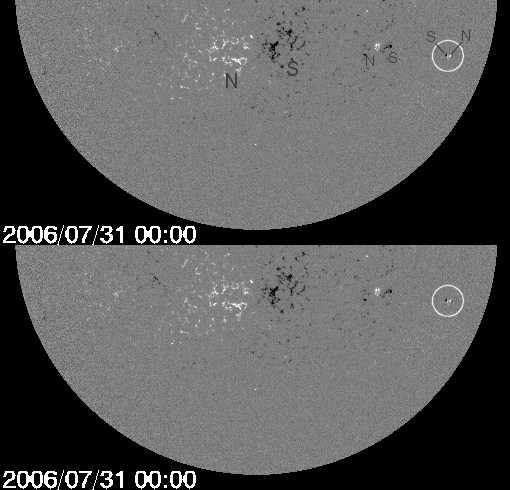
The recent appearance on the sun of two so-called "backward sunspots" may mean solar Cycle 23 is drawing to a close and Cycle 24 now is under way or soon will be. At least that's the thinking of some scientists. "We've been waiting for this," said Solar Physicist David Hathaway of the Marshall Space Flight Center in Huntsville, Alabama, after the first backward spot showed up. "

A backward sunspot is a sign that the next solar cycle is beginning." The term "backward" refers to the sunspots' magnetic polarity. One such sunspot appeared briefly July 31, then disappeared, but its significance was that its magnetic polarity was just the opposite of current Cycle 23 spots.

Another more robust spot, Sunspot 905, appeared earlier this month -- although it subsequently began to dissipate -- and some sungazers are saying Cycle 24 already has begun.

ARRL propagation guru Tad Cook, K7RA, has been a bit more cautious. "As time goes on, there will be more Cycle 24 spots and fewer Cycle 23 spots," he said in a recent "Solar Update." In any event, radio conditions will not improve any time soon but over a period of several years of the course of the 11-year cycle, perhaps peaking around 2010.

You can find more on this backward sunspot on the NASA Science website.

Computing Unplugged weighs in on BPL

During this summer Computing Unplugged magazine, an online e-zine, has been covering the BPL vs Ham debate. While the editor of the magazine promised a fair and balanced discussion of this issue, it is quite obvious he is NOT a fan of ham radio or radio listening in general. It is quite obvious he is not qualified at any level to be writing about the downside of BPL and its impact on the radio spectrum. Unfortunately, his written words remain online. Truly journalism at its lowest level.

This debate was started by an interview that David Gewirtz, who is the Editor-in-Chief of the ZATZ magazines and the author of The Flexible Enterprise and Lotus Notes Revealed, contacted with a BPL industry insider! You can be reached him via email at david@zatz.com. Here are some of the lowlights from this individual who claims to be fair and balanced and a journalist.

"Who's funding the ARRL? Do the cable providers and DSL providers have an interest in this debate? After all, BPL is a direct competitor to cable modems and DSL services. Or is this truly the case of one technology interfering with another?

"Frankly, if it were just ham radio operators unable to play with their toys, this debate would be a non-issue. Ham radio is really a technology of the 20th Century. It was exciting back then when you couldn't call any country easily except with a ham radio. It was exciting when you couldn't talk to anyone when they were out and about unless they had an operator's license.

"But today, we have cell phones and Skype. We can talk to anyone, anywhere. And we can reach people all over the world merely for the cost of sustaining a broadband connection. Technology that can deliver broadband is, in Computing Unplugged's opinion, more valuable than ham radio as a hobby."

The thing that bothers me is he is assuming that the only service to get QRM from BPL is hams per se, since they are the major player fighting it. Although he mentioned a few others opposition comments in the FCC R&O, nothing was mentioned about our radio listening hobby. As most of you know BPL is not just a ham issue, but it is detrimental to the entire spectrum from the VHF lo band down into HF.

As part of this debate Fred Stevens, K2FRD/VO2FS posted this to the Ham DX Chat newsgroup:

My article in Computing Unplugged magazine on Broadband Over Powerline vs. ham radio (and everyone else who uses the HF and lower VHF airwaves) was published today. I wish I had more than the three days I was given (I normally prefer three months) to polish it, research and document more of my statements, maybe tone down some of the rhetoric a little, and add some qualifications to make it more technically accurate and, hence less subject to criticism. Not my best effort, but it'll do. Nevertheless, I'm honored that my letter was chosen for amplification and publication from the hundreds submitted. The article: http://www.computingunplugged.com/issues/issue200608/00001832001.html .

For those who aren't aware of it, Computing Unplugged dedicated its entire summer series to the BPL controversy and, after "fair and balanced" reporting, arrived at the conclusion that BPL in its present form needs to be scrutinized very closely before extensive future deployment and CU ultimately gave ham radio a generally positive and supportive review in the BPL battle.

Complete index of all twelve CU BPL articles including one from Allen Pitts W1AGP, ARRL Media and Public Relations Manager, also published today: http://www.computingunplugged.com/issues/issue200608/00001837005.html .

Computing Unplugged homepage which does NOT index all the BPL articles: http://www.computingunplugged.com/

For those seriously concerned about the future of ham radio as potentially affected by BPL, I encourage you to read the entire series of articles. If you are a radio listener of the HF or VHF low band spectrum, then this is a must read at Computing Unplugged magazine.

Tuesday, August 22, 2006

Monitoring Hotlanta


Last week Gayle and I ventured down to Atlanta GA and did a bit of monitoring. The mil stuff is on our milblog, but here is a summary of truck systems and conventional frequencies we snagged during our day trip.


Atlanta Public Safety and City Services
Motorola Type II Smartnet
856.4625 856.4875 857.4625 857.4875 858.2375 858.4375 858.4625 858.4875 858.7625 858.9375 859.2375 859.4375 859.4625 859.4875 860.2375 860.4625 860.4875 860.7625 860.9375 866.0625 866.3125 866.6125 866.7875 866.8625 867.1375 867.1875 867.3125

Forsyth County Public Safety
APCO P25 Exclusive
866.1000c 866.6500 867.6625 867.8625 868.2750 868.6000 868.9875

Fulton County Public Safety and County Services
Motorola Type IIi Hybrid
853.0375 854.5125 854.5625 855.6625 855.7375 856.3875 856.4125 857.3875 857.4125 858.3875 858.4125 859.3875

Georgia Emergency Wireless Interoperable Network (GEWIN)
APCO P25 Exclusive
Cobb County 856.2125 857.2125 858.2125 859.2125 860.9875 866.8875 867.5500 868.0375 868.3000
State Metro Atlanta TRS
866.4500 866.7500 867.2375 867.2875 867.4375 867.4875 868.0375 868.0875 868.3250 868.7000 868.7875

Conventional Frequencies
154.025 Calhoun PD repeater output (141.3 Hz PL)
155.625 Fannin/Gilmer County SO/PD Interagencysimplex
156.1275 Blue Ridge PD Dispatch repeater output (DCS 412)
156.240 Woodstock PD Dispatch repeater outpout (141.3 Hz PL)
158.730 Fannin County SO Dispatch repeater output (141.3 Hz PL)
158.730 Cherokee County SO Dispatch repeater output (156.7 Hz PL)
158.850 Gilmer County SO Dispatch repeater output (74.4 Hz PL)
159.540 Gordon County/Calhoun PD repeater output (141.3 Hz PL)

Friday, August 11, 2006

8/11/2006 Russian Launch Schedule/Manifest

Russian launch schedule courtesy of Andrey Krasil'nikov and NASA Spaceflight.com. Subject to change.

Date Satellite(s) Rocket/Upper stage Cosmodrome
2006
9/14 Soyuz TMA-9 Soyuz-FG Baikonur
10/7 MetOp-A Soyuz-2.1a/Fregat Baikonur
10/18 Progress M-58 Soyuz-U Baikonur
Oct/Nov Genesis 2 Dnepr Dombarovsky
11/10 Arabsat 4B/Badr 4 Proton Baikonur
12/5 SAR-Lupe 1 Kosmos-3M Plesetsk
12/15 Sumbandila Shtil' Sub in Barents sea
12/20 Progress M-59 Soyuz-U Baikonur
Dec Measat 3 Proton Baikonur
Dec Kosmos-242X (3 Glonass-M) Proton-K/DM-2 Baikonur
(TBD) Kosmos-242X (Don) Soyuz-U Baikonur
(TBD) Kosmos-242X (Meridian) Soyuz-2.1a/Fregat Plesetsk
(TBD) Kosmos-242X (Tselina-2) Zenit-2 Baikonur
(TBD) EgyptSat-1+more Dnepr Baikonur
(TBD) GIOVE-B Soyuz-FG/Fregat Baikonur
(TBD) TerraSAR-X Dnepr Baikonur

2007
Jan Genesis 2 Dnepr Dombarovsky
2/7 Progress M-60 Soyuz-U Baikonur
3/9 Soyuz TMA-10 Soyuz-FG Baikonur
7/28 Progress M-61 Soyuz-U Baikonur
9/2 Soyuz TMA-11 Soyuz-FG Baikonur
Sep SMOS, PROBA-2 Rokot/Briz-KM Plesetsk
(TBD) Meteor-M Soyuz-2.1b/Fregat Baikonur
(TBD) Corot Soyuz-2.1b/Fregat Baikonur
(TBD) Anik F3 Proton-M Baikonur

Wednesday, August 09, 2006

HFLINK NEWS #1

In this HFLINK NEWS Special Bulletin:
(1) ALE On-The-Air Week "AOTAW 2006" (13-23 October 2006)
(2) New Amateur Radio ALE Channel List 2006-2007
(3) Amateur ALE Standards
(4) Amateur ALE Net Calls
(5) New PCALE Version Now In Beta Testing Phase

Website: http://hflink.com

Dear ALE operator,
Welcome to the first edition of HFLINK NEWS! HFLINK NEWS is a Special Bulletin service of HFLINK Group. The HFLINK Special Bulletin is issued only a few times per year, to keep members of HFLINK Group informed about events and changes in ALE and Selcall worldwide. We hope to link with you soon, and please consider activating your station during ALE On The Air Week in October!

Best Regards,
Bonnie Crystal, KQ6XA
HFLINK Founder

=======BEGIN HFLINK NEWS SPECIAL BULLETIN======

=================================
ALE On-The-Air Week "AOTAW 2006"
=================================

Starts: 0001 UTC Friday 13 OCTOBER (13/10/06)
Ends: 1159 UTC Monday 23 OCTOBER (23/10/06)
10 Days of worldwide Amateur Radio ALE activity...

HFLINK is sponsoring a new International Amateur Radio event called: ALE On The Air Week (AOTAW). All ham radio operators worldwide are invited to participate in 10 days of amateur radio HF-ALE Automatic Link Establishment and HF Selcall activity. AOTAW is an open operating event to explore ALE communications and equipment. The experience gained by participation is also useful for HF emergency and disaster
relief communications.

There are now many hundreds of amateur radio operators worldwide with ALE stations. The AOTAW gives operators a chance to exercise ALE transceivers, antennas, software, systems, and operating procedures.

ALE Operator Certificate for AOTAW2006
=======================================

HFLINK issues a unique ALE Operator Certificate to operators who participate in AOTAW. To qualify for an ALE Operator Certificate, the operator must initiate and complete at least 5 QSOs through Automatic Link Establishment with other ALE operators. The ALE link must then be followed by a communication either by voice or texting. Additional certificate endorsement is issued by HFLINK for operators who link and QSO with 25 ALE stations or more. Logs: After the event, a very simple list of date/ callsign/ frequency log of QSOs should be sent in email plain text to: aotaw2006@ yahoo.com.

Operating Standards for AOTAW
==============================
AOTAW is not a contest. All operators are reminded to be courteous and operate within the recognised Amateur Radio ALE channels and standards. The ALE netcall "HFL" may be used as the general CQ call for the event. ALLCALLs (one-way linking) should not be used in AOTAW, and a QSO started by an ALLCALL does not qualify as a valid ALE link for certificate.

About AOTAW
============
AOTAW provides a way for more operators to gain valuable practical knowledge and expertise in the operation of an Amateur Radio ALE station. Amateur operators who use ALE for government and non-governmental organisations may be especially interested in participation, for this is a chance to explore the various operational
aspects of ALE that may not be utilised otherwise. The 10 days of AOTAW enables operators to participate as they can, for any amount of time in the event, and to experience ALE operation under various ionospheric propagation conditions. Also, an ALE demonstration Special Event HF Station will be in operation during the ARRL Pacificon convention in California USA on 14-15 October.

=============================================
New Amateur Radio ALE Channel List 2006-2007
=============================================
The new channel list is effective 01 September 2006. PCALE channel fill files (QRG) will be available in August.

ALE Automatic Link Establishment and Selective Calling
International Amateur Radio Service

Amateur Radio ALE Channel List 2006A
CHAN/ kHz /GENERAL-PURPOSE/IARU-REGION/(Sounding)
=================================================
01= 1806.0 VOICE-DATA- Regional R1,3
02= 1840.5 VOICE-DATA- Regional (Sound=R1)
03= 1845.0 VOICE DATA- INTERNATIONAL COMMON R1,2,3
04= 1996.0 VOICE-DATA- Regional (Sound=R2)
05= 3565.0 DATA-VOICE- Regional R1,3
06= 3617.0 DATA-VOICE- Regional (Sound=R1)
07= 3626.0 DATA-VOICE- Regional (Sound=R2)
08= 3791.0 VOICE- INTERNATIONAL COMMON R1,2,3
09= 3996.0 VOICE- Regional R2
10= 5371.5 VOICE- Emergency; Regional R1,2
11= 5403.5 VOICE-DATA- Emergency; Regional R1,2
12= 7030.5 DATA- Regional (Sound=R3)
13= 7040.5 DATA- Regional (Sound=R1)
14= 7065.0 VOICE- International/Regional R1,3
15= 7102.0 DATA-VOICE- International R1,2,3 (Sounnd=R2)
16= 7165.5 VOICE- INTERNATIONAL COMMON R1,2,3
17= 7296.0 VOICE- Regional R2
18= 10136.5 DATA- VOICE-International R1,2,3
19= 10145.5 DATA- INTERNATIONAL COMMON (Sound=R1,2,3)
20= 14100.5 DATA- International R1,2,3
21= 14109.5 DATA- International (Sound=R1,2,3)
22= 14342.5 VOICE-INTERNATIONAL COMMON; R1,2,3
23= 14346.0 VOICE-International R1,2,3
24= 18106.0 DATA- International (Sound=R2,3)
25= 18117.5 VOICE-DATA-INTERNATIONAL COMMON R1,2,3(Sounnd=R1)
26= 18157.5 VOICE-International R1,2,3
27= 21117.5 DATA- International(Sound=R1,3)
28= 21157.5 DATA- International R(Sound=R2)
29= 21437.5 VOICE- INTERNATIONAL COMMON R1,2,3
30= 24926.0 DATA- International (Sound=R1,2,3)
31= 24977.5 VOICE- International Regional R1,2,3
32= 28117.5 DATA- International/Regional (Sound=R1)
33= 28146.0 DATA- International/Regional (Sound=R2)
34= 28327.5 VOICE- INTERNATIONAL COMMON R1,2,3
35= 50162.5 VOICE-DATA- Regional
36= 144162.5 VOICE-DATA- Regional

Note 1) All Amateur Radio ALE channels use "USB" Upper SideBand (including frequencies below 10MHz). USB conforms to international standards for ALE / Selcall, and enables compatibility with commercial transceivers.

Note 2) The ALE-Selcall list is designed for international, regional, and local use in the Amateur Radio Service. All channels are subject to the different rules, regulations, and bandplans of the region and local country of operation. It is the responsibility of every operator to maintain the highest technical and ethical standards for all transmissions. Some channels or modes in the list may not be available in every country. The HF spectrum is a shared resource, so there is no
guarantee that a channel is clear in a local area or region.

Note 3) Use of 5MHz channels and frequencies may vary in each country. Although 5MHz ALE and SELCALL transmissions are authorised in some countries, USA does not yet allow it on 5MHz. Therefore, operators in USA may receive monitor the 5MHz channels, but care should be taken to lock out the transmitter from making ALE or Selcall transmissions (except in case of an Emergency).

======================
Amateur ALE standards
======================
1. ALE System= MIL-STD 188-141 ; FED-1045 (8FSK, 2kHzBW)
2. Call or sounding transmission duration: 30 seconds.
3. Scan rate: 1 or 2 channels per second.
4. Sounding Interval= 60 Minutes (or more) (for same channel)
5. CQ Call= Netcall to "HFL" net
6. Digi Texting/Data Audio Centre Frequency= 1500HZ (to 1800HZ)
7. Short text messaging standard = AMD
8. TWS SOUNDING (Recommended)
9. Always transmit "CLEAR LINK" after ALL CALLS and LINKING!

=======================
Amateur ALE Net Calls
=======================
1. HFL = CQ, ALL AMATEUR RADIO ALE STATIONS
2. HAM = EMERGENCY/RELIEF NET ONLY, AMATEUR:NGO/GOV
3. GPR = GEO POSITION REPORTS
4. RPT = STATION STATUS REPORTS
5. QRZ = REPLY CALL PROMPT
6. CQA = RESERVED FOR FUTURE USE

============================================
New PCALE Version Now In Beta Testing Phase
============================================
PCALE software author Charles Brain G4GUO has been working on the new version over the past year. Charles has been collaborating with Steve N2CKH (MARS-ALE) on the software and radio support, and with Bonnie KQ6XA on some of the innovative new features. A small group has been working behind the scenes using the experimental software. The exciting release of the new improved PCALE is dependent upon the successful testing of the PCALE Beta Version. A group of volunteer ALE amateur radio operators is now using it on the air. The PCALE Beta Test Group is looking for more operators, but membership is limited. If you are an experienced operator with PCALE or MARS-ALE, please consider it. Beta Test Group: http://groups.yahoo.com/group/pcale/

Some Of The New PCALE Features Now In Beta Testing:
====================================================
1. Separately programmable sounding and scanning channels
2. Sounding/traffic associated channels (similar to 3G ALE)
3. New Text Keyboarding window for real time texting
4. GPS interface with ALE-GPR (Geo-Position Reporting)
5. Automatic station status reporting (80 Character text)
6. Ambush (auto message, link when a specific station is heard)
7. Easy channel scan groups and alphanumeric group labeling
8. Improved spectrum scope display, sync, and audio AGC
9. Improved user interface and option setup
10. Improved scanning reliability and timing
11. Improved and expanded radio interface
12. CAT support for more transceivers
13. Improved callsign (address) input
14. Improved modem operation and decoding
15. Other features and improvements.

==============
ABOUT HFLINK
==============
HFLINK is an international resource: for radio operators using ALE Automatic Link Establishment and Selcall Selective Calling; for the development of communications for organisations, Emergency / Relief networks; and for the development of ALE operating methods applicable to Amateur Radio Service. HFLINK is the Frequency and Address Coordination group for Amateur Radio ALE and Selective Calling.

HFLINK Website: http://hflink.com

========END HFLINK NEWS SPECIAL BULLETIN========

(c)2006 HFpack, Inc. All rights reserved.

2006-032A Hot Bird™ 8 Launched


BAIKONUR COSMODROME, Kazakhstan - A Proton Breeze M launch vehicle successfully placed the HOT BIRD™ 8 satellite into orbit 5 Aug 2006, for the fourth launch of the year for International Launch Services (ILS).

The launcher lifted off at 3:48 a.m. Saturday local time (23:48 Friday CET, 21:48 Friday UTC, 17:48 Friday EDT). The mission lasted 9 hours and 11 minutes before HOT BIRD™ 8 was released into a geosynchronous transfer orbit. The satellite is a Eurostar E3000 model built for Eutelsat by EADS Space. From its final orbital position of 13 degrees East longitude, HOT BIRD™ 8 will serve customers in Europe, the Middle East and North Africa.

Hot Bird™ 8 has a Ku-band downlink in the 10.7-12.7 GHz range. HOT BIRD™ 8 is the largest and most powerful European Ku-band broadcast satellite to go into geostationary orbit.

International Designator: 2006-032A/SSC #29270


Photo - artist rendering of the 13 deg east Hotbird orbital slot (Courtesy of Eutelsat).

Thursday, August 03, 2006

N5FPW Hurricane Emergency Monitoring List Update 5


There are a lot of hurricane frequency list out there, but most of them have old material or frequencies that are basically useless for keeping track of the big winds. I will be posting to this list with frequencies I regularly monitor before, during, and after an event. All frequencies are kHz and all times are UTC.

Last Update: August 2006


2326.0 Operation Secure SEM Net ALE/USB
2411.0 Operation Secure SEM Net USB
2414.0 Operation Secure SEM Net ALE/USB
2419.0 Operation Secure SEM Net USB
2422.0 Operation Secure SEM Net USB
2439.0 Operation Secure SEM Net USB
2463.0 Operation Secure SEM Net USB
2466.0 Operation Secure SEM Net USB
2471.0 Operation Secure SEM Net USB
2474.0 Operation Secure SEM Net USB
2487.0 Operation Secure SEM Net USB
2511.0 Operation Secure SEM Net USB
2535.0 Operation Secure SEM Net USB
2569.0 Operation Secure SEM Net USB
2587.0 Operation Secure SEM Net USB
2670.0 US Coast Guard Marine Information Broadcast (USB)
2801.0 Operation Secure SEM Net USB
2804.0 Operation Secure SEM Net USB
2812.0 Operation Secure SEM Net ALE/USB

3202.0 Operation Secure SEM Net ALE/USB
3388.0 FEMA Operating Frequency
3907.0 Ham Coastal Carolina Emergency Net LSB
3940.0 Ham Florida Phone Traffic Net LSB
Ham Salvation Army Team Emergency Net LSB
Ham South Florida ARES Net LSB
Ham Tropical Phone Traffic Net LSB
3960.0 Ham Northeast Coast Hurricane Net LSB
3975.0 Ham Georgia SSB Net LSB

4125.0 US Coast Guard USB Voice Radio Guard Simplex
4316.0 US Coast Guard HF Voice Broadcasts
NMG New Orleans: 0330/0515/0930/1115/1530/1715/2130/2315
4426.0 US Coast Guard HF Voice Broadcasts [ITU Marine Channel 424]
NMN Chesapeake: 0330/0515/0930
NMC Point Reyes: 0430/1030
4490.0 SHARES SCN ALE Net [SCN Channel 3]
4557.1 US Air Force MARS Phone Patch (occasional hurricane hunter
traffic)[RK]
4573.5 SHARES Alternate frequency for channel 1 voice check-in
4582.0 National Civil Air Patrol Calling frequency USB
4640.0 Operation Secure SEM Net USB
4724.0 HF-GCS (Hurricane Hunter aircraft frequently check into this
network)
4780.0 FEMA Operating Frequency

5135.0 Operation Secure SEM Net ALE/USB
5140.0 Operation Secure SEM Net ALE/USB
5192.0 Operation Secure SEM Net ALE/USB
5195.0 Operation Secure SEM Net ALE/USB
5211.0 FEMA Primary frequency USB/LSB
5236.0 SHARES SCN Voice Net [SCN Channel 1]
5320.0 US Coast Guard District Discrete USB
5402.0 FEMA Operating Frequency
5696.0 US Coast Guard Air-Ground USB
5711.0 SHARES SCN ALE Net [SCN Channel 4]
5732.0 COTHEN/US Coast Guard [Scan 1] ALE/USB
5847.0 National Guard Nationwide Nets ALE/USB

6106.0 FEMA Operating Frequency
6215.0 US Coast Guard USB Voice Radio Guard Simplex
6501.0 US Coast Guard HF Voice Broadcasts [ITU Marine Channel 601]
NMN Chesapeake: 0330/0515/0930/1115/1530/2130/2315
NOJ Kodiak: 0203/1645
NMO Honolulu: 0600/1200
NRV Guam: 0930/1530
6739.0 HF-GCS (Hurricane Hunter aircraft frequently check into this
network)
6800.0 SHARES SCN BBS Net [SCN Channel 9]
6985.0 US Army Corps of Engineers Net ALE/USB

7241.0 Ham Caribbean Maritime Mobile Net LSB
7242.0 Ham Florida Midday Traffic Net LSB
Ham Tropical Phone Traffic Net LSB
7250.0 Ham Salvation Army Team Emergency Net LSB
7255.0 Ham East Coast Amateur Radio Service LSB
7265.8 Salvation Army Team Emergency Radio Net (SATERN) LSB
7348.0 FEMA Operating Frequency ALE/USB/LSB
7477.0 Operation Secure SEM Net ALE/USB
7480.0 Operation Secure SEM Net USB
7527.0 COTHEN/US Coast Guard [Scan 2] ALE/USB
7633.6 US Air Force MARS Phone Patch (occasional hurricane
hunter traffic) [ACJ]
7650.0 US Army Nationwide Net ALE/USB
7802.0 Operation Secure SEM Net USB
7805.0 Operation Secure SEM Net USB
7932.0 Operation Secure SEM Net USB
7935.0 Operation Secure SEM Net USB

8047.0 National Guard Nationwide Net ALE/USB
8184.5 US Army Air net ALE/USB
8291.0 US Coast Guard USB Voice Radio Guard Simplex
8502.0 US Coast Guard HF Voice Broadcasts
NMG New Orleans: 0330/0515/0930/1115/1530/1715/2130/2315
8764.0 US Coast Guard HF Voice Broadcasts [ITU Marine Channel 816]
NMN Chesapeake: 0330/0515/0930/1115/1530/1715/2130/2315
NMC Point Reyes: 0430/1030/1630/2230
NMO Honolulu: 0005/0600/1200/1800
8912.0 COTHEN/US Coast Guard [Scan 3] ALE/USB
8983.0 US Coast Guard Air-Ground USB
8992.0 HF-GCS (Hurricane Hunter aircraft frequently check into
this network)

9081.5 US Army net ALE/USB
9106.0 SHARES SCN ALE Net [SCN Channel 5]
9110.0 US Coast Guard NMF Boston, MA weather charts FAX

10194.0 FEMA ALE/USB/LSB
10242.0 COTHEN/US Coast Guard [Scan 4] ALE/USB
10493.0 FEMA Primary frequency USB/LSB
10586.5 SHARES SCN [SCN Channel XF]
10588.0 FEMA ALE/USB/LSB
10816.5 National Guard Nationwide Net ALE/USB

11175.0 HF-GCS (Hurricane Hunter aircraft frequently check
into this network)
11217.0 SHARES SCN ALE Net [SCN Channel 6]
11494.0 COTHEN/US Coast Guard [Scan 5] ALE/USB

12087.0 National Guard Nationwide Net ALE/USB
12216.0 FEMA ALE/USB/LSB
12290.0 US Coast Guard USB Voice Radio Guard Simplex
12788.0 US Coast Guard HF Voice Broadcasts
NMG New Orleans: 0330/0515/0930/1115/1530/1715/2130/2315

13089.0 US Coast Guard HF Voice Broadcasts [ITU Marine Channel 1205]
NMN Chesapeake: 1115/1530/1715/2130/2315
NMC Point Reyes: 0430/1030/1630/2230
NMO Honolulu: 0005/1800
NRV Guam: 0330/2130
13200.0 HF-GCS (Hurricane Hunter aircraft frequently check
into this network)
13242.0 SHARES SCN BBS Net (G-TOR) [SCN Channel 10]
13907.0 COTHEN/US Coast Guard [Scan 6] ALE/USB
13927.1 US Air Force MARS Phone Patch Primary (occasional hurricane
hunter traffic) [ACB]
13956.0 FEMA Primary USB/LSB

14265.0 Ham Salvation Army Team Emergency Radio Net (SATERN) USB
14300.0 Ham Intercontinental Amateur Traffic Net USB
Ham Maritime Mobile Service Net USB
Ham US Coast Guard Amateur Radio Net USB
14303.0 Ham International Assistance and Traffic Net USB
14313.0 Ham US Coast Guard Amateur Radio Net USB
14325.0 Ham Hurricane Net (NHC Hurc Net) USB
14327.0 Ham US Coast Guard Amateur Radio Net USB
14396.5 SHARES SCN Voice Net [SCN Channel 2]
14567.0 FEMA Primary USB/LSB
14606.1 US Air Force MARS Phone Patch (occasional hurricane
hunter traffic) [ACF]
14653.0 National Guard Nationwide Net ALE/USB
14757.0 US Army Nationwide Net ALE/USB
14776.0 FEMA ALE/USB/LSB
14898.5 SHARES Alternate frequency for channel 2 voice check-in

15016.0 HF-GCS (Hurricane Hunter aircraft frequently check into
this network)
15088.0 US Coast Guard Air-to-ground net USB
15094.0 SHARES SCN ALE Net [SCN Channel 7]
15867.0 COTHEN/US Coast Guard [Scan 7] ALE/USB

16338.5 National Guard Nationwide Net ALE/USB

17314.0 US Coast Guard HF Voice Broadcasts [ITU Marine Channel 1625]
NMN Chesapeake: 1115/1530/1715/2130/2315
NMC Point Reyes: 1630/2230
17487.0 SHARES SCN ALE/STI Net [SCN Channel 8]

18594.0 COTHEN/US Coast Guard [Scan 8] ALE/USB
18617.1 US Air Force MARS Phone Patch (occasional hurricane hunter
traffic)

20890.0 COTHEN/US Coast Guard [Scan 9] ALE/USB
20992.6 US Air Force MARS Phone Patch Secondary (occasional
hurricane hunter traffic) [ACR]

23214.0 COTHEN/US Coast Guard [Scan 10] ALE/USB

25350.0 COTHEN/US Coast Guard [Scan 11] ALE/USB


Will be adding more listing including ham nets as the season progresses so be sure to check back often.

Reference websites:
National Hurricane Center
NHC Aircraft Recon Page
403AW Hurricane Hunters webpage
National Hurricane Operations Plan 2007
NOAA/NWS Worldwide Marine Radio Facsimile Broadcast Schedules
NOAA/OPC Radio Facsimile Users Guide

73 and stay safe de LVH

Wednesday, August 02, 2006

Monitoring HFDL Comms


I like playing around occcasionally with HF Data Link (the HF version of ACARS). I think these HFDL squitters are also excellent propagation beacons. And I have seen an occasional military aircraft. If you want to get into the world of HFDL monitoring you can download a free or commericial ($35 fee) version of my friend Charles Brain's PC-HFDL program off his website at PC-HFDL .

And since you are here reading this, I will let you in on a secret. MT Computer and Radio columnist John Catalano will cover this PC-HFDL Professional program in his September 2006 column in Monitoring Times. Shhhhh! Don't tell anybody I told you.

Here is the latest HFDL info: Table 6 Version 01D (12 May 2006)
HFDL SYSTEM TABLE from Andy (m0adl) and courtesy of the UDXF newsgroup list.

Ground Station ID 1 SAN FRANCISCO - CALIFORNIA
Longitude 121-45-34W Latitude 38-22-48N
2947.0 4672.0 5508.0 6559.0 8972.0 10081.0 11327.0 13276.0 17919.0 21934.0

Ground Station ID 2 MOLOKAI - HAWAII
Longitude 157-10-46W Latitude 21-10-47N
2947.0 3019.0 3434.0 4687.0 5463.0 5514.0 6559.0 6565.0 8912.0 8936.0 10081.0 11312.0 11348.0 13276.0 13312.0 13324.0 17919.0 17934.0 21928.0 21937.0

Ground Station ID 3 REYKJAVICK - ICELAND
Longitude 21-50-59W Latitude 64-04-47N
3116.0 3900.0 5720.0 6712.0 8977.0 11184.0 15025.0 17985.0

Ground Station ID 4 RIVERHEAD - NEW YORK
Longitude 72-38-22W Latitude 40-52-47N
3410.0 3428.0 5523.0 5652.0 6646.0 6652.0 6661.0 8831.0 8885.0 8912.0 10227.0 11315.0 11354.0 11387.0 13276.0 17919.0 17934.0 17952.0 21931.0 21934.0

Ground Station ID 5 AUCKLAND - NEW ZEALAND
Longitude 174-48-35E Latitude 37-01-10S
Number of frequencies 10
3016.0 3404.0 5583.0 6535.0 8921.0 10084.0 11327.0 13351.0 17916.0 21949.0

Ground Station ID 6 HAT YAI - THAILAND
Longitude 100-23-24E Latitude 06-56-23N
3470.0 4687.0 5655.0 6535.0 8825.0 10066.0 13270.0 17928.0 21949.0

Ground Station ID 7 SHANNON - IRELAND
Longitude 08-55-46W Latitude 52-43-48N
2998.0 3455.0 5547.0 6532.0 8843.0 8942.0 10081.0 11384.0 21928.0

Ground Station ID 8 JOHANNESBURG - SOUTH AFRICA
Longitude 28-12-35E Latitude 26-07-46S
3016.0 4681.0 8834.0 13321.0 21949.0

Ground Station ID 9 BARROW - ALASKA
Longitude 156-46-46W Latitude 71-18-00N
2944.0 2992.0 3007.0 3497.0 4654.0 4687.0 5529.0 5538.0 5544.0 6646.0 8927.0 8936.0 10027.0 10093.0 11354.0 17919.0 17934.0 21928.0 21937.0

Ground Station ID 14 KRASNOYARSK - RUSSIA
Longitude 92-18-00E Latitude 56-06-00N
2878.0 2905.0 4679.0 5622.0 6596.0 8886.0 10087.0 13321.0 17912.0 21990.0

Ground Station ID 13 SANTA CRUZ - BOLIVIA
Longitude 63-07-46W Latitude 17-40-11S
2983.0 3467.0 4660.0 6628.0 8957.0 11318.0 13315.0 17916.0 21946.0 21973.0 21988.0 21997.0

Ground Station ID 16 AGANA - GUAM
Longitude 144-48-00E Latitude 13-28-11N
6550.0 6634.0 6652.0 6661.0 8912.0 8927.0 8936.0 11288.0 11306.0 13276.0 13312.0 13339.0 17919.0 17934.0

Ground Station ID 15 AL MUHARRAQ - BAHRAIN
Longitude 50-39-00E Latitude 26-16-12N
2986.0 5544.0 8885.0 10075.0 11312.0 13354.0 17967.0 21982.0

Ground Station ID 17 CANARIAS - SPAIN
Longitude 15-23-23W Latitude 27-56-59N
2905.0 5589.0 6529.0 8948.0 11348.0 13303.0 17928.0 21955.0

Sunday, July 30, 2006

Kompsat-2 Launched


Kompsat-2 (Arirang-2) developed by KARI (Korea Aerospace Research Institute) was launched 28 July 2006 at 0705 UTC from Plesetsk on Eurockot’s Rokot (SL-19) launch vehicle. Kompsat-2 SSC number is 29268/International designator 2006-031A. The satellite is in a sun-synchronous (98.1 deg inc) orbit.

The mission for this 760-kg satellite is to carry scientific instruments for observation of natural resources, digital map-making and atmospheric research, and high resolution imaging with a multi spectral camera (MSC) that can capture down to 1-meter black and white high-resolution imagery and 4-meters color.

The satellite transmits its data using a 320 Mbit/s QPSK encrypted X-band downlink at 8205.0 MHz. It is also using an unknown S-band downlink for TT&C.

Thursday, July 27, 2006

Dnepr Rocket Launch a Failure - 18 Satellites Lost

The Wednesday launch of an ISC Kosmotras Dnepr rocket ended in failure moments after liftoff from an underground missile silo in Kazakhstan. The first stage of the rocket, a decommission Russian SS-18 ICBM, apparently shutdown 86 seconds after liftoff (about 10 seconds early). The rocket and its payload of 18 satellites fell back to earth 16 miles south of the Baikonur Cosmodrome.

The Dnepr carried 18 satellites in all, including a remote sensing spacecraft for Belarus, a Russian student-built satellite, two Italian university microsatellites, and 14 palm-sized CubeSat payloads housed inside five portable deployment devices.

The payloads lost due to this failure included:

  • BelKA - the first orbiting satellite for Belarus. An Earth observation platform, built by Energia in Russia, to carry out a robust remote sensing campaign for Belarus and other users worldwide.

  • Baumanets - a Russian microsatellite built by a group of students at the Moscow State Technical University. The small spacecraft was to have operated in space for at least one year as an educational tool and technology pathfinder for students.

  • UniSat 4 - an Italian payload was the fourth member of a series of microsatellites managed by professors and students at the University of Rome.

  • PICPOT - another Italian payload that was designed and developed by engineering students in Torino, Italy.

    Also lost were 14 CubeSats from 10 different universities and 1 private company. The launch was coordinated by California Polytechnic State University. The Cubesats lost included:

  • AeroCube-1 built by The Aerospace Corporation and carried a 902 to 928 MHz spread spectrum downlink.

  • CP-1* and CP-2* built by California Poly Tech. They carried 436.845 and 437.325 MHz downlinks respectively.

  • ICE Cube-1* and ICE Cube-2* developed by Cornell University and carrying 437.305 and 437.425 MHz downlinks respectively.

  • ION* built by the University of Illinois with a 437.505 MHz downlink.

  • HAUSAT-1* built by Hankuk Aviation University in South Korea with a 437.465 MHz downlink.

  • KUTESat* built by Kansas University with a 437.385 MHz downlink.

  • MEROPE* built by Montana State University with a 145.980 MHz downlink.

  • nCube-1* developed by several Norway universities carried a 437.305 MHz downlink.

  • RINCON* and SACRED* built by the University of Arizona. They each carried a 436.870 MHz downlink.

  • SEEDS* built by Nihon University in Japan and carrying a 437.485 MHz downlink.

  • Voyager* built by the University of Hawaii and carrying a 437.405 MHz downlink.

    Satellites marked with an asterisk would have carried an amateur radio band downlink and would have picked up an OSCAR satellite number from AMSAT if it would have been operational.

    More information on this satellite program and a preliminary timeline of this launch failure can be found on the Cubesat website.